You can close your eyes by simply lowering your eyelids. But your ears? You cannot close them. They are always open, always receiving, always listening – even when you are asleep.
Hearing is our most primal connection to the world. It is the first sense to develop in the womb. Long before a child can see its mother, it can hear her voice. Long before the new-born understands language, it responds to tone.
We are born with the ability to identify, interpret and attach meanings to sounds we hear. The interconnection of the physics of sound energy, and psychology of hearing enables our auditory perception. Sound is the brain’s earliest teacher, our nervous system’s first conversation with existence.
And yet, we rarely pause to examine this: Why does sound move us so deeply? Why do we feel before we understand?
This is the emotional physics of sound – where biology, psychology, and the ancient intelligence of the human voice intertwine.
All of us think in terms of visual images, but thinking in terms of sound and music engages our senses in cultivating awareness of the unspoken, physical sensations and mental processes by integrating sound in the mind and body. The feeling of sound or music triggers emotional responses, yet it is unseen. Sound and music have been the way of life for the earliest humans across cultures for centuries. The idea of harmony and rhythm, musically and physically, has been a subject of careful attention from philosophers world over.
The Ear: Our First Window to the World
By the 18th week of foetal life, the human auditory system is already forming. By 26 weeks, the foetus begins responding to sounds – the mother’s voice, her heartbeat, the muffled world of the womb.
Anne Karpf writes in The Human Voice: “Hearing is one of the first senses to develop in a foetus-the ear has already begun to be formed in an eight-week-old foetus, and three months later is structurally complete. When we go to sleep, our perception of sound is the last sense to close off, and when we awake, the first to start up again. And hearing, its claim, is the last sense to die at the end of life.”
Hearing is our earliest experience of relationship. By the third trimester, unborn babies can differentiate between languages, latch onto vowel sounds, and even remember auditory patterns after birth.
Cognitive neuroscientist Eino Partanen explains: “Once we learn a sound, and if it is repeated to us often enough, we form a memory of it, which is activated when we hear the sound again. This memory speeds up recognition of sounds in the learner’s native language and can be detected as a pattern of brain waves, even in a sleeping baby.”
Have you ever wondered how the sound waves transform into mechanical vibrations inside the ear, and then into electrical signals firing towards the brain? Speech perception is an enormous area of interest for neuroscientists, for it is still a profound mystery how the human brain performs the acoustic–phonetic transformation of sound waves.
Sound shapes the developing brain. Later, it shapes identity, emotion, language, and presence.
The Science of Sound: Energy That Becomes Emotion
The human auditory system requires stimulation through speech, music, and other sounds to evolve perfectly. Acoustic stimuli, that we experience before birth, lay the foundation for language development, and these stimuli play a major role in the way we understand sound and human voice.
ALSO READ: The healing voice: Where sound becomes spirit
Strip away the poetry and mystery, and sound is vibration – air molecules vibrating at precise frequencies. But the moment it touches the human ear, sound is no longer physics. It becomes biology. A sound wave becomes a mechanical vibration, then an electrical signal, then a perception, and finally – a feeling.
Every sound you hear triggers a biochemical reaction.
We all know that we are nothing but matter. Our physical body is made up of trillions of cells that consists of atoms. The sub-atomic particles in all matter vibrate at extraordinary speeds of about 100 trillion times per second, creating a ‘tone’, 20 octaves above the range of our hearing. So our body is constantly producing rhythmic sounds that we ourselves cannot hear. Interestingly, Indian mathematical genius Aryabhata’s compositions of his mathematical treatise as poetic verses in Sanskrit called Aryabhatiya proves his inclination towards rhythm and harmony.
Sound is not separate from us. We are sound.
The RAS: How the Brain Filters the World Through Sound
A growing body of research shows that our hearing and our emotions are deeply intertwined – the way we feel shapes how the brain processes sound, and the sounds we absorb shape how we feel.
Recently, after a long time, I chose to take an autorickshaw instead of driving. What I expected to be a noisy, chaotic ride turned into something unexpectedly delightful. Amidst the honks, engines, and traffic hum, there was a tiny bell tied in front of the driver, gently jingling with every movement.
The sound was soft, almost hidden beneath the city’s noise, yet my mind kept returning to it.
I found myself smiling, watching it sway, letting that delicate frequency cut through the chaos.
Why does this happen? Because the brain has an internal filtering system designed to tune out constant, repetitive noise like traffic – so it can highlight what feels different, meaningful, or emotionally relevant.
Even the faintest pleasant sound can rise above the noise when the heart recognizes it.
This filtration is done by the Reticular Activating System (RAS) – a network of neurons in the brainstem, plays a powerful role in wakefulness, attention, and what the mind chooses to notice.
- One of its key functions is filtering. It quietly turns down your awareness of repetitive, predictable background sounds that the brain decides are not important in the moment.
- At the same time, it amplifies anything that is new, emotionally charged, or relevant to your internal goals – like a notification tone, your baby crying, or even your name spoken across a crowded room.
The RAS decides:
- what we notice
- what we ignore
- what we feel
- and what we remember
In simple terms: the brain reduces the “noise of the background” and heightens the sounds that matter. It mutes the familiar and boosts the meaningful.
This becomes even more interesting when emotions enter the picture. Your RAS, auditory system, and limbic system (especially the amygdala) work together as a single loop.
The RAS decides what gets in; the emotional circuits decide what that sound means and how you respond.
This is why a faint, pleasant sound can rise above chaos, and why the smallest tone can shift your entire emotional state. We feel sound before we comprehend it.
The Pathway: How Sound Becomes Emotion
- When sound enters the ears, it travels through the auditory pathways to the auditory cortex, while simultaneously projecting to emotional centres like the amygdala and other parts of the limbic system.
- The amygdala quickly evaluates the sound’s qualities: pitch, intensity, roughness to determine whether it is pleasant, neutral, or potentially threatening. This emotional “tag” is sent back into the system, influencing how much attention the brain gives that sound.
- The ascending Reticular Activating System (RAS) connects the brainstem, thalamus, cortex, and limbic areas. It modulates alertness and also participates in emotional and fight-or-flight responses to meaningful auditory cues.
- When a sound carries emotional weight; a scream, a comforting voice, or even your favourite music, the limbic system signals the RAS to heighten cortical activation and sharpen attention.
Meanwhile, unimportant background noise is suppressed even further.
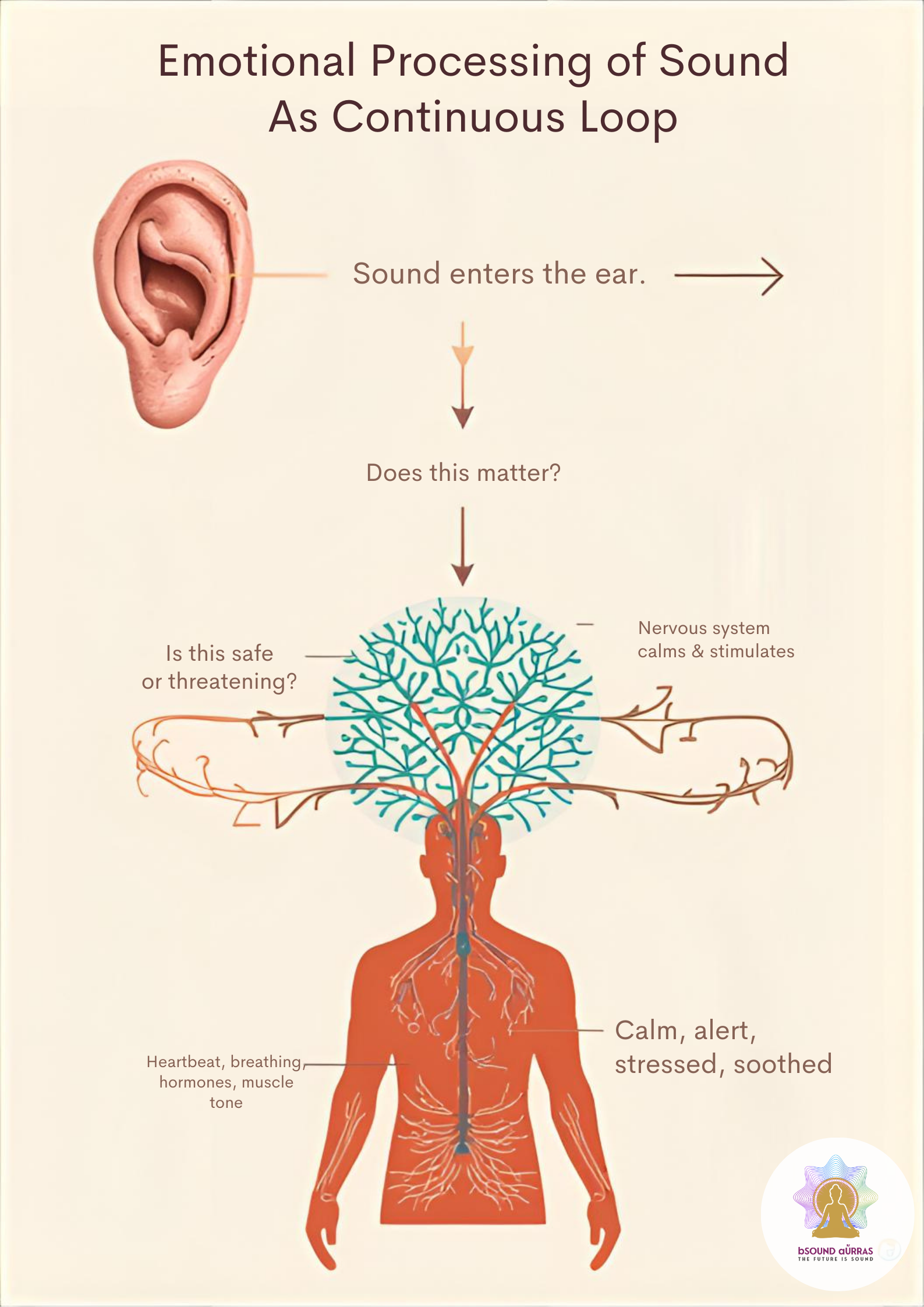
In essence, the brain listens with both its senses and its emotions, deciding not just what you hear, but how it makes you feel.
The emotional processing of sound is a loop:
- Sound enters the ear.
- The RAS filters it: “Does this matter?”
- The limbic system assigns meaning: “Is this safe or threatening?”
- The nervous system reacts: calm, alert, stressed, soothed.
- The body follows — heartbeat, breath, hormones, muscle tone.
This is why:
- A harsh tone can spike cortisol.
- A chant can steady the breath.
- A lullaby can slow a racing heart.
- A scream can activate fight-or-flight within milliseconds.
- A soothing voice can down-regulate the nervous system.
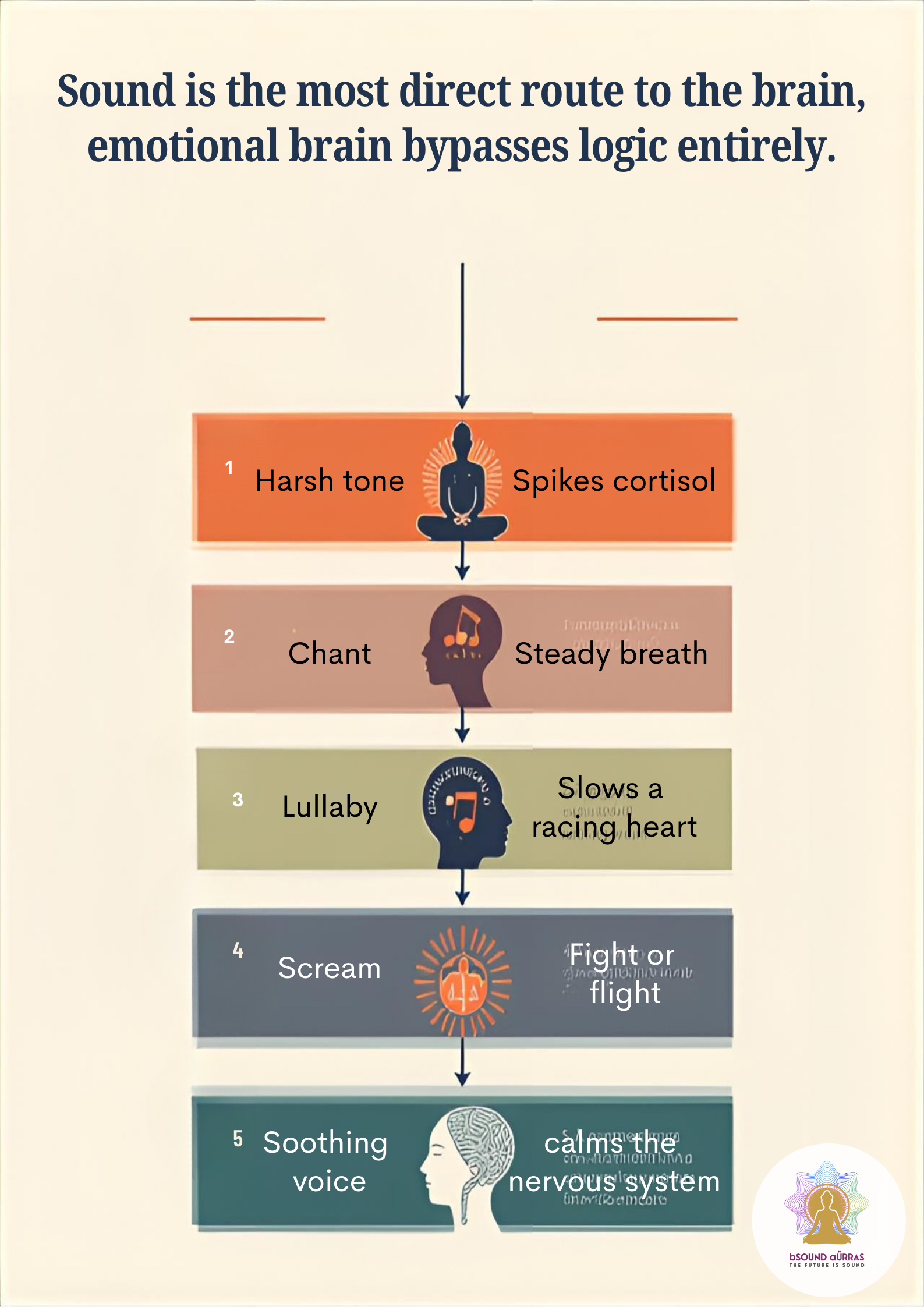
Sound is the most direct route to the emotional brain. It bypasses logic entirely.
Sound Entrainment & Emotional Regulation
- In sound therapy, soothing or preferred frequencies do two things at once:
(1) they entrain rhythmic brain activity, (2) they activate emotional and reward circuits. - As rhythmic patterns stabilize arousal through the Reticular Activating System (RAS) and pleasant emotional tagging arises from the limbic and reward networks, the whole system shifts toward calmer, more regulated states: reduced stress responses, steadier breath, and a more grounded mood.
In essence: The RAS decides – “This sound is important enough to enter awareness.”
The limbic system decides – “This feels safe, soothing, or stressful.”
Therapeutic sound is designed to win that internal competition, guiding the brain repeatedly into more coherent, harmonious emotional patterns.
Sound as Regulation: Modern Therapeutic Insights
Many sound-based therapeutic approaches target RAS + Limbic Pathways
- Binaural beats & acoustic neurostimulation: Often use alpha-range frequencies (8–12 Hz, commonly around 10 Hz) to entrain relaxed wakefulness. This gently modulates RAS-driven arousal and promotes mental ease.
- Rhythmic music that gradually slows or softens: Regulates autonomic functions such as heart rate and cortisol levels. The RAS shifts attention from heightened alertness into a calmer, parasympathetic rhythm.
- Meditation audio, guided relaxation, and therapeutic voicework: Use tone, pacing, pauses, and repetition to anchor attention (RAS) while simultaneously soothing emotional and stress circuits (limbic + prefrontal regions).
- Vagal toning through humming, chanting, or breath-sound techniques
Stimulate the Vagus nerve, improving emotional regulation and stress resilience.
Evidence is still growing and protocols differ, but many stress-focused sound therapies consciously or unconsciously follow this pattern: use rhythm and tone to stabilize RAS-level arousal, while shaping emotional meaning and safety signals in limbic circuits to pull the whole system toward a more regulated, less stressed baseline.
Many sound intervention protocols use at least 15 – 30 minutes of such acoustic environments, allowing neuroendocrine and autonomic markers of stress (e.g., cortisol, heart rate) to shift.
Putting it together: a limbic‑targeted relaxation soundscape typically uses slow, steady tempo near 60 bpm, simple rhythms, consonant tonal harmony, gentle melodies, warm timbres, soft volume, and gradual evolution over 20+ minutes to signal “safety” to emotional circuits and damp the stress response.
Science is still catching up, but the mechanisms are becoming clear:
Sound reorganizes the nervous system.
Tone rebalances emotional circuitry.
Resonance restores coherence.
Ancient Cultures Understood Sound Better Than We Do
Long before neuroscience mapped these circuits, ancient civilizations were already using sound as:
- medicine
- ritual
- community synchronizer
- spiritual technology
Sound is the brain’s oldest language – older than words, older than thought, older even than sight. Every tone, every rhythm, every whisper travels through neural circuits that decide what matters, what moves us, and what we remember.
ALSO READ: What ancient civilizations knew about sound that modern science is finally proving
As research deepens, one truth becomes clear: sound is not entertainment – it is biology, psychology, and emotion woven together. When we understand this, we begin to use sound not just to communicate, but to regulate, soothe, influence, and heal. The more consciously we listen, the more clearly we live.
Sound, Emotion, and Human Connection
A few months ago, I witnessed something that reminded me how fragile our emotional ecosystems can be. I was at dinner with friends and their children, when a sudden argument erupted between a couple. Voices rose, tones sharpened, and the entire table felt the tension shift.
The husband’s defensiveness came through not in his words, but in the edge of his voice.
The wife’s frustration wasn’t in her sentences, but in the tone beneath them.
I quietly nudged her under the table, hoping she would pause, but the spiral continued.
And in that moment, it became painfully clear:
Relationships don’t break from the content of our words. They fracture from the frequency of our sound.
Conflicts escalate because of:
- harshness in the voice
- sharpness in delivery
- the subtle sting of dismissiveness
- old resentments that leak through unspoken vibrations
Even silence, when charged and used aggressively, can be louder than shouting and wound even more deeply.
Because sound is intimacy.
Tone is safety.
Presence is not spoken, it is transmitted.
And this is why the tiny bell in the autorickshaw mattered so much that day.
Amidst the chaos of honking and traffic noise, its gentle jingle created a pocket of harmony inside the mind, a reminder that beneath all the noise, our nervous system is always listening for what feels safe.
The bell in the autorickshaw is not trivial. It symbolizes something profound:
Your nervous system is always listening for harmony. And it knows when it finds it. Also, if you did not know, here’s an intriguing fact – the hearing is the last sense to fade at the end of life, you are probably still listening to what people felt about you until you are buried or engulfed in flames.