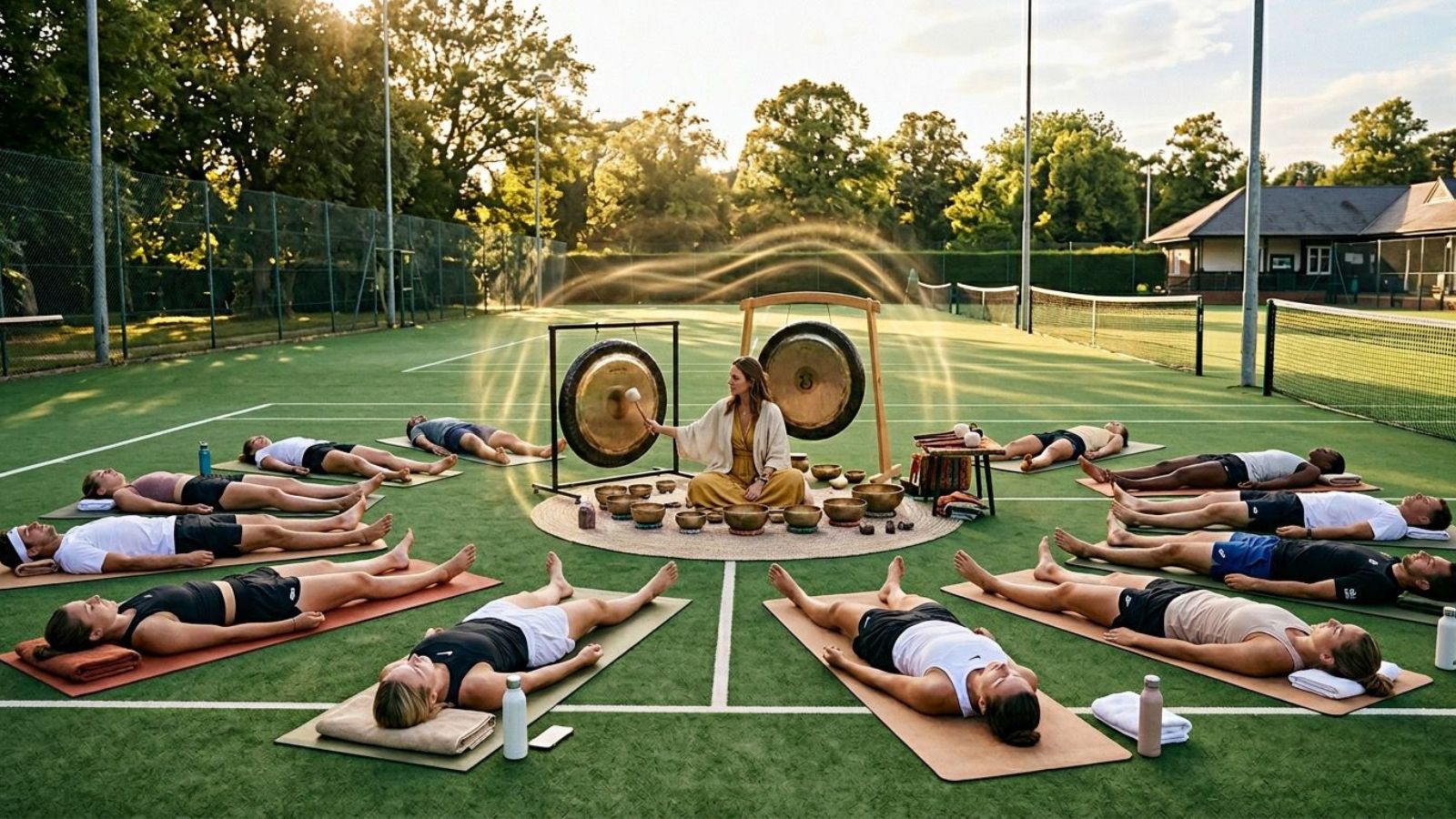
Before the stadium roars, the whistle blows, the first move unfolds, there’s a unspoken ritual few notice.
An athlete sits alone, quiet and immersed – eyes closed, breath steady, headphones on. The sound isn’t always hype-pumping music. It might be slow, rhythmic tones. A guided meditation. Or a simple hum of ambient vibration.
To outsiders, it’s just prep. To the athlete, it’s mind training: forging unbreakable focus. In elite sports, victory hinges on fractions of a second. Physical prowess and technique matter, but coaches and sports scientists now agree – mental clarity seals the deal.
That’s where sound meditation steps in.
`
The Inner Game of Sport
Modern sports psychology knows athletic success isn’t just muscle – it’s mind. Concentration, emotional control, and staying present under fire make all the difference.
A tennis pro locks in for hours of rallies.
A diver masters their thoughts in the split-second plunge.
A chess grandmaster sustains focus through marathon matches.
Distraction is performance poison.
That’s why meditation rules training. Now, sound meditation takes it further: using rhythm and vibration to rewire the brain for peak flow.
Whether it’s steady tones, chanting, breath pulses, or specific frequencies, sound acts as a mental anchor. It quiets mental chatter by syncing brainwaves – shifting from beta (stress) to alpha/theta (calm focus), as per neuroscience on entrainment. Polyvagal theory adds: these vibrations soothe the nervous system, dialing down fight-or-flight for that sweet spot athletes crave.
The result is a state athletes often describe as “being in the zone.”
Why Athletes Turn to Meditation
Some of the world’s top athletes credit meditation with improving concentration and performance. At its core, meditation helps regulate the nervous system, calming the stress response and allowing the mind to remain steady under pressure. Increasingly, sound whether through rhythm, breath, or subtle frequencies is being understood as a powerful complement to this process.
Many athletes use music before competition not simply to energize themselves, but to regulate emotion.
Research in sports psychology suggests that music can influence mood, motivation, and endurance. The right sound can shift the nervous system into a state of optimal arousal alert but not anxious.
When athletes enter what psychologists call the flow state, action and awareness merge. Movements feel automatic. Time seems to slow down. Performance becomes effortless.
Sound gives the mind something to return to. It anchors attention. It reduces internal noise. And in doing so, it helps athletes enter states of deep focus often described as being “in the zone.”
Novak Djokovic – Tennis
Twenty-four-time Grand Slam champion Novak Djokovic incorporates mindfulness meditation into his daily routine, calling it essential for maintaining mental balance during long and demanding matches. Tennis requires constant mental resets as momentum shifts rapidly. Meditation allows Djokovic to return to the present moment, quieting mental distraction and sharpening focus between points. In such moments, even the rhythm of breath can act as an anchor, stabilising attention.
Tom Daley – Diving
Olympic diver Tom Daley uses mindfulness practices to remain calm before competition. In diving, a single moment of distraction can affect the entire performance. Meditation helps regulate pre-performance anxiety, allowing the mind to stay clear and composed. When paired with steady breathing or internal rhythm, it supports the precision required for each movement.
Anthony Ervin – Swimming
Olympic swimmer Anthony Ervin practices Zen meditation, which he credits for emotional balance in competition. Swimming itself is deeply rhythmic – breath, stroke, and movement create a natural flow. Meditation strengthens this rhythm, allowing the athlete to move with greater ease and awareness. The repetition becomes almost meditative, turning performance into a continuous state of focus.
D Gukesh – Chess
World chess champion D. Gukesh has spoken about how meditation and yoga helped him improve focus and manage impulsive thinking during tournaments. In chess, where attention must be sustained for hours, mental endurance becomes critical. Meditation strengthens this capacity, allowing the mind to remain sharp and composed over long periods.
Stephen Curry – Basketball
NBA star Stephen Curry has explored sensory-deprivation flotation, a form of deep meditative practice that removes external stimuli. These sessions allow the mind and body to reset, enhancing clarity and focus. By reducing sensory input, the nervous system settles, creating an ideal state for visualization and performance readiness.
Cristiano Ronaldo – Mental Quiet Before Precision
Football icon Cristiano Ronaldo is known not only for his physical conditioning but also for his disciplined mental preparation. Ronaldo has spoken about practicing meditation and controlled breathing as part of his routine to remain calm under pressure and sharpen focus before matches. He has said he meditates regularly because it “calms me and brings me serenity,” helping him isolate distractions and concentrate on performance.
In football, where a momentary lapse in attention can cost a goal, this mental stillness becomes crucial. Meditation helps Ronaldo regulate stress and maintain emotional balance during high-stakes matches.
For athletes like Ronaldo, the mind must become quiet before the body performs at its best. Sound meditation, breathing rhythms, and focused listening can act as anchors for attention – tools that help transform nervous energy into controlled performance.
Kobe Bryant – Mindfulness and the “Mamba Mentality”
Basketball legend Kobe Bryant was one of the most outspoken advocates of meditation in professional sports. Under the guidance of his coach Phil Jackson, Bryant practiced mindfulness meditation as a way to improve concentration and emotional control on the court.
Bryant believed meditation helped him slow down the mental noise of competition, allowing him to read the game more clearly and respond instinctively rather than react impulsively. The practice became part of what he famously called the “Mamba Mentality” – a disciplined commitment to mastering both body and mind.
For Bryant, meditation was not about relaxation alone; it was about sharpening awareness. In the intensity of an NBA game, where thousands of stimuli compete for attention, the ability to stay mentally centred can determine the outcome of a play.
A Connecting Insight
Across sports, the pattern is clear. Whether through breath, rhythm, silence, or sound, athletes are learning to train their attention as deliberately as they train their bodies.
Adding sound to the meditation practice only amplifies the experience. Because sound does not replace meditation, it deepens it.
It gives form to stillness.
It turns awareness into something the mind can hold.
In one episode of The Good Doctor, a young video gamer relies on music through his headphones to sustain focus during intense gameplay. What appears to be a habit is, in fact, a form of self-regulation. The character explains that the sound helps him block out distractions and maintain concentration, a subtle but powerful illustration of how the brain uses auditory input to organize attention.
The episode also draws an interesting parallel to elite performers, including athletes, who use similar techniques – music, rhythm, or controlled sound environments to enter states of deep focus. Whether on a gaming console or a professional court, the principle remains the same: sound becomes a cognitive anchor, helping the mind filter noise and remain present.
Why Sound Supercharges Focus (Beyond Silence) – and Why Sound Deepens Meditation
Meditation thrives in silence, but intentional sound turbocharges concentration by hacking the brain’s wiring. Neuroscientists like those at MIT have demonstrated how rhythmic vibrations entrain brainwaves, syncing neural oscillations to external frequencies for laser-like attention.
In 1973, biophysicist Gerald Oster revealed something subtle yet profound: the brain does not merely hear sound it participates in creating it. When exposed to two slightly different frequencies, the brain generates an internal rhythmic beat, a phenomenon now known as binaural beats.
This discovery suggested that the brain can synchronize with external sound patterns, hinting at a deeper possibility that attention and mental states may not always be forced into focus, but gently guided through rhythm and vibration.
In this sense, the brain is not just a receiver of sound – it is an active participant in shaping its own state of awareness.
Brainwave Magic Unlocked by Sound
- Alpha waves (8–12 Hz): Promote relaxed alertness, ideal for flow states
- Theta waves (4–8 Hz): Fuel creativity and deep visualization
This entrainment via solfeggio tones, gongs, or even ocean waves activates the vagus nerve, shifting from sympathetic stress to parasympathetic calm. Mental chatter fades, and focus locks in. The body listens before the mind understands. While meditation is often associated with silence, sound can actually enhance concentration when used intentionally.
The brain is naturally responsive to rhythm and vibration. Neuroscientists have shown that certain auditory patterns can influence brainwave activity, guiding the mind toward states associated with calm attention.
American Neuroscientist Stephen Porges, through his Polyvagal Theory, explains that the human nervous system is constantly scanning the environment for cues of safety or threat. This process, known as neuroception, operates beneath conscious awareness, shaping how we feel, think, and perform.
Sound plays a crucial role in this process. Gentle, rhythmic, and predictable auditory cues signal safety to the nervous system, allowing the body to shift into a state of calm alertness the very state required for sustained focus and peak performance. In this sense, sound meditation does more than relax the mind; it creates the physiological conditions in which attention can stabilize and precision can emerge.
The Neuroscience of Listening
One reason sound meditation works so effectively lies in the way the brain processes auditory information. Sound reaches the brain extremely quickly. The auditory system connects directly to regions responsible for emotion, memory, and autonomic regulation.
This means that sound can influence:
- breathing patterns
- heart rate
- muscle tension
- emotional state
before the rational mind even interprets what is being heard.
For athletes, this rapid influence is valuable. Sound can shift the body out of stress mode and into focused readiness within minutes. The nervous system learns to associate certain sounds with concentration, much like Pavlov’s famous conditioning experiments.
Over time, simply hearing those sounds can trigger the desired mental state.
The Unspoken Edge
While not all athletes explicitly use sound-based practices, the underlying principle remains the same, the mind performs best when it is regulated, steady, and free from distraction. Sound meditation builds on this principle, offering an additional pathway to stabilize attention through rhythm and auditory cues.
At first glance, meditation may seem unrelated to the intensity of competitive sport. Yet athletes who practice it often describe the same paradox: stillness creates strength.
When the mind becomes quiet, attention sharpens.
When attention sharpens, movement becomes precise.
And when movement becomes precise, performance reaches its highest expression.
Perhaps this is why so many athletes today are turning toward practices once rooted in spiritual disciplines. Not as an escape from performance, but as a way to deepen it.
Because before every powerful action lies a moment of stillness. And interestingly, that stillness begins with a sound.
Did you know that you can join The Theorist on WhatsApp and stay updated? Click here