One evening a young mother called me, her voice trembling. She spoke of a deep worthlessness consuming her. A mother of two boys, aged six and two, she found herself living in regret. Her days revolved around caring for her children while her husband shouldered the role of breadwinner. Dynamic and ambitious, she now felt trapped between two powerful currents: the desire to nurture her children and the longing to pursue her career.
Her pain and guilt was not unusual. In fact, it mirrors a collective wound. We live in a world that conditions us to equate purpose with profession, worth with productivity, and identity with achievement. But how often do we pause to ask: were humans really born to run corporations, amass wealth, wage wars, propagate violence, and suppress the poor?
We inhabit worlds of illusion, stories, roles, and constructs we have agreed upon. And in those worlds, we experience a uniquely human gift: emotions. Unlike instincts, emotions give us depth and colour. They shape our inner and outer landscapes. Yet, when unacknowledged, emotions do not dissolve. They linger, settle, and echo.
Shadows, Games, and the Cost of Suppression
Back to the young mother. I listened, empathised, and then gently asked: Who is telling you that you are nothing without a career? Which version of you insists that your worth lies outside the embrace of your children?
We all live with myriad shadows: parts of ourselves that play games, tugging us into conflict. As Carl Jung observed, “Until you make the unconscious conscious, it will direct your life and you will call it fate.” Winning these inner battles does not mean silencing our shadows but noticing them with calmness and stillness. Only then can we see clearly, feel intuitively, and respond consciously rather than react mechanically.
When we are trapped in these games, stress arises. The body absorbs what the heart suppresses. We lose our awareness of self and allow emotions to overwhelm us, robbing us of vitality.
The Illusion of Complexity
Life, in truth, is simple. Yet we complicate it endlessly with validation-seeking, hoarding, and attachments to identities. We construct stories of success, applauded loudly by society, and cling to them as if they were the essence of being alive.
If we look closely, however, much of this is made up. What does it mean to “arrive”? Who decides the benchmarks? Societal applause may give momentary satisfaction, but seldom does it nourish the soul.
ALSO READ: Stop chasing wellness and find healing in your own voice
The mystic Jiddu Krishnamurti once remarked: “It is no measure of health to be well adjusted to a profoundly sick society.” His words remind us that true simplicity begins when we turn inward, away from borrowed measures of value.
Awareness: The Seed of Transformation
Awareness is often described as the voice of the higher self – a quiet, guiding force that arises when we are willing to observe without judgment. As awareness deepens, transformation begins. Suddenly, the unnoticed details of life: a breath, a pause, a subtle emotion, gain meaning.
Emotions, after all, are energy in motion. When blocked, they manifest as disease. Science increasingly echoes what sages have long intuited: every emotion triggers a biochemical cascade that shapes our physiology. Suppression is not neutral; it leaves imprints.
Modern medicine prescribes lifestyle redesigns: better food, more movement, stress management. All valuable. But they are incomplete if we ignore the undercurrent: the emotional charge we carry. Dissect “stress,” and you’ll find not one feeling, but layers; fear, anger, shame, regret, all echoing through the body until you set out to release them.
Ego: The Architect of Burdens
At the heart of this entanglement lies the ego. Society itself is built upon its architecture. Ego is not evil; it helps us navigate the world. Yet when it governs us, we react rather than respond.
Loosening the grip of ego is deeply personal. It cannot be imposed. It begins by witnessing unpleasant truths about ourselves; a process as excruciating as it is liberating. From this soil of discomfort, discernment and compassion arise. Without them, we remain trapped in cycles of reaction; with them, we begin to respond with clarity.
The stoic philosopher Marcus Aurelius advised, “You have power over your mind, not outside events. Realize this, and you will find strength.” Observing ego is precisely that, reclaiming inner power instead of outsourcing it to circumstance.
Observation as Medicine
Observation is the foundation of inner change. You do not need to force breakthroughs; you need to watch closely enough, long enough.
Before inner work takes root, a storm often brews. Suppressed emotions long for release. If denied, they become heavier burdens than the ego itself. Observation allows this storm to pass without causing destruction.
This applies especially in relationships. Many of the deepest stresses arise not from strangers, but from bonds that once held the potential to be the most beautiful parts of our lives. We yearn to be seen, heard, understood. Yet often, the first safe space must be created within.
When we learn to hold space for our own emotions, even silence becomes a witness. From that silence flows compassion, for self and others.
Venting, Healing, and the Need for Introspection
Venting is not separate from healing; it can be part of the same journey. Yet without introspection, venting becomes cyclical; an endless loop of blame, resentment, and outbursts.
Unhealthy coping mechanisms abound. Silence wielded as a weapon can wound more deeply than words. Coldness in intimacy can scar more than conflict. Loud flare-ups and quiet withdrawal alike can complicate rather than heal.
This is why introspection is non-negotiable. With it, release transforms into healing. Without it, we only recycle pain. Sometimes healing requires solitude, not because others don’t care, but because the soul itself asks for space to integrate, release, and rise.
Circles of the Soul
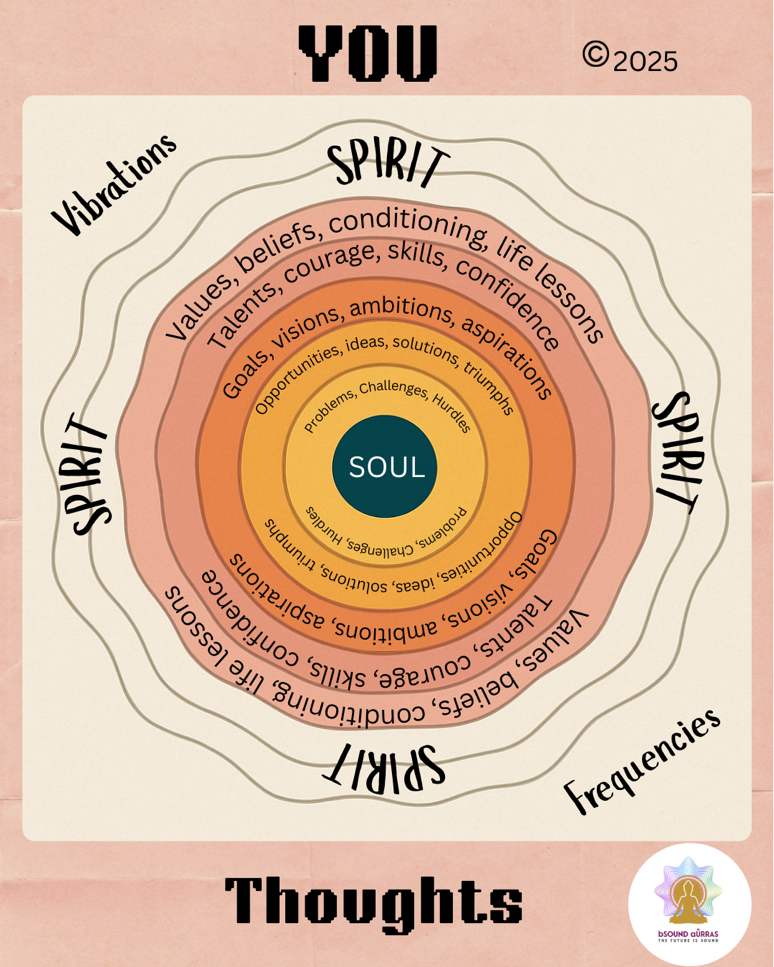
Imagine yourself as a point of light, bubbling with energy, rippling into the universe around you. This is your soul – the smallest yet most infinite version of you. Surrounding it are circles, each representing an aspect of life:
- Problems, Challenges, Hurdles — the first circle of friction.
- Opportunities, Ideas, Solutions, Triumphs — the second, full of possibilities.
- Goals, Visions, Ambitions, Aspirations — the third, shaping direction.
- Talents, Courage, Skills, Confidence — the fourth, your innate resources.
- Values, Beliefs, Conditioning, Lessons — the fifth, your inherited and learned truths.
- Spirit — the outermost, vibrant circle, embodying all layers while remaining free.
This framework reveals a profound truth: life always holds both – problems and solutions, chaos and peace, shadows and light. What we choose to focus on expands.
The Bhagavad Gita reminds us: “Yoga is the journey of the self, through the self, to the self.” These circles mirror that journey, from the turbulence of challenges to the expansiveness of spirit.
Gratitude, Impermanence, and Lightness
We are not here to fix others or control circumstances. The only sovereignty we truly hold is over our response.
Life is not a neat guidebook. It is a flowing river, sometimes turbulent, sometimes serene. We can remain stuck in loops of complaints, or we can cross hurdles and evolve. Gratitude acts as an anchor, recognising blessings shifts us from scarcity to abundance.
When we stop being consumed by the past, release bitterness, and lighten our hearts, we begin to taste wholeness. To feel joy amidst chaos is no small feat; it is a superpower.
Impermanence is the ultimate teacher. Each breath is all we truly have. As the Buddha said, “The trouble is, you think you have time.” Recognising the fragility of life urges us to embrace each moment with presence.
Toward a Tender Future
What if we could envision a world that feels safe, tender, and kind? A world where peace is not abstract but embodied in daily choices? The future is uncertain, yes, but hope lives in the act of breathing together, moving forward with awareness.
Observation is the bridge between who you are and who you are becoming. Set your intention, not in terms of wants or needs, but in essence:
“I am that which I wish to become.”
Intention, at its deepest, is not about acquisition but about embodiment. It is not what’s in it for me but what I am choosing to be.
And perhaps that is the invitation: to listen to the echoes of unfelt emotions, to soften the ego’s grip, to honour the concentric circles of the soul, and to keep becoming – with awareness, compassion, and lightness.