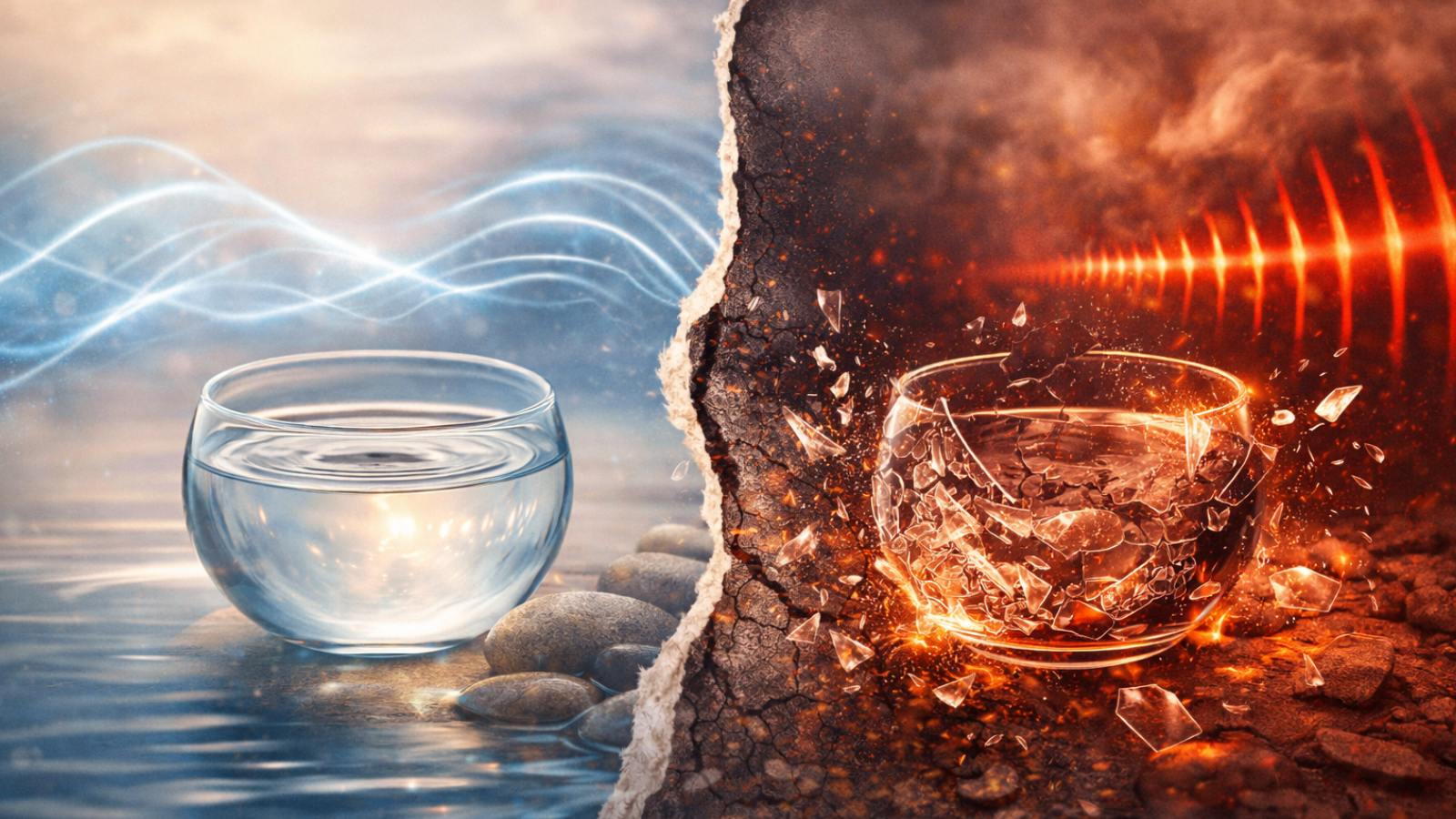
We often speak of sound as a gentle force — something that heals, soothes, and restores balance. But sound has another nature, one we rarely acknowledge. The same vibration that calms the nervous system can also shatter glass. The same frequencies used to heal tissue can also be engineered to disorient crowds. The same human voice that comforts can also wound.
`
The same force that builds harmony can also dismantle – sound doesn’t just create, it destroys too.
For every lullaby that soothes an infant, there exists a frequency capable of shattering glass. For every chant that calms the nervous system, there exists a vibration that can rupture tissue. Sound is not inherently benevolent. It is energy in motion and energy reorganizes matter, for better or worse.
The deeper we explore sound as medicine, the more we must acknowledge its dual nature. Sound does not only create harmony; it can also induce chaos. And sometimes, that destruction is exactly what we need.
Creation and Destruction: The Cosmic Blueprint
In Hindu philosophy, the Trinity – Brahma (creation), Vishnu (preservation), and Shiva (destruction) – represents the cyclical nature of existence. Shiva, often misunderstood as the destroyer, is not the god of annihilation but of transformation. His damaru, the small hourglass drum, symbolizes primordial sound, the rhythm from which the universe emerges and dissolves.
The cosmic dance of Shiva as Nataraja symbolizes this eternal rhythm. Shiva’s drum – the damaru represents the vibration from which creation emerges, while his dance also signifies dissolution. In this view, sound is not only the beginning of existence but also the force that dissolves form back into silence. Sound creates, and sound destroys, as part of the same cosmic cycle.
Sound creates form. Sound dissolves form. Some destruction clears the way for growth, like pruning a tree; other times, it harms without purpose.
Destruction, in this cosmology, is not malevolent. It is necessary. Old structures must collapse for new ones to emerge. The same vibration that builds can dismantle. The same frequency that sustains can disintegrate.
Modern science, in its own language, confirms this ancient intuition.
When Destruction Heals: Ultrasound in Medicine
Today, science has given us a clearer understanding of how vibration affects matter.
Sound’s targeted “breaking” power brings real medical wins. High-intensity focused ultrasound (HIFU), operating at frequencies from 100,000 to 3 million Hz, blasts cancer cells with heat and mechanical force, destroying tumors in prostate, liver, and kidney cancers while sparing healthy tissue. Doctors also use shockwave lithotripsy intense sound pulses to shatter kidney and gallbladder stones into passable fragments, freeing patients from surgery. Here, sound destroys, but with precision. It dismantles pathology and disintegrates what the body cannot dissolve on its own.
MUST READ: Where medicine stops and sound begins: Healing beyond the visible
Destruction, in this case, restores balance.
Nature-Inspired Examples of Sonic Transformation
Nature-inspired experiments have explored whether sound might even transform pollutants. In 2010, during the Deepwater Horizon oil spill in the Gulf of Mexico, the largest offshore spill in U.S. history, releasing nearly five million barrels of crude oil – researchers and independent experimenters began exploring unconventional and low-impact clean-up methods beyond chemical dispersants and mechanical skimmers.
Among these explorations, researchers John Hutchison and Nancy Hutchison experimented with specific sound frequencies to study their effects on oil-contaminated water. Their experiments targeted at investigating whether specific sound frequencies could influence the behaviour of oil molecules in water. They tested tones around 528 Hz, a frequency often associated within sound-healing communities with restorative or structuring properties. The idea was that carefully applied vibrations might help break large oil masses into finer dispersions, allowing natural microbial processes to degrade them more efficiently.
While the primary clean-up efforts relied on established methods such as dispersants, controlled burning, and microbial breakdown, these experimental sonic approaches pointed to a compelling possibility: that sound may be capable of influencing matter at surprisingly subtle scales. In principle, this is not entirely unfamiliar to science. Ultrasound technologies, are routinely used to fragment kidney stones or assist targeted medical therapies through controlled acoustic energy.
Although the frequency-based oil-dispersion experiments were never formally adopted as part of the official Gulf restoration program and remain largely exploratory, they contributed to a growing curiosity about the role vibration might play in environmental processes. The idea resonates with broader scientific investigations into acoustic emulsification and fluid dynamics, where controlled sound waves are studied for their ability to reorganize particles within liquids.
Whether or not sound will one day play a significant role in environmental restoration remains an open question. Yet the experiments themselves illustrate a deeper truth: sound does not merely move through matter; it can reshape it.
Sound is not metaphorical. It is mechanical force.
Infrasound and the Weaponization of Vibration
Unchecked, sound turns weapon. Sonic devices, or “sound cannons,” fire painful infrasound or ultrasound to disperse crowds, causing nausea, disorientation, and tissue damage without leaving visible marks. In 2019, Venezuela’s government allegedly deployed such tech against protesters. In 1957, French scientist Dr. Vladimir Gavreau accidentally discovered the unsettling effects of infrasound; frequencies below 20 Hz, beneath the threshold of human hearing. Waves so low (below 20 Hz) they vibrated organs internally; his team suffered vertigo, chest pain, and near-death sickness, birthing modern sonic weaponry research. Researchers exposed to these low-frequency vibrations reported nausea, anxiety, disorientation, and internal pressure sensations.
The sound was inaudible, but physiologically potent.
Since then, governments and military researchers have explored the possibility of sonic weaponry. Reports from Venezuela and other geopolitical regions have sparked public conversations about acoustic devices allegedly used for crowd control or psychological disruption.
ALSO READ: Emotional frequency and mental health
While many claims remain speculative or controversial, one fact is undisputed: the human nervous system responds to frequencies we cannot consciously hear.
The body listens, even when the mind does not.
The human voice packs similar punch. An opera singer, under precise acoustic conditions, can shatter a glass. It is not brute force, but resonance alignment. The voice amplifies the natural frequency of the object until it can no longer sustain its form. Every object has a resonant frequency – a natural vibration at which it oscillates most efficiently. When external vibration matches that frequency at sufficient amplitude, structural collapse can occur.
What applies to glass applies to bridges, buildings, and bodies. Sound reorganizes matter. This is neither mystical nor exaggeration; it is physics.
Sound weapons have played roles in military history from ancient psychological tactics to modern non-lethal tech. Armies used sound for intimidation long before electronics. Long before modern sonic weapons existed, ancient cultures understood that sound could influence the human mind. Celtic warriors used the carnyx, a tall bronze war horn shaped like the head of an animal, whose piercing metallic roar echoed across battlefields that terrified Romans during battles around 50 B.C.
The instrument was designed not for melody, but for intimidation – an early reminder that sound has always carried the power not only to heal and unite, but also to unsettle and destroy.
Modern Uses of Sound as a Weapon
In recent decades, sound has been developed into highly precise tools capable of controlling or disabling people without physical contact. One example is the Long Range Acoustic Device (LRAD), originally developed in the early 2000s. These devices can produce extremely loud sound, up to 145–153 decibels – strong enough to cause intense discomfort, pain, and disorientation. They have been used by military forces for crowd control and by naval units to deter pirates at sea. Some police departments have also deployed LRAD systems during emergencies and large public gatherings.
Other experimental systems have attempted to use sound in even more targeted ways. Reports describe devices such as “The Scream,” tested in the mid-2000s, which used bursts of modulated sound intended to induce dizziness or nausea. Earlier experiments, including Britain’s so-called “Squawk Box” in Northern Ireland during the 1970s, explored the use of ultrasonic tones to disperse crowds by creating discomfort and disorientation.
These technologies show how sound has evolved from a natural and ritualistic force into a tool of precision control. Unlike conventional weapons, sonic devices can affect the human body and mind invisibly, without leaving visible marks, demonstrating how powerful vibration can be when directed with intention.
Sound in Popular Imagination: When Fiction Mirrors Science
Cinema has long intuited the power of sound as both healer and destroyer, amplifying sound’s dual edge.
In The Kingsman: The Secret Service, a high-frequency signal is used as a weapon to induce chaos and violence. A sonic weapon disguised as church speakers blasts lethal high-decibel waves, liquifying brains in a crowd fiction rooted in real LRAD tech. In Stranger Things, sound and resonance are repeatedly used as portals, disruptors, and gateways between worlds.
Fiction dramatizes what physics makes possible: sound is force.
It penetrates walls, destabilizes systems, bypasses defence.
These narratives exaggerate for entertainment, but they reflect a deeper cultural recognition – vibration changes behaviour.
Not All Music Soothes: The 432 Hz vs 440 Hz Debate
Even music hides peril. Tuning shifted from 432 Hz (said to harmonize with nature’s rhythms, promoting calm) to 440 Hz post-WWII, allegedly for control – some claim it agitates the nervous system, spiking anxiety. Some argue that 432 Hz often called “natural tuning” resonates more harmoniously with human biology than the modern standard of 440 Hz.
Scientific consensus does not currently support dramatic claims that one frequency is inherently healing while the other is harmful. However, studies do suggest that subtle changes in pitch can affect emotional perception and physiological response.
The broader truth remains: not all music calms. Not all tunes soothe; aggressive metal or discordant noise can elevate cortisol, mimicking stress signals. In recent years, conversations about tuning standards have resurfaced.
Destruction Within the Mind
Shiva reminds us destruction precedes creation. Sound baths repair by dissolving tension, just as ultrasound eradicates disease. Yet wielded wrongly, it disrupts. The body, vibrating at 62-78 MHz when healthy, responds instantly: beneficial tones entrain peace, harmful ones fracture balance. Choose frequencies wisely 528 Hz for repair, avoid chaos-inducing blasts. In wellness, this duality empowers: harness sound to break bad patterns, not build harm.
A harsh tone can trigger fight-or-flight responses. Repeated exposure to chaotic noise pollution has been linked to increased anxiety, sleep disturbance, and cardiovascular strain.
Urban environments saturated with honking traffic, construction vibrations, and constant sonic stimulation place the nervous system in chronic low-grade alertness. Noise can erode coherence. Yet silence alone is not the solution. It is intentional sound structured, rhythmic, attuned that restores equilibrium.
During the Second World War, scientists even explored the possibility of using sound as a weapon. Nazi Germany’s architect Albert Speer is believed to have experimented with an “acoustic cannon” designed to focus powerful sound waves through large reflector dishes. The device was intended to project intense vibrations over distances of about 100 yards, potentially causing severe physical distress. Although the idea was never fully developed or used in combat, it revealed early attempts to harness sound as a destructive force.
At the same time, both Allied and Axis forces used sound in a different way – through loudspeakers, propaganda broadcasts, and emotionally charged music aimed at weakening enemy morale. In these cases, sound did not destroy physically, but it worked powerfully on the human mind.
Sound does not only affect physical structures. It alters psychological architecture.
Balancing the Power – Sound as Responsibility
We live in an age where sound surrounds us constantly – curated playlists, algorithmic noise, digital alerts, ambient media.
We rarely ask:
What is this sound doing to my nervous system?
What frequencies dominate my environment?
What rhythms shape my baseline?
If sound can destroy cancer cells, it can certainly disrupt inner equilibrium. If it can shatter glass, it can unsettle the psyche.
But if destruction can heal, then vibration can also liberate.
The Transformative Necessity of Destruction
Returning to Shiva, destruction is not the enemy of healing; it is often its prerequisite.
When ultrasound destroys a tumour, it is performing an act of mercy. When lithotripsy fragments kidney stones, it is dismantling obstruction. When a frequency destabilizes entrenched emotional patterns, it may feel uncomfortable – but that discomfort can precede integration.
Even within psychotherapy, breakthroughs often follow rupture.
Perhaps the real question is not whether sound destroys – but what it destroys.
Does it dismantle pathology or coherence?
Does it dissolve rigidity or destabilize safety?
Does it shatter illusion or shatter structure?
The difference lies in precision, intention, and attunement. As we explore sound in wellness practices, we must also acknowledge responsibility.
The same frequencies that entrain calm can induce distress. The same rhythmic repetition that heals trauma can destabilize if poorly administered. Sound therapy is not casual ambience; it is interaction with a living nervous system.
Intensity matters, so does duration and personal history.
What heals one individual may agitate another.
Sound is not inherently good or bad – it is potent.
The Double-Edged Frequency
Sound is not merely aesthetic. It is structural.
It creates form.
It dismantles form.
It regulates bodies.
It destabilizes systems.
To engage with sound as wellness is to engage with a force that carries both tenderness and power. Perhaps this is why ancient traditions treated sound with reverence. Mantras were not casual recitations. Drums were not background noise. Bells were rung intentionally. Chant was disciplined.
They understood what we are only beginning to rediscover: Sound is not decoration, but architecture. And like all architecture, it can build sanctuaries or collapse foundations. The responsibility lies not in fearing sound’s destructive power, but in understanding it.
For within the same vibration that dissolves lies the potential to transform.
And sometimes, healing begins not when something is added, but when something harmful is finally dismantled. From Shiva’s cosmic drum to surgical ultrasound, from war horns to healing chants, sound has always carried the power to create and to dissolve.
Perhaps the real question is not whether sound heals or destroys, but how consciously we choose to use it. Sound does not choose between creation and destruction. It simply amplifies intention.