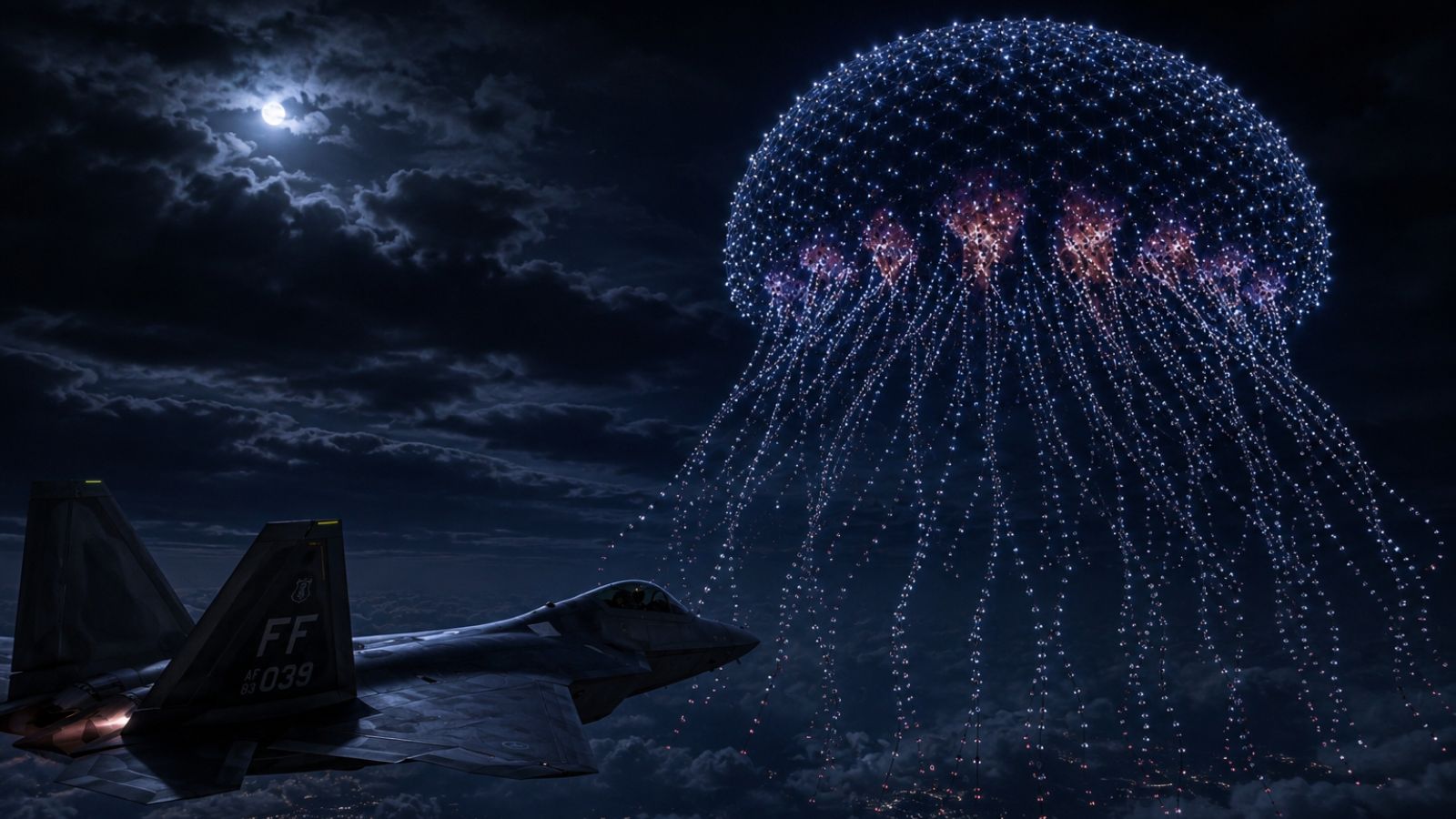
A reported sighting of a jellyfish-like swarm of interconnected drones has emerged as a possible explanation behind the downing of a US F-15E Strike Eagle during conflict over Iran in April. The account, attributed to the pilot who survived the crash and was later rescued by US special forces, has prompted renewed scrutiny of Iran’s drone warfare capabilities, reported CNN.
The aircraft was brought down on April 3, marking the first known instance of a US military aircraft being lost over Iranian territory during the conflict. While US authorities have not publicly disclosed the exact cause of the crash, the incident became a major turning point in the war and was followed by a high-risk rescue mission involving the US commandos.
Pilot’s Testimony Draws Intelligence Attention
According to reports, the pilot described witnessing multiple drones operating in a coordinated formation that resembled a jellyfish. Sources familiar with the debriefing said the drones appeared interconnected and moved together as a single unit, with smaller drones positioned beneath larger ones.
“Multiple drones interconnected and moving as one with smaller drones below the bigger drones like legs… Real alien s**t,” a source familiar with the pilot’s testimony told CNN.
Another official reportedly said the pilot described the airspace as a “minefield of drones” while ejecting from the aircraft. The account has generated interest within the US intelligence community, though officials have urged caution while evaluating the testimony.
MUST READ: What is the 14-point Iran-US peace deal?
Officials Assess Alternative Explanations
Initial assessments had suggested that the F-15E may have been brought down by Iran’s Majid infrared air defence system or by shoulder-fired missiles. However, if the drone swarm account proves accurate, analysts believe it would indicate a significantly advanced capability involving coordinated drone networking.
Intelligence officials have noted that the pilot suffered a severe concussion during the incident. Reports also indicated that he had previously been involved in a separate wartime friendly-fire event, factors that investigators are considering while reviewing his recollections.
ALSO READ: Chilling details in Pune man’s death: Fiancee had tried to kill him once before
Understanding the ‘Jellyfish’ Drone Concept
Defence analysts describe the reported system as a drone swarm built around mesh networking technology. In such a configuration, multiple drones remain digitally linked, allowing them to coordinate movements and operations in real time.
At the centre of the formation is believed to be a larger “mothership” drone that acts as a command platform. Smaller drones operate beneath it, maintaining connectivity through a mesh network. The interconnected drones resemble a jellyfish when seen from afar.
How the Drone Swarm Could Operate
Experts say the mothership drone may fly at higher altitudes to provide surveillance and battlefield awareness. Once a target is identified, smaller drones can be deployed for reconnaissance or attack missions.
The networking technology allows a single operator to oversee multiple drones simultaneously, increasing operational flexibility. Similar networking systems are already used in civilian applications, including providing communications and internet access in remote regions.
Military analysts believe such drone formations could pose difficulties for conventional radar and air defence systems. Operating at lower altitudes and across wider areas, the interconnected drones could create what some experts describe as an airborne obstacle field.
In addition to offensive capabilities, the swarms may also be used for surveillance missions over hostile territory without exposing pilots to direct risk.
Experts Highlight Future Warfare Implications
Drone warfare specialists have suggested that capabilities resembling the reported swarm were previously associated mainly with advanced military powers such as China and Russia. However, some analysts argue that Iran has spent years developing technologies designed to counter the conventional advantages of larger military forces.
“They are adapting faster than us. Iran has spent years developing capabilities designed to offset the overwhelmingly conventional advantages of the US,” Brett Velicovich told The New York Post, quoted India Today.
Coordinated Swarms Could Change Battlefield Dynamics
Defence analyst Emma Bates said one significant feature of advanced drone swarms is their ability to maintain coordinated operations even if individual drones are destroyed. According to her assessment, replacement drones can potentially join the formation and continue the mission with minimal disruption.
Bates told to CNN, developing effective countermeasures against such systems could require substantial financial investment and technological upgrades.
Geopolitical analysts have argued that low-cost drone systems combined with increasingly autonomous coordination could reshape modern air combat. Some experts believe the technology may alter the risk calculations for manned aircraft operating in contested regions.
Iran has not publicly confirmed the existence of a jellyfish-style drone swarm. Following the April incident, Iranian officials stated that a new air defence system had been used against the US aircraft but did not provide additional details about the technology involved.