Written by Tanisha Mishra and Gouravi Sharma
Kalighat Patachitra, a distinctive and vibrant style of traditional Indian painting, originated in the 19th century around the sacred Kalighat Temple in Kolkata, West Bengal. Evolving from the ancient Bengali Patachitra scroll painting tradition, this urban folk art form developed a unique visual language that combined mythological storytelling, social satire, and expressive brushwork.
Once a popular medium for urban and temple-going audiences in colonial Calcutta, Kalighat Patachitra continues to resonate today, especially among art lovers abroad. However, in the city where it originated, the Kalighat Patachitra lost its charm amid a nudge for mordernisation.
Kalighat Patachitra began as a reinterpretation of older Patachitra traditions, but in the bustling, cosmopolitan environment of colonial Kolkata, it underwent a transformation. The rural ‘Patuas’ or ‘Chitrakars’ (artists), who migrated to the city in search of opportunities, adapted their techniques and materials for a new urban audience. They replaced traditional scrolls with single-sheet paintings on paper and used homemade natural dyes derived from indigo, turmeric, and soot. These early works became immensely popular among pilgrims and tourists visiting the Kalighat Temple.
As the 19th century progressed, colonial Calcutta boomed with migration and modernity. Artists found themselves catering to an audience that was increasingly literate, urban, and curious about indigenous traditions. The Kalighat artists simplified the elaborate narratives of Patachitra into bold, minimal compositions, highlighting Hindu deities like Durga, Kali, Shiva, and Krishna, along with mythological scenes from the Ramayana and Mahabharata. Their style was characterized by fluid brushstrokes, flat tones, expressive gestures, and minimal ornamentation.
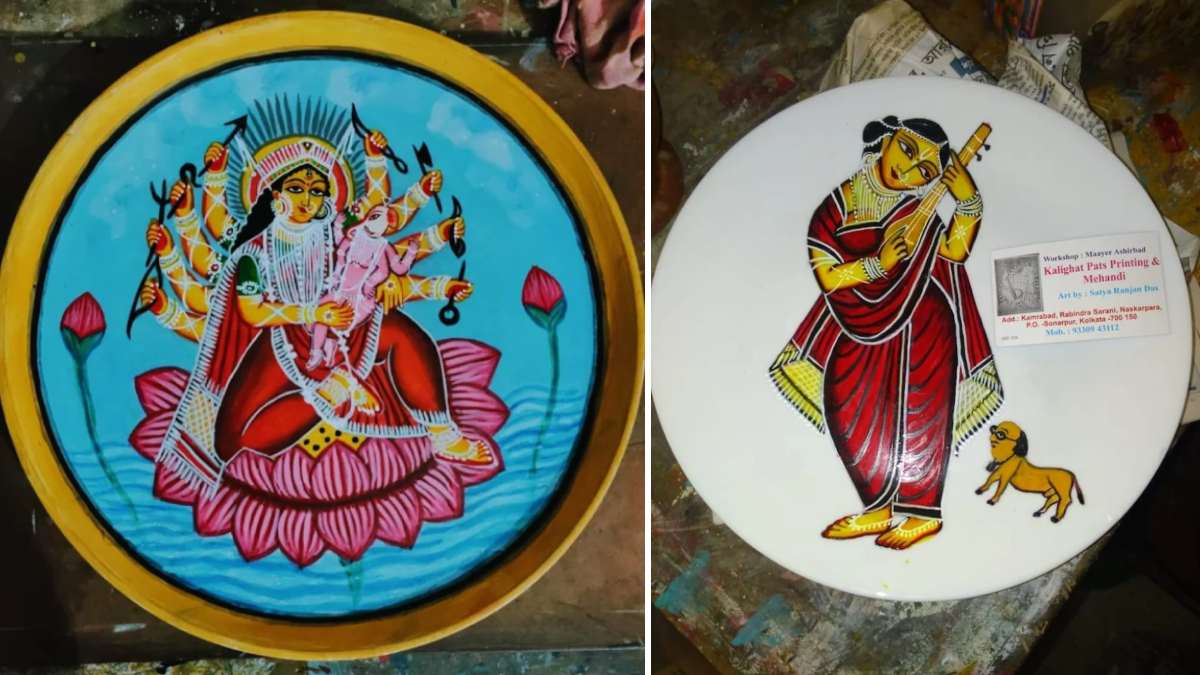
Satya Ranjan Das, another Kalighat painter, shared that “the market for Patachitra art is not growing in Bengal.” (Photo: Gouravi Sharma)
Importantly, Kalighat paintings were never intended for elite galleries. They were accessible, affordable art for the people—deeply rooted in the local culture, yet open to experimentation.
As British colonial influence seeped into Bengal, Kalighat paintings subtly pushed back by celebrating Indian mythology and traditions while also mocking Westernization and Babu culture. This fusion created a mirror to society, both reverent and satirical.
ALSO READ: Did the British melt Maratha cannons for this dome? The history of Kolkata’s Gwalior Monument
To understand how the tradition lives on today, we spoke with Bhaskar Chitrakar, a contemporary Kalighat painter from a lineage of Patua artists. “This is my fourth generation continuing the tradition of making these paintings,” he says. “Most of my clients are based abroad, particularly Bengalis in the USA. They have a deep appreciation for this art form. The starting price of a Patachitra starts from Rs 3000.”
However, the art form’s local market seems to be in decline. Satya Ranjan Das, another Kalighat painter, shared that “the market for Patachitra art is not growing in Bengal.” Many artists, he explained, have switched to idol-making, changing professions almost overnight.

As British colonial influence seeped into Bengal, Kalighat paintings subtly pushed back by celebrating Indian mythology and traditions while also mocking Westernization and Babu culture. (Photo: Wikimedia Commons)
Das also reflected on the changing themes in Kalighat art: “In the beginning, the art was inspired by Babu culture. Over time, it evolved to focus more on mythological subjects, and now it’s mostly shaped by customer preferences.” Unlike Bhaskar, he was not born into the tradition. “This art doesn’t run in my family,” he said. “I wasn’t born into it. I learned it from Sirish Chandra Chitrakar.” Most of his clients, he added, come from Delhi, Rajasthan, and Gujarat, rather than Bengal.
ALSO READ: Kolkata’s hand-pulled rickshaws: A heritage but what’s the price of nostalgia?
Kalighat Patachitra bridges the gap between rural folk traditions and urban popular culture. It is widely recognized as a precursor to modern Indian art, with luminaries like Jamini Roy drawing direct inspiration from its bold forms and earthy palette. Today, museums in India and abroad preserve priceless Kalighat works, a testament to its enduring cultural significance.
More than just decorative art, Kalighat Patachitra is a powerful visual chronicle of an era marked by tradition, change, resistance, and wit. Its bold lines and striking compositions narrate stories that remain relevant—capturing gods and goddesses, common people and colonials, in a style that is unmistakably Indian, undeniably modern, and eternally expressive.