Written by Shruti Singh and Arpan Nag
On the eastern banks of the Hooghly, not far from the bustle of Babu Ghat, stands a quiet but firm reminder of British imperial ambition—the Gwalior Monument. Built in 1847 AD, this octagonal memorial was erected to commemorate British soldiers who lost their lives in the fierce battles of Maharajpur and Punniar in 1843, during the British-Maratha conflict.
Though the British had signed a treaty with the Marathas, rising tensions and strategic betrayal led to a bloody confrontation.
Later, according to historical records from the then Governor-General’s office, the Gwalior Monument was commissioned under the command of Governor-General Lord Ellenborough and supervised by military engineer Colonel H. Godwin. As per the official records, the structure was designed not only to honour the war dead but also to symbolize the victory of British authority over one of the last strongholds of native resistance.
Strategic Symbolism Behind the Structure
As part of an ongoing heritage revival initiative inspired by West Bengal Chief Minister Mamata Banerjee, the Gwalior Monument has recently been reopened to the public.
Speaking about the monument’s deeper strategic significance, Heritage Coordinator and Retired Security Advisor of Syama Prasad Mookerjee Port (formerly known as Kolkata Port Trust), Gautam Chakraborty shared some valuable insights during the visit.
“Navigation was key at the time. In 1843, there were no landmarks or high-rise structures along the river. The British built the monument with a specific architectural design so pilots coming up the river could easily spot it and steer ships accordingly. It acted as a watermark—both literally and symbolically,” he explained.
Architecture Designed for Visibility
Chakraborty also pointed out that the monument’s shape was more than just aesthetic.
“If you observe closely, the structure flares slightly outward at the base, narrows at the middle, and shoots up like a spire. This wasn’t accidental—it helped make the structure visible from far down the river. Fort William needed to be guarded at all times, and this monument was part of that larger security net,” he said.
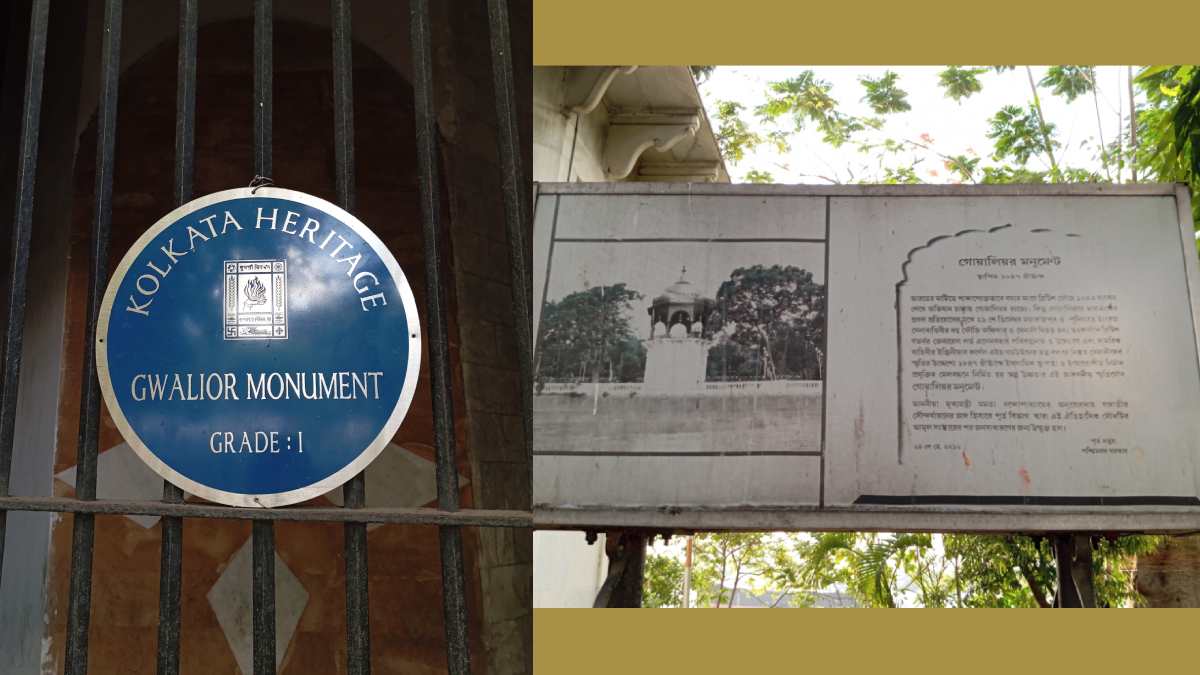
A plaque (left) lists the Gwalior Monument as a Grade 1 heritage, while another (right) talks about its history. (Photos: Arpan Nag)
The Dome of Repurposed Resistance
One of the most fascinating elements of the Gwalior Monument is its dome. According to heritage oral accounts recorded in the archives of the Indian Museum, the dome was crafted from the melted-down copper of 96 rifles seized during the war.
ALSO READ: Story of Kristo Das Pal — A forgotten journalist whom Kolkata remembers only through an ignored statue
These rifles, taken as trophies from the Marathas, were supposedly repurposed to create the iconic dome of the memorial. While this story remains open to contradiction due to the lack of documented evidence, it adds a powerful layer of colonial symbolism—where instruments of resistance were transformed into a crown of conquest.
“It’s symbolic, even if not entirely proven,” Chakraborty said. “Using the enemy’s weapons to build your monument sends a message that resonates through generations.”
Faded Grandeur and Fragmented Memory
The octagonal structure, which once housed more relics of the past, has weathered years of neglect. Some elements have been lost to insensitive renovations, and signs of vandalism are visible on the faded plaques that once bore the names of fallen soldiers—now nearly illegible except for one.
Inside the Gwalior Monument, a staircase winds upwards, revealing the internal structure and purpose. The design is a blend of Islamic motifs and European masonry, making it a rare example of Indo-colonial fusion. Once a strategic lookout, today the interior stands as a quiet chamber echoing the unspoken legacy of conquest.
“Earlier, there were many things here—artefacts, names, emblems. Slowly they vanished. Now, with some attention, we hope people will start respecting this place again,” Chakraborty added.
A Riverside Retreat with Historical Echoes
Located just a 7 to 8-minute walk from Babu Ghat, the monument is easily accessible for a peaceful visit. Tucked beside the Water Gate of the river, the site is now adorned with stone benches, lush green plants, and tall trees that create a serene riverside retreat.
The view of the Hooghly, especially during sunset, is breathtaking, making it a place where history and tranquillity coexist. As per the guidebook published by the Kolkata Municipal Corporation’s heritage wing, visitors today may come seeking a moment of rest, perhaps unaware of the imperial past that still lingers in the brick-and-mortar of this quiet sentinel.
ALSO READ: Kolkata’s hand-pulled rickshaws: A heritage but what’s the price of nostalgia?
Though largely forgotten in the city’s bustling urban sprawl, the Gwalior Monument stands as a reminder of a violent turning point in Indian history—a time when treaties were broken, resistance was crushed, and empires rose brick by brick.
The reopening of the Gwalior Monument offers not just a chance to revisit a colonial relic but also to re-examine the layered narratives of power, resistance, and memory. In the fusion of melted rifles and architectural grace lies the complex legacy of an era gone by, waiting to be acknowledged by the present.
(Shruti Singh and Arpan Nag are interns with thetheorist.in)