Written by Mahek Chhabra
Born in the age of rajas and refined by colonial rule, Kolkata’s hand-pulled rickshaws still trace forgotten paths through a city racing toward modernity.
In the dim alleys of North Kolkata, the creak of wooden wheels still cuts through the noise — a rare fading sound in a city that barely notices anymore. The hand-pulled rickshaw, one of the oldest surviving symbols of Kolkata’s layered past, continues to crawl forward, worn but dignified, bearing not just passengers but a weight of forgotten history.
Originally introduced in 19th-century Japan, hand-pulled rickshaws found their way to India during the late 1800s. The British embraced them during their Calcutta rule, followed by Bengali aristocrats and royal families. For the local rajas and maharajas, “they weren’t just transport — they were chariots of pride, escorted by footmen and lined with silk.”
How hand-pulled rickshaws were pushed out of the streets
Over time, these rickshaws became part of everyday Kolkata. From flooded monsoon lanes to chaotic markets, they were unmatched in resilience. Crafted with wooden frames, iron shafts, and rubber-tyred wheels, their build was both simple and strong. But as cycle rickshaws, scooters, and app-based transport entered the picture, the hand-pulled rickshaw slowly fell from favor.
For Lakhan, a rickshaw-puller from Bihar, the fall has been hard. “Since scooties came in eight to 10 years ago, people stopped our services for short trips,” he says. “Some days we earn well. Other days, not even enough for one meal. Still, I have to pay Rs 240 every week to the owner of the rickshaw no matter what.”

In places like Bhowanipore, College Street, and Kalighat, a handful of these rickshaws still glide through the city’s pulse. (Photo: Alisha Alam)
This quiet pressure runs through every puller’s story. Arjun Yadav, also from Bihar, nods in agreement. “We charge according to the distance. But competition is everywhere. We’re all working under owners, and the weekly rent is the same — Rs 240.
ALSO READ: Story of Kristo Das Pal — A forgotten journalist whom Kolkata remembers only through an ignored statue
While the uncertain earning is one issue, for the hand-drawn rickshaw-pullers, the trouble doesn’t stop at just that. When asked what happens when there is a repair needed? Yadav says, “We take it to Haddi Bagan, Park Circus to get it fixed.” Yadav usually functions around Bhowanipore area.
The hands that make them
On Yadav’s cue, thetheorist.in found out a workshop too and the shrieking reality was evident at just one glance. The decline isn’t just on the streets. It’s in the workshops too.
Jaleshwar Sharma, a master craftsman who has been repairing rickshaws for over 40 years, reflects on a vanishing art. “My forefathers fixed horse-drawn carriages for the kings. Then came these rickshaws from Japan. We built them, repaired them. But now, I work alone under my employer Dr. Iqbal,” he says. After a brief pause he adds, “There used to be many garages — now barely any. No one is coming to learn this work anymore.”
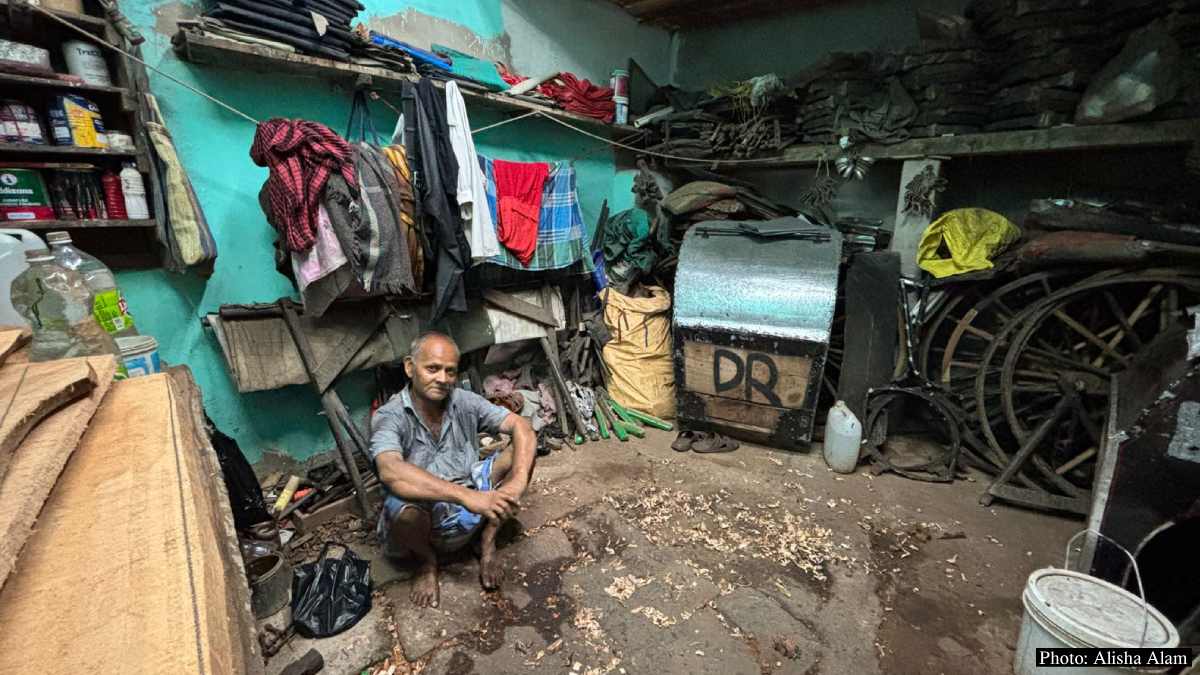
Jaleshwar Sharma, a master craftsman who has been repairing rickshaws for over 40 years. (Photo: Alisha Alam)
“Repairing just one tyre can cost Rs 7,000 to Rs 8,000 today,” Jaleshwar says. “But a well-repaired one will last over two years. These rickshaws are strong — wood, iron, rubber, so many things go into building rickshaws. They were made to survive.” His voice falters for a moment and then Sharma begins to speak again. “If the government could help, even a little, maybe this work would not die. This is part of Kolkata’s heritage.”
Raj Kishore Rai, another rickshaw puller from Bihar, adds, “Even if we earn nothing some days, rent doesn’t stop. We try to recover it on better days. We’re mostly migrants — from Bihar, UP, some from Kolkata too. We live on what we earn each day.”
ALSO READ: Ever touched real Moon soil or seen Neil Armstrong’s hair? This Kolkata museum has it all
Rai adds, “Once, rickshaws were meant for kings. Now, we pull them to feed our families.”
In places like Bhowanipore, College Street, and Kalighat, a handful of these rickshaws still glide through the city’s pulse, carrying the elderly, battling waterlogged streets, or simply offering tourists a nostalgic ride. But their numbers are dwindling fast. Fewer than 2,000 remain today.
As the city moves forward, these wooden-wheeled relics are being left behind. Not preserved in museums, but clinging to survive on the same streets they once ruled. They are stories on wheels, of displacement, dignity, and determination.