Written by Novena Rao
If you walk behind the Lower Circular Road Cemetery, once one of the largest Christian burial grounds in Kolkata, you will find a quiet, almost hidden building. It looks like just another old structure lost in time. But this is the gas crematorium—a place that once symbolized modernity and reform, and today stands as a city’s fading heritage.
The crematorium was built in 1906 by the French company Toisoul Fradet & Co. of Paris and managed by the Christian Burial Board of Kolkata. The gas crematorium was designed to offer a cleaner and faster alternative to the traditional wood pyre.
When the crematorium first opened, it was met with curiosity and some popularity. Subhadip Mukherjee, travel and heritage blogger (Indian Vagabond), who has been documenting such overlooked corners of the city, says, “Its design was very traditional and the gas burner back then was the latest on design and functionality.”
Despite its promise, the crematorium, Asia’s first says Mukherjee, never truly took root within the Christian community. “Christians in India preferred to be buried as there was ample space in the Lower Circular Cemetery,” Mukherjee explains. Still, the facility did not stand completely abandoned in its early years. “Later on, the Brahmo Samaj also used this facility,” he adds, pointing to its brief extension of purpose beyond Christian use.
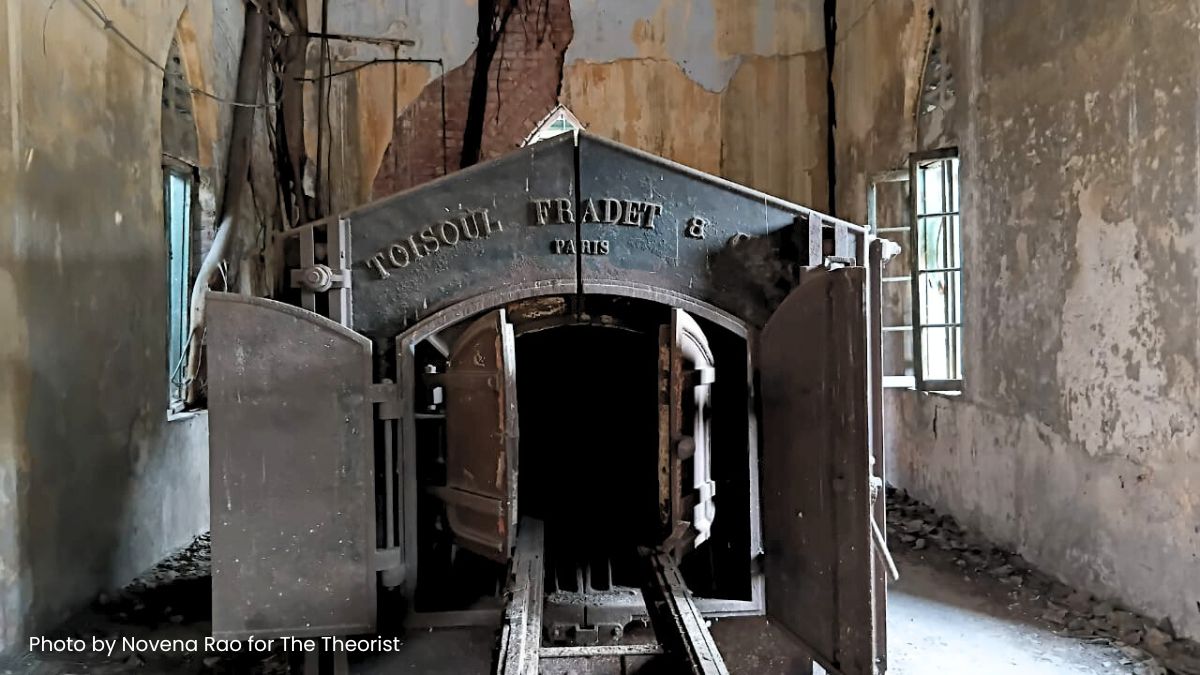
The crematorium was built in 1906 by the French company Toisoul Fradet & Co. of Paris and managed by the Christian Burial Board of Kolkata. (Photo by Novena Rao)
The most significant of the gas crematorium in Kolkata came in 1937, when Jagadish Chandra Bose, India’s legendary scientist and innovator, was cremated here.
“Gas supply stopped in the 1980s. Greater Calcutta Gas Supply never resumed supply and with no demand, it was never restored,” Mukherjee says. Without gas and without demand, the crematorium fell into disuse, its promise as a modern alternative extinguished.
ALSO READ: The fading music of Kolkata’s pipe organs: A saga of practical migration & cultural amnesia
For Mukherjee, the crematorium is more than a structure — it is part of a heritage that risks being erased from public memory. “It’s part of the dwindling Christian heritage of Kolkata which hardly anyone nowadays worries about,” he reflects.
As a Bengali Christian himself, Mukherjee’s interest in documenting such places is deeply personal. “It’s a historic place and city heritage. People of the city must know about this unique place,” he says.
The gas crematorium behind Lower Circular Road Cemetery may never return to function, but its story of innovation, and forgotten heritage — deserves a place in Kolkata’s collective memory.
(Novena Rao is an with The Theorist)