Written by Disha Dey
Kolkata’s Durga Puja dazzles millions every year with its majestic pandals and idols, but the real story lies in the unseen lives of the pandal makers who bring these spectacular visions to life. These skilled artisans, decorators, and workers balance tradition with survival, yet remain excluded from basic social security and fair compensation.
According to UNESCO, cultural heritage is “our legacy from the past, what we live with today and what we pass on to the future generations.” By that definition, the work of pandal makers is a living heritage. Still, their contribution to Durga Puja often goes unnoticed, even as the festival brings in enormous investments and global recognition.
Craftsmanship rooted in survival
For many artisans, Durga Puja is the main source of livelihood, even though the returns barely sustain their families. Akash Bhakta, a fibre decorator from Behala Thakurpukur, explains, “Most of my earnings come from making Puja pandals, and I have to save that money to run my household for the rest of the year. After the festival, I take up decoration work for weddings and other events that are not fixed as well, and sometimes building construction work as well.”
Bhakta earns around ₹2,500 a week around Durga Puja but even that comes after a lot of bargaining, he says. “Since I live in Kolkata, I can return home late at night, but those who come from the villages have to stay back and manage with many struggles behind the pandals. This work has been in our family for generations,” Bhakta says.
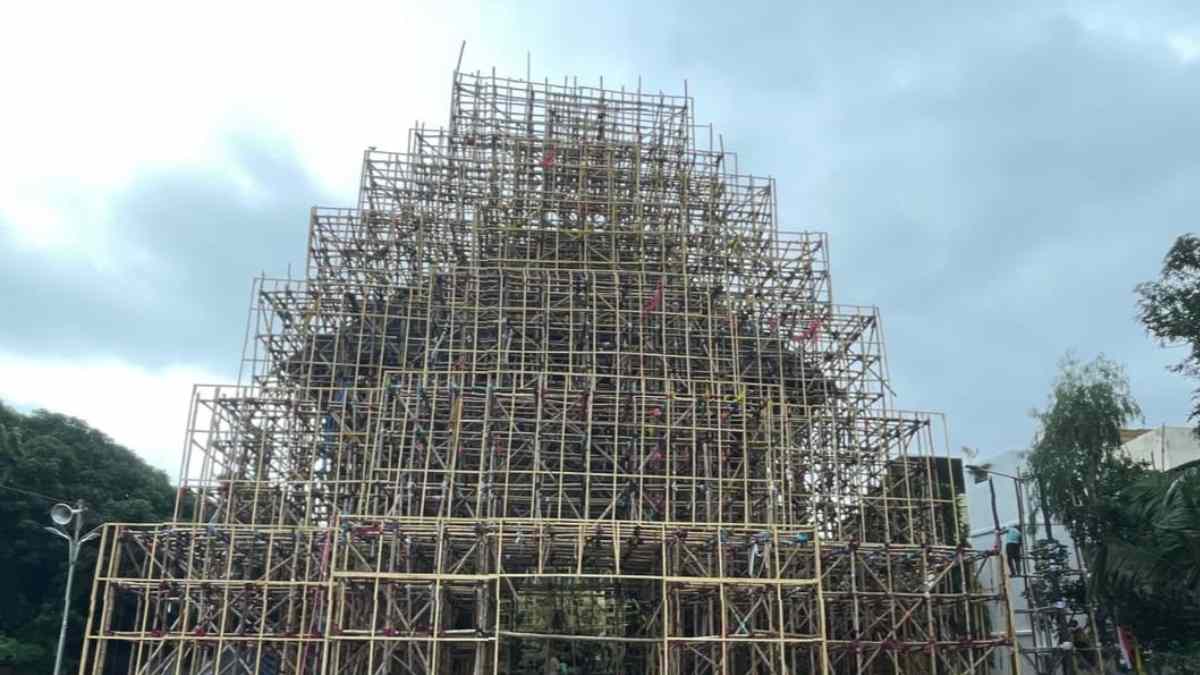
The long working hours and harsh conditions are compounded by health hazards. With the festival coinciding with the retreating monsoon, workers face heightened risks of waterborne and mosquito-borne diseases. (Photo by Disha Dey)
A fifty-one-year-old artisan from Haldia, who has been working for two decades at Baghbazar Sarbojonin, is leading a team of 70 workers this year. “We are called for Durga Puja work a month in advance, and the Baghbazar Puja has to be completed by Panchami. The idol is created inside the pandal itself. We are not allowed to leave before Lakshmi Puja,” he says.
ALSO READ: A British sahib who painted glimpses from rural Bengal and loved animals — Who is Colesworthey Grant
One of his team members from Behrampur adds, “They make us work 17–18 hours a day. We are no longer young, our bodies ache, but there is no rest, no sleep. Even when it rains, we somehow keep going. They don’t pay us properly, yet this is the only way we can survive. So we keep pushing ourselves, even through the pain.”
Their team leader admits that the earnings are meagre despite the backbreaking schedule: “After Durga Puja, we do get work throughout the year, but the income is never the same. I take up jobs at fairs and some small decoration work here and there. The fairs keep us going somewhat—Durga Puja, Kali Puja, Jagadhatri Puja, and a few others—but even after all that, it doesn’t amount to even one lakh rupees a year. Still, this is our main source of income, so we silently endure all the hardships. Otherwise, it becomes very difficult to look after a family of four.”
Health risks and little recognition
The long working hours and harsh conditions are compounded by health hazards. With the festival coinciding with the retreating monsoon, workers face heightened risks of waterborne and mosquito-borne diseases. Rajen Mistry, from Mitali Sangha in Kankurgachi, shares, “Mosquitoes bite us because we stay in tents behind the pandals. Many of us fall sick, but no one really pays much attention. At best, someone brings us medicine, but even then, it feels like they’re only worried that our working hours might reduce. Beyond that, we don’t really receive any respect from anyone.”
ALSO READ: This Durga Puja, a special pass for senior citizens, pregnant women at 24 pandals
On the other hand, puja committees highlight the support they extend. “The workers get paid ₹500 per day till the completion of the puja pandal and after Puja we give them a saree and a kurta, bhog is served every day during Puja,” says Sagar Basak, a member of a puja committee in North Kolkata.
For most workers, this is far from enough. While pandals shine as the centrepiece of Durga Puja, the very hands that build them often live on the margins, battling low pay, poor working conditions, and lack of social security.
(Disha Dey is an intern with The Theorist)