Written By Novena Rao
Tucked away in the bustling lanes of Beliaghata, Kolkata, stands Hyderi Manzil — a simple, two-storey house that once became the epicentre of India’s experiment with peace during its bloodied birth in 1947. At a time when the newly independent nation was being ripped apart by communal riots, Mahatma Gandhi chose this unassuming home to make a statement — that peace could still prevail, if lived and practised.
As India celebrated Independence, several parts of the country witnessed violence, distrust, and grief. It was against this backdrop that Gandhi arrived in Bengal, determined to douse the fires of hate with the power of truth and nonviolence.
“Gandhi came from Bihar to Kolkata in Sodepur Ashram on 8th or 9th August. He had a pre-determination to go to Noakhali for the riots issue,” recalls Papri Sarkar, secretary of the Purba Kalikata Gandhi Smarak Samiti, the organization that now cares for Hyderi Manzil.
A turning point: Gandhi decides to stay
But history took a turn. Kolkata’s situation was worsening fast. Gandhi was urged by Congress leaders and Suhrawardy Sahab to stay in the city. “They told him if you start your peacemaking activities from here, it will spread to Noakhali and as well as all over India,” Sarkar explains.
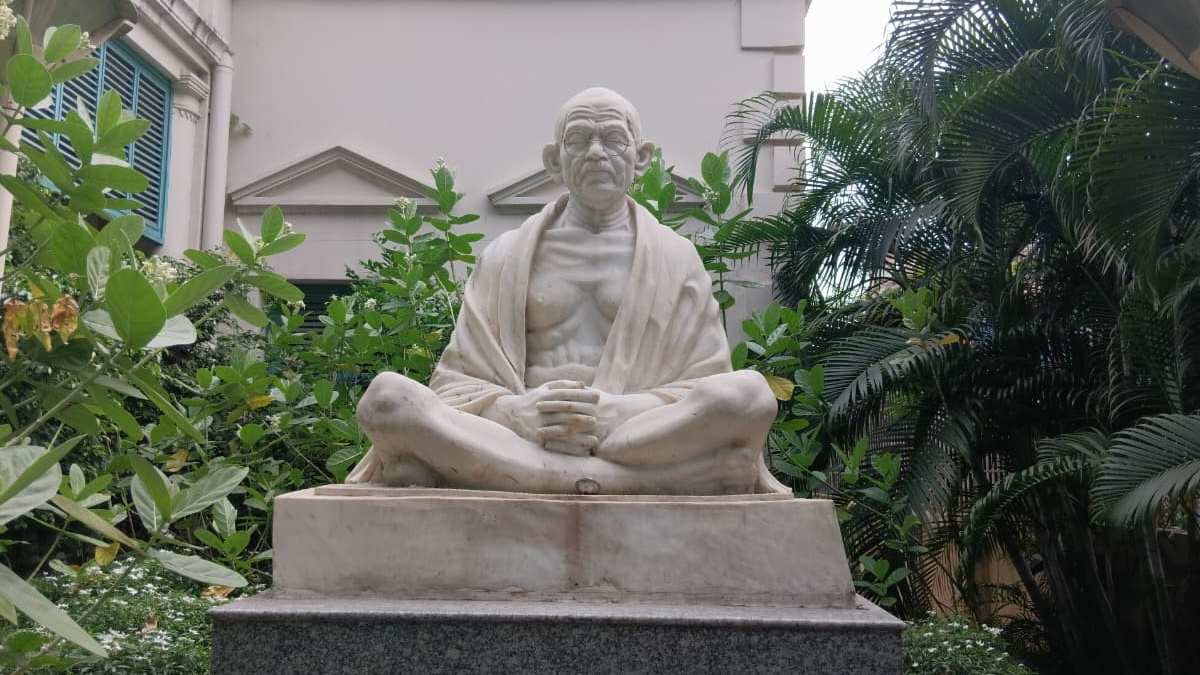
By staying in an abandoned Muslim house in a Hindu-majority area and insisting that Muslim leaders live with him, Gandhi turned Hyderi Manzil into more than a shelter. (Photo by Novena Rao)
Gandhi, after quiet contemplation, agreed — but laid down two non-negotiable conditions.
ALSO READ: How a 124-year-old ‘Street Orderly Bin’ became Kolkata’s last link to its civic past
“Gandhiji said first, I would stay in an abandoned house of Muslims situated in a Hindu area. Second, Suhrawardy Sahab has to stay with me in that house,” Sarkar recounts.
Finding Hyderi Manzil
With help from Hemchandra Naskar and Prafullo Ghosh, a suitable house was found in Beliaghata — a Muslim-owned home left abandoned amid the riots. On August 13, 1947, just two days before Independence, Gandhi arrived at Hyderi Manzil with his companions.
The area was deeply divided. “Towards Sealdah, the areas were Muslim dominated and after the Khalpole rail bridge, there were Hindu majority areas. It was a totally disturbed zone in those days,” Sarkar explains. Gandhi chose to settle in the middle of this fault line — a deliberate act of courage and symbolism.
By staying in an abandoned Muslim house in a Hindu-majority area and insisting that Muslim leaders live with him, Gandhi turned Hyderi Manzil into more than a shelter — it became a living example of coexistence. His quiet defiance, his prayer meetings, and his refusal to leave until peace returned began to work a silent miracle. Slowly, the riots subsided. The city, soothed by his moral presence, began to heal.
Hyderi Manzil today: A house of peace
Today, Hyderi Manzil stands as a memorial, managed by the Purba Kalikata Gandhi Smarak Samiti. Its worn walls echo the story of one man’s determination to confront hatred with humanity. Visitors walk through rooms where Gandhi fasted, prayed, and met both Hindus and Muslims — a space that once breathed both conflict and reconciliation.
As Papri Sarkar reflects, “Gandhi’s stay here was not just about stopping riots — it was about showing that peace is possible when we dare to live it, even in the heart of conflict.”
In a time when divisions still simmer, Hyderi Manzil remains a quiet witness to the possibility of harmony — a reminder that peace is not declared, but lived.
(Novena Rao is an intern with The Theorist)