In a remarkable milestone for Indian mountaineering, a team of tribal youths from Jashpur district, Chhattisgarh, has achieved the extraordinary — opening a new alpine route on Jagatsukh Peak (5,340 meters) in Himachal Pradesh’s Duhangan Valley.
The route, named the “Vishnu Deo Route” in honor of Chief Minister Vishnu Deo Sai, was scaled in just 12 hours from base camp — an achievement in the pure, self-reliant alpine style, considered one of the most demanding forms of climbing.
The expedition, held in September 2025, was organized by the Jashpur District Administration in collaboration with Pahadi Bakra Adventure, with vital support from Hira Group and several national and international partners.
What makes this climb truly historic is that all five climbers were first-time Himalayan mountaineers. They had trained at Deshdekha Climbing Area, India’s first outdoor natural rock climbing zone for adventure sports, developed by the Jashpur Administration.
To prepare them, a world-class training regimen was designed by experts Swapnil Rachelwar, Dave Gates (USA), and Sagar Dubey. The team underwent two months of intensive training and a 12-day pre-expedition climbing drill to strengthen technical and psychological endurance.
Extreme Challenges on the Vishnu Deo Route
Expedition leader Swapnil Rachelwar described the route as extremely challenging due to unstable weather, poor visibility, and concealed crevasses.
“Despite the dangers, the team climbed without fixed ropes or external support — true alpine style,” Rachelwar said.
Unlike commercial expeditions, which rely on large support crews, this ascent was marked by self-sufficiency and pure skill. It was a symbolic statement that passion and preparation can overcome even the highest odds.
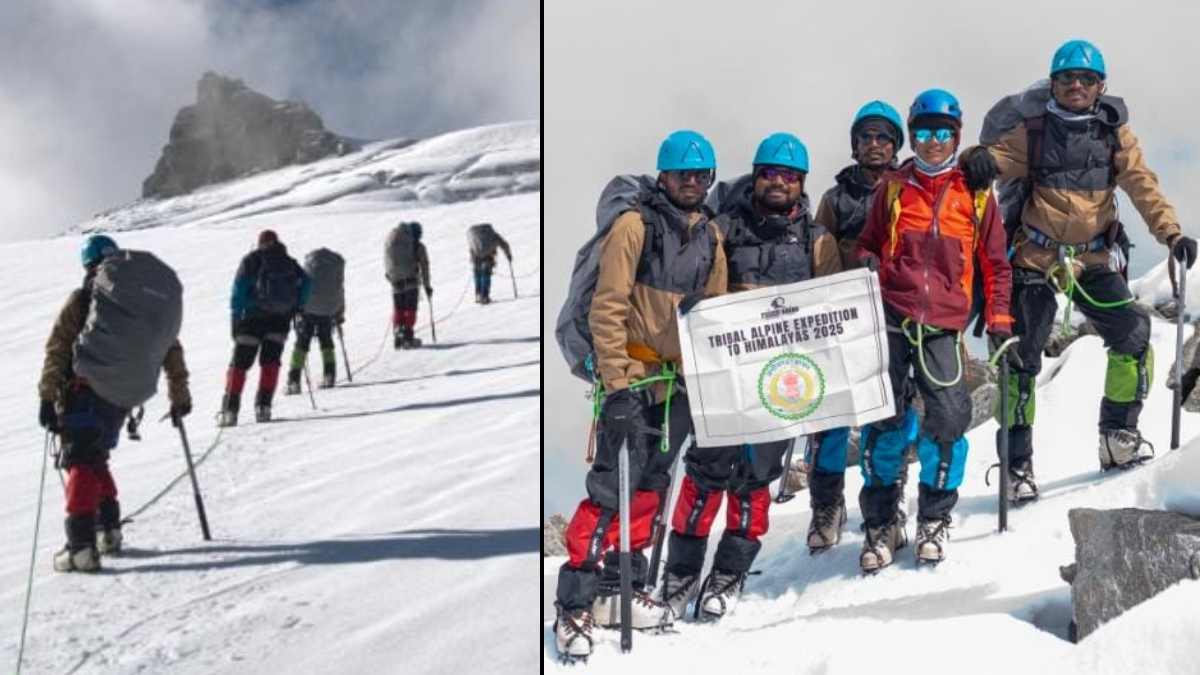
What makes this climb truly historic is that all five climbers were first-time Himalayan mountaineers. (Theorist photo)
The expedition received global acclaim from elite mountaineers.
Vells, Spanish mountaineer and former World Cup coach who was part of the technical team, said: “These young climbers — who had never even seen snow before — have opened a new route in the Himalayas. It proves that with training and opportunity, they can compete at the world’s highest level.”
The accomplishment not only represents an athletic triumph but also a social and cultural breakthrough for India’s tribal communities.
New Routes, New Peaks, and New Horizons
Beyond the Vishnu Deo Route, the Jashpur team opened seven additional routes across the Duhangan Valley — including the first ascent of an unclimbed 5,350-meter summit, now named “Chhupa Rustam Peak.”
Its ascent route, “Curcuma” (scientific name for turmeric), symbolizes resilience and healing — values deeply rooted in Indian tradition.
The pioneering team included Ravi Singh, Tejal Bhagat, Rusnath Bhagat, Sachin Kujur, and Prateek Nayak, led by Swapnil Rachelwar with Rahul Ogra and Harsh Thakur as co-leaders.
Key administrative support came from Dr. Ravi Mittal (IAS), Rohit Vyas (IAS), Shashi Kumar (IFS), and Abhishek Kumar (IAS).
Technical contributors included Dave Gates (USA), Ernest Venturini, Marta Pedro (Spain), Kelsey (USA), and Oyvind Y. Boe (Norway).
The expedition’s documentation and photography were handled by Ishan Gupta’s Coffee Media team.
Adventure Partnerships and Sponsors
Major sponsors and institutional partners included: Petzl, Allied Safety Equipment, Red Panda Outdoors, Rekki Outdoors, Advenam Adventures, Jai Jungle Pvt. Ltd., Adi Kailash Holistic Center, Golden Boulder, Crag Development Initiative, and Mystic Himalayan Trail.
Their combined support turned this dream into a disciplined, record-setting reality.
As Chief Minister Vishnu Deo Sai said: “India’s future can emerge from its villages — and ascend to the world’s heights.”
This expedition is a testament to that vision — showing that tribal and rural youth, given the right opportunities, can reach the summits of global recognition.
With Jashpur now emerging as an adventure and eco-tourism hub, India’s mountaineering landscape has gained a new frontier of courage, sustainability, and local empowerment.