Leadership, as we have long understood it, has been shaped by strategy, intelligence, and the ability to influence outcomes. Yet, beneath these visible dimensions lies a quieter, often overlooked foundation – the inner state from which a leader thinks, feels, and acts.
This inner state is not built through information alone. It is cultivated through awareness and stillness. Increasingly, we understand that awareness is not merely a cognitive process. It is experiential. And stillness is embodied. At its deepest level, it is vibrational.
The Whole Leader: Beyond Skill to Self
True leadership cannot be reduced to competencies alone. It is an expression of the whole self – mind, body, and spirit – what we may call the inner compass. Leadership does not start in boardrooms or balance sheets. It begins much earlier – in the choices we make, the awareness we cultivate, and the relationship we hold with ourselves.
Holistic frameworks of human development have long emphasized that well-being is not fragmented. Emotional clarity, mental focus, physical vitality, and spiritual alignment are deeply interconnected. When one aspect is disturbed, the others inevitably follow.
Leadership reflects this same interconnectedness.
A leader who is mentally sharp but emotionally unsettled, creates inconsistency. A leader who is driven but disconnected from purpose, creates direction without meaning. A leader who lacks inner alignment may still achieve outcomes – but often, at the cost of sustainability, trust, or well-being.
Conscious leadership begins when the individual turns inward – not to withdraw, but to align.
Spiritual Intelligence: The Inner Compass
At the heart of this alignment lies what is often referred to as spiritual intelligence – the capacity to understand oneself beyond roles, achievements, and external validation. Leadership at its highest expression is not merely about influence or decision-making. It is about alignment – an inner coherence between thought, intention, and action. This alignment is closely linked to what is now being recognised as spiritual intelligence: the capacity to act from awareness, meaning, and a sense of interconnectedness that extends beyond individual ambition.
However, such clarity cannot be accessed through intellect alone. It is, a matter of state.
It is the ability to:
- Reflect with honesty
- Act with intention
- Hold complexity without fragmentation
- Remain grounded in values under pressure
Each of us carries what may be called an inner compass – a quiet orientation that guides our choices. It is not fixed. It evolves as we grow, learn, and become more aware.
Leadership, when guided by this compass, shifts from reaction to response.
Decisions are no longer driven solely by urgency or external demand, but by clarity and alignment.
Yet, this clarity is not easily accessible.
MUST READ: The Sound of Focus: How Sound Meditation Is Transforming Athletic Performance
Modern leadership operates in environments of constant stimulation – information overload, rapid decision-making, and continuous external input. In our professional environments, we have gradually moved away from the holistic understanding of human functioning – where mind, body, and spirit are seen as interconnected. Emotional stability, mental clarity, and inner balance are often treated as secondary, when in fact they are foundational to sustainable performance and meaningful leadership. Over time, this creates internal noise:
- Overthinking
- Emotional reactivity
- Fragmented attention
- Disconnection from purpose
In such states, leaders may appear active, but not necessarily aligned. The challenge, then, is not only to think better, but to quiet the noise that distorts thinking.
This is where sound-based practices offer a powerful and often underestimated pathway.
Sound as a Pathway to Awareness: From State to Leadership
This is where sound enters the conversation.
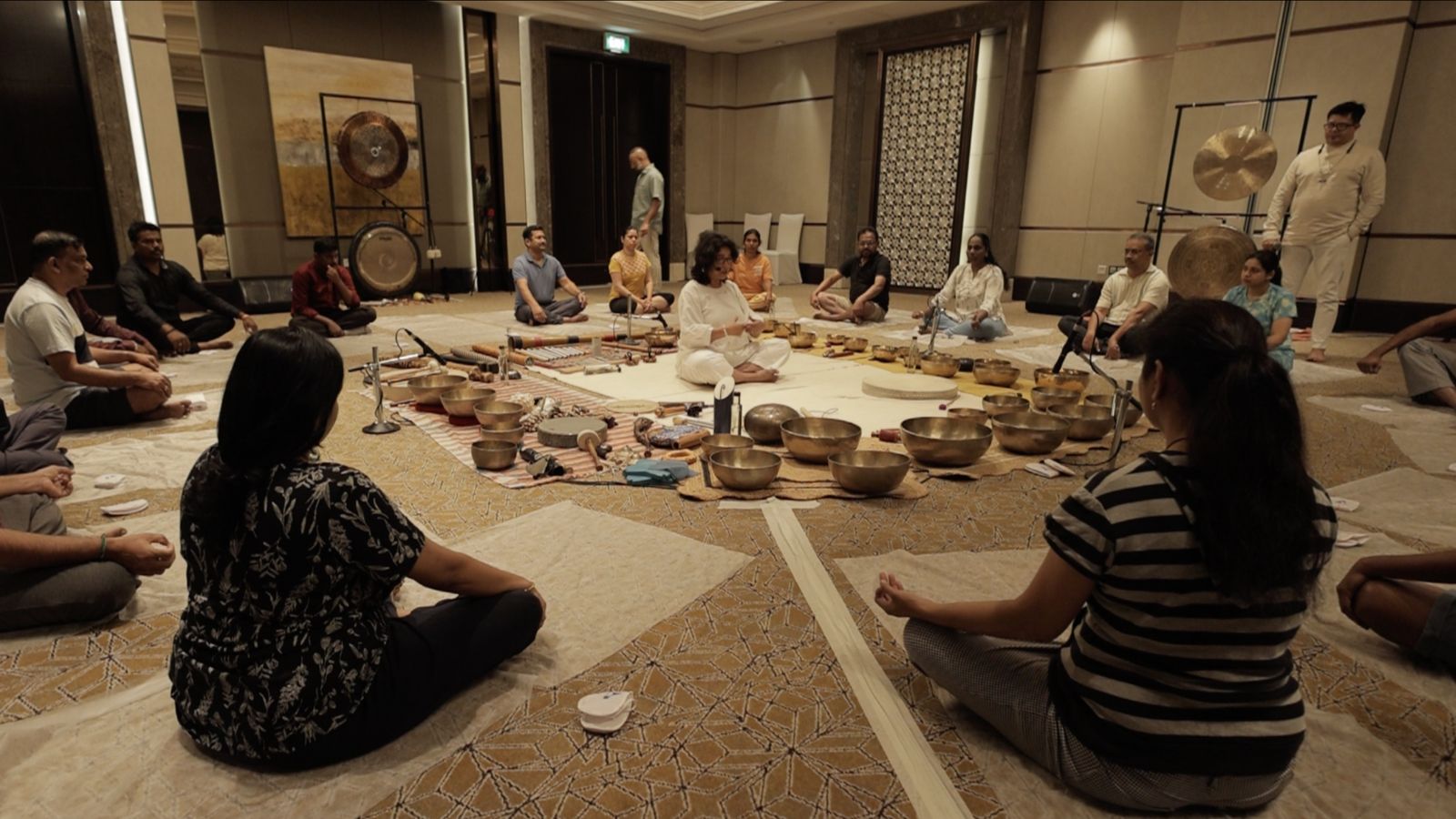
Sound meditation offers a direct pathway into the regulation of the inner state. Unlike purely cognitive practices, sound works through rhythm, repetition, and vibration, engaging the body and nervous system before the mind attempts to interpret.
When the mind follows sound:
- Attention stabilizes
- Breathing deepens
- Internal chatter reduces
This is not about escape. It is about returning to coherence. Sound is not merely auditory stimulus. It is something we experience physiologically. Through the principle of brainwave entrainment, rhythmic sound patterns can gently guide the brain from high-frequency beta states associated with stress and overactivity, into slower alpha and theta states, where creativity, intuition, and integration naturally arise. As the nervous system begins to regulate, cognitive load reduces, and awareness expands.
Clarity, in this space, is not forced – it is revealed.
In these states, leaders often experience clearer thinking, reduced reactivity and a deeper presence. What emerges is not forced focus, but effortless attention.
The quality of leadership is deeply influenced by the quality of internal state.
A regulated mind listens better, decides more clearly, and responds rather than react. It operates from a deeper connection to vision and purpose, rather than pressure or defensiveness.
Sound meditation supports the shift from the latter to the former.
By stabilizing internal rhythms, it allows leaders to access what might be called inner stillness – not inactivity, but clarity without noise. From this stillness, leadership becomes more precise. They begin to lead not from reaction, but from resonance.
MUST READ: The healing sound of laughter in silent rooms: The science and spirit of medical clowning
This marks the evolution toward a higher spiritual quotient (SQ), where leadership is no longer driven solely by outcomes, but by meaning, integrity, and long-term impact. When leaders learn to regulate their internal state, access deeper awareness, and act from coherence, their decisions naturally become more aligned, ethical, and sustainable.
Purpose as a Living Choice
One of the most persistent questions in leadership is that of purpose – often treated as a distant milestone – something to be discovered after achievement, success, or stability. In reality, it is something that is continuously chosen.
It is reflected in what we prioritise, the ways we respond to people and situations, and how we show up for what we stand for.
Chronic stress today is rarely just a result of workload. It stems from a more subtle dissonance – a lack of inner joy, contentment, and meaning. Many find themselves caught in cycles of earning, consuming, and achieving – yet unable to access a lasting sense of fulfilment. Growth, in such contexts, is defined materially, while the deeper experience of the self remains unaddressed.
At its deepest level, purpose is not about individual achievement alone. It carries an inherent relational quality – a movement toward contributing beyond oneself. This is where leadership intersects with spiritual intelligence, the ability to act with awareness of the larger whole.
When leaders operate from this space:
- Decisions become more inclusive
- Actions carry ethical depth
- Influence extends beyond immediate outcomes
A critical dimension of conscious leadership is the willingness to face oneself with brutal honesty. Self-deception, whether through avoidance, denial, or external validation creates misalignment. Over time, this leads to burnout, dissatisfaction and compromised decision-making
Practices that cultivate reflection including meditation, allow leaders to engage with their own patterns more clearly. This is not about critical judgment, but about awareness that brings in clarity of choices and the courage to choose what aligns the best.
The Paradox of Stillness
At first glance, stillness may appear disconnected from leadership, which is often associated with action, speed, and decisiveness. Yet those who cultivate inner stillness often describe a different experience. Stillness does not slow leadership, it refines it. A quiet mind allows attention to sharpen, deepening perception and choosing more intentional actions.
In this sense, stillness is not the absence of movement or the antonym of sound.
It is the foundation of precise movement and the right moment of expression.
Much like a leopard in the wild – composed, alert, and seemingly still – every fibre of its being is attuned to the moment before it moves. The stillness is not inactivity; it is contained energy, gathered for precision.
In leadership too, the most powerful actions often emerge not from urgency, but from this quality of poised awareness.
True power is not in constant motion, but in knowing exactly when to pause and reflect, and when to act and move.
The Sound of Conscious Leadership – Leading from Within
Sound, then, becomes more than a tool for relaxation. It becomes a medium through which leaders can:
- regulate their internal state
- access deeper awareness
- align with their inner compass
It does not replace strategy or skill. It enhances the clarity with which they are applied.
Conscious leadership is not defined by how loudly one speaks, but by how clearly one listens, both to the external world and to the inner self.
And often, that listening begins in silence. Or in a single, steady sound that silences the chaos within.
Sound has the ability to regulate attention, calm the nervous system, and guide the mind into deeper levels of awareness. The brain is wired to respond to sound, filtering attention and shaping performance in real time.
The future of leadership is not only about innovation, intelligence, or influence.
It is about integration.
Leaders who are able to align thought with feeling, action with intention and ambition with awareness, will not only perform better, they will lead more sustainably, more ethically, and more humanly.
Sound meditation offers a simple yet profound entry point into this alignment. Because before leadership is expressed outwardly, it is first shaped within. And the quality of that inner space determines everything that follows.
The most powerful leaders are not those who control the noise around them, but those who have learned to quiet the noise within. Interestingly, incorporating sound into meditation allows this state to be accessed with greater ease and efficiency. Sound, in this context, is not just something we hear. It is something we learn to attune ourselves to.
The future of leadership will not be louder. It will be more attuned.