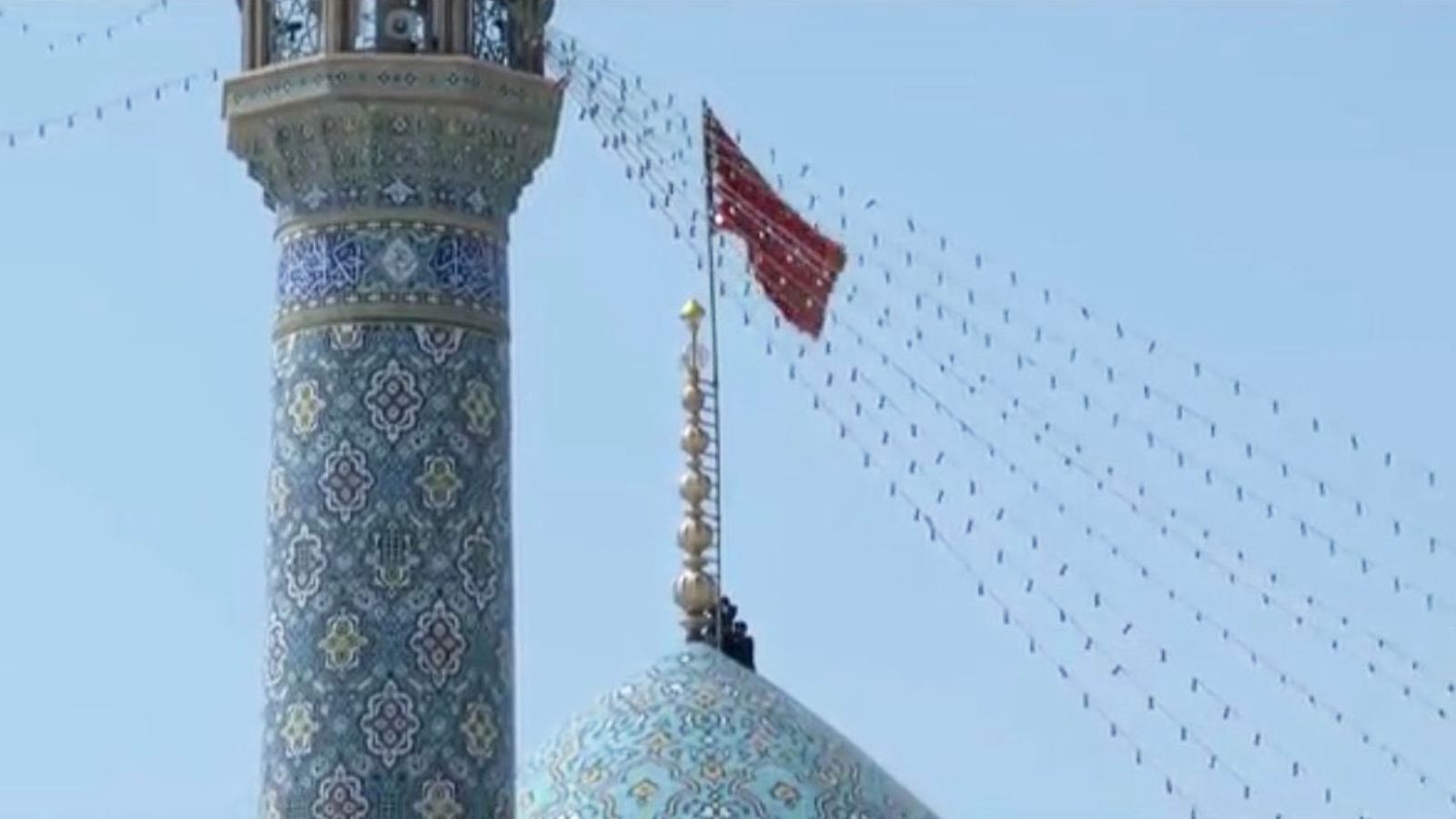
A red “flag of revenge” has been raised over the dome of the Jamkaran Mosque, a major religious site in Iran’s holy city of Qom, following the reported killing of Ayatollah Ali Khamenei in a joint US–Israel airstrike.
The symbolic act is widely interpreted in Iran as a declaration of justice and retribution. According to multiple media reports, the red banner reflects mounting anger among supporters as regional tensions escalate sharply.
`
Khamenei, 86, was killed in an airstrike in Tehran on Saturday during coordinated US–Israeli military action, Iranian state media confirmed on Sunday.
The announcement triggered protests and mourning in several countries, including India. Meanwhile, reactions from Washington and Tel Aviv underscored the geopolitical significance of the development.
MUST READ: Video: Explosions rock Tehran after Israel strikes heart of ‘terror regime’
US President Donald Trump said in a statement: “Khamenei, one of the most evil people in history, is dead.”
He added: “This is the single greatest chance for the Iranian people to take back their country.”
Israeli Prime Minister Benjamin Netanyahu said there were “many signs that this tyrant is no longer alive,” and addressed Iranians directly:
“This is your time to join forces, to overthrow the regime and to secure your future.”
Earlier, the Israel Defense Forces (IDF) described Khamenei as “the architect of the plan to destroy the State of Israel” and referred to him as the “head of the Iranian octopus.”
Symbolism of the Red Flag in Qom
The red flag atop Jamkaran Mosque carries deep religious symbolism in Shia Islam. Traditionally associated with martyrdom and a call for justice, it is rarely raised and typically signals extraordinary circumstances.
Cheers were reportedly heard on Tehran’s streets when early reports of Khamenei’s death emerged from Israel, even as plumes of smoke hovered over the district where he usually resided.
ALSO READ: Ayatollah Alireza Arafi named Iran’s interim supreme leader
However, state media coverage has focused on national mourning and defiance.
Iran Activates Interim Leadership Council
Following confirmation of Khamenei’s death, Iran activated Article 111 of its Constitution, initiating a temporary leadership structure.
State-linked ISNA reported that Ayatollah Alireza Arafi has been appointed as the jurist member of the three-member interim Leadership Council.
He joins:
- Masoud Pezeshkian, President of Iran
- Gholamhossein Mohseni Ejei, Chief Justice of Iran
The council will exercise the Supreme Leader’s constitutional powers until the Assembly of Experts selects a permanent successor.
State media repeated the announcement, emphasising Arafi’s clerical credentials and his membership in the Guardian Council.
What Happens Next for Iran?
Iran now faces a dual challenge: managing heightened military tensions with Israel and the United States while overseeing a sensitive leadership transition.
The Assembly of Experts will ultimately determine the next Supreme Leader. Until then, the interim council holds ultimate authority.
Meanwhile, the raising of the red flag at Jamkaran Mosque signals that Iran’s internal and external response is far from settled.