India-Pakistan Ceasefire | The Indian government on Tuesday firmly denied former US President Donald Trump’s assertion that he brokered a ceasefire between India and Pakistan in exchange for trade concessions, stating unequivocally that “the issue of trade did not come up” in any official dialogue during the military escalation.
The Ministry of External Affairs (MEA) issued a sharp rebuttal after Trump publicly claimed that his administration facilitated a “full and immediate ceasefire” during the recent India-Pakistan standoff by leveraging trade pressure on both sides.
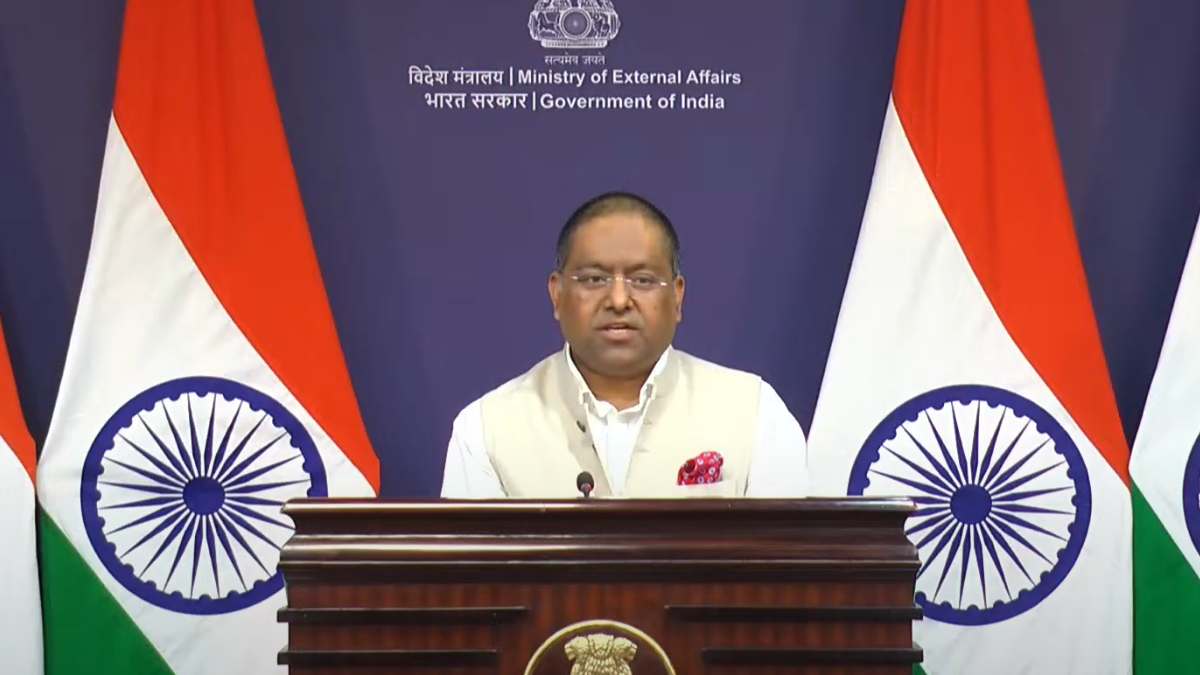
Watch the full address here:
Responding to widespread media queries, the MEA said that while Indian and US leaders were in contact during Operation Sindoor, which commenced on May 7, there was no discussion on trade-related matters.
“From the time Operation Sindoor commenced on May 7 till the understanding on cessation of firing and military action on May 10, there were conversations between Indian and US leaders on the evolving military situation. The issue of trade did not come up in any of the discussions,” read the MEA’s official statement.
This directly contradicts Trump’s recent remarks, in which he claimed credit for defusing a potential “nuclear war” and suggested that threats of halting US trade with both nations played a pivotal role in the ceasefire.
Operation Sindoor: Military Force, Not Mediation, Drove Ceasefire
Reaffirming India’s decisive military actions, the MEA revealed that Pakistan’s willingness to halt firing was a direct consequence of India’s powerful aerial offensive on May 10, which targeted key Pakistan Air Force bases.
ALSO READ: Modi’s Adampur speech in S-400 backdrop decimates Pakistan propaganda
“Early on May 10 morning, we had mounted an extremely effective attack on key Pakistan Air Force bases. That was the reason they were now willing to stop firing and military action. Let me be clear — it was the force of Indian arms that compelled Pakistan to stop its firing,” the statement emphasised.
India also outlined the timeline and procedural details leading to the ceasefire, clarifying that the Director Generals of Military Operations (DGMOs) of both nations held a phone call at 3:35 PM on May 10, during which the precise terms were agreed upon.
“The request for this call was received by MEA from the Pakistani High Commission at 12:37 PM. The Pakistani side had initial difficulties connecting the hotline due to technical reasons. The timing was then decided based on the availability of the Indian DGMO,” the ministry noted.
India Maintains Transparent, Consistent Global Messaging
Addressing speculation over international mediation, the MEA stated that India’s messaging to global leaders remained transparent and unchanged.
“As regards conversations with other nations, the message from India was clear and consistent… India was responding to the April 22 terrorist attack by targeting the terrorist infrastructure. However, if the Pakistani armed forces fire, the Indian armed forces will fire back; if Pakistan stops, India will also stop.”
ALSO READ: ‘Pakistani sena ko dhul chata diya’: Listen to PM Modi speech at Adampur Air Base
The MEA also clarified that this message was conveyed to the Pakistani side at the onset of Operation Sindoor, and that any foreign leaders who engaged with India during the operation were likely relaying India’s firm stance to Pakistan.
Trump’s Ceasefire Claims Draw Scrutiny
Trump’s attempt to attribute the India-Pakistan ceasefire to US mediation efforts has sparked backlash both in diplomatic circles and on Indian social media. Critics argue that his remarks appear to overstate Washington’s role while downplaying India’s strategic military execution.
Political commentators and defence analysts were quick to note that India’s ceasefire decision was the result of operational success, not foreign pressure.