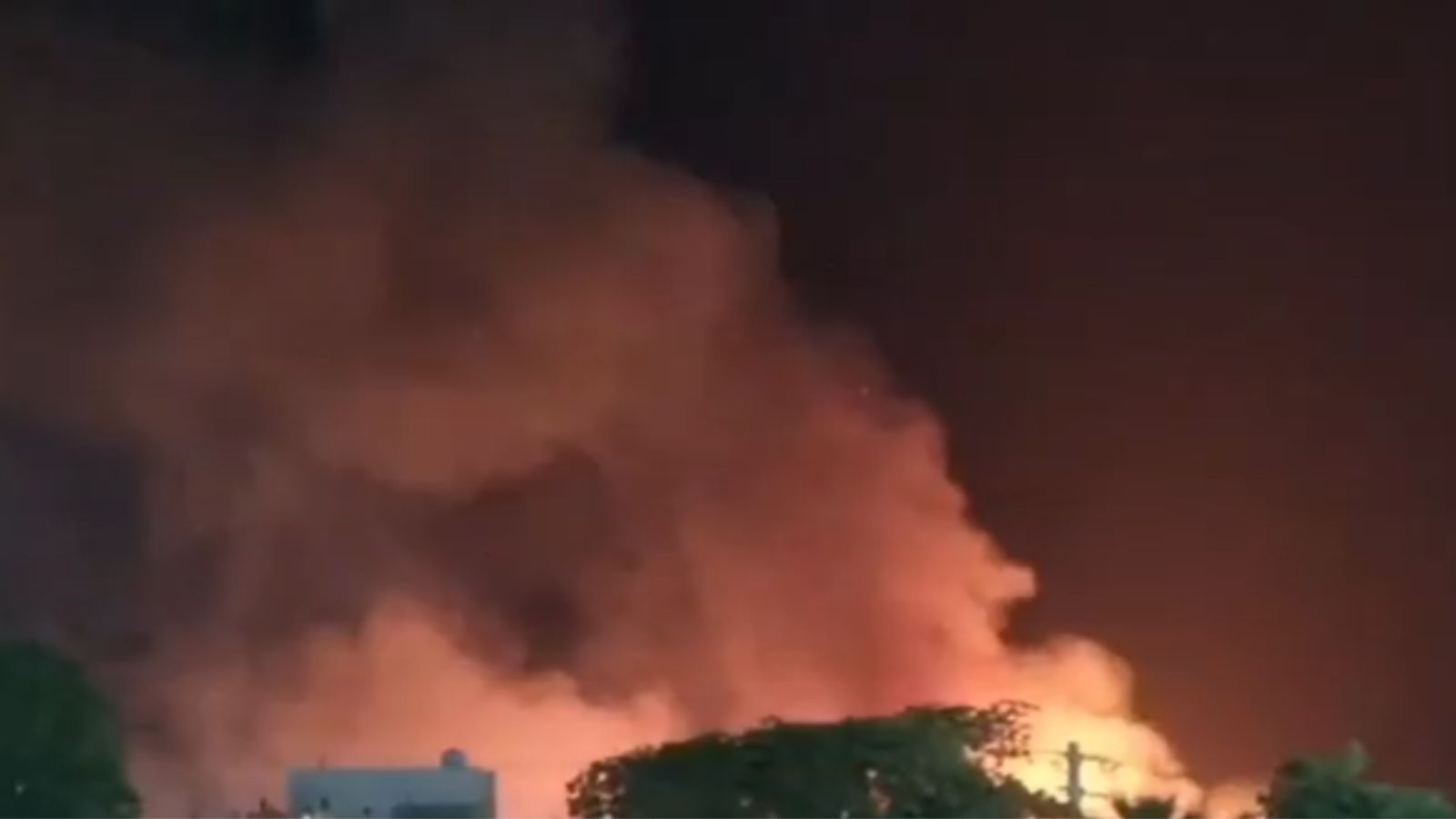
US President Donald Trump on Thursday shared images and a video purportedly showing a fresh American strike on an airbase in Iran’s southeastern city of Iranshahr, as the United States carried out military operations against Iranian targets for a second consecutive day.
The latest strikes came amid rapidly escalating tensions between Washington and Tehran, with both sides exchanging military action following attacks on commercial shipping in the Strait of Hormuz. Trump also warned that any further Iranian aggression would be met with a significantly stronger US response.
Trump renews warning to Iran
Speaking to reporters aboard Air Force One, Trump claimed Iran was seeking to revive negotiations despite the recent escalation in hostilities.
Footage of U.S. strikes on Chabahar Iran, and across southern Iran
These attacks are violent pic.twitter.com/JLYGMhqGOo
— Ryan Rozbiani (@RyanRozbiani) July 8, 2026
“Iran called a while ago. They want to make a deal so badly. I just don’t know if they are worthy. I don’t know if they are going to honour the deal. That’s the problem,” Trump said.
The US President did not identify who had contacted Washington or provide details of the alleged communication.
Trump also reiterated earlier threats to target additional Iranian infrastructure if tensions continue to escalate. He said the US military could strike Iran “20 times harder” than Tehran targets commercial shipping in the Strait of Hormuz, while also referring to possible action against critical infrastructure and the strategic oil export hub of Kharg Island.
His remarks came a day after he declared that, in his view, the interim memorandum of understanding (MoU) between the United States and Iran was effectively “over”, although he said negotiations could continue.
Fresh US strikes reported across southern Iran
Iranian state media reported explosions at several locations along the country’s southern coastline following the latest wave of US attacks.
🇺🇸🇮🇷⚡️ Two docks and a maritime traffic control tower in Chabahar were targeted by USAF strikes.
▶️ Iranian outlets also confirmed efforts are underway to restore power in the city, which was cut off after three power lines were damaged. pic.twitter.com/wELq3hYEFp
— War Flash (@WarFlash_2630) July 8, 2026
Among the locations mentioned were Bushehr, home to Iran’s only operational nuclear power plant, as well as the port cities of Bandar Abbas, Sirik, Chabahar and Konarak. Reports also said an airbase in Iranshahr, which has been partially used by the Islamic Revolutionary Guard Corps (IRGC), was struck.
The strikes followed earlier US military action targeting Iranian assets after attacks on commercial vessels in the Strait of Hormuz.
Iran retaliates with attacks on Gulf states
Iran responded by launching attacks targeting US military facilities in Bahrain, Kuwait and Qatar, widening fears of a broader regional conflict.
According to the Associated Press, the latest Iranian attacks appeared more extensive than previous retaliatory operations. However, there were no immediate reports of significant damage in the three Gulf countries. Kuwait’s military said its air defence systems were intercepting incoming drones and missiles.
The exchange of attacks has further strained efforts to preserve an interim agreement intended to prevent the conflict from expanding.
Iranian leaders reject Trump’s threats
Senior Iranian officials strongly criticised Trump’s latest remarks and insisted Tehran would continue to defend its interests.
Parliament Speaker Mohammad Bagher Ghalibaf, who has played a central role in negotiations with the US, said the Strait of Hormuz would operate only under arrangements approved by Iran.
In a post on X, Qalibaf warned that any attack on Iran would draw a direct response, accusing Washington of repeatedly violating its commitments.
Deputy Foreign Minister Kazem Gharibabadi also condemned Trump’s comments, arguing that threats and sanctions had failed to force Iran to change its policies.
Foreign Minister Seyed Abbas Araghchi described Trump’s language toward Iran as unacceptable, saying the country would respond through actions rather than rhetoric.
Military adviser Mohsen Rezaei also warned that those responsible for attacking Iran would face severe consequences.
Strait of Hormuz remains at the centre of crisis
The latest confrontation comes as tensions continue to centre on the Strait of Hormuz, one of the world’s most important energy corridors.
Following recent attacks on commercial tankers, Tehran has insisted that ships use routes designated by Iranian authorities and has indicated that it intends to regulate passage through the waterway. The United States and its allies have rejected that position, arguing that international shipping must remain free from unilateral restrictions.
The current military escalation has raised fresh concerns over global energy supplies and maritime security, with oil prices already reacting sharply to fears of prolonged instability in the Gulf.
Why it matters
The exchange of military strikes has cast fresh uncertainty over diplomatic efforts between Washington and Tehran. With both sides continuing military operations while leaving the door open to negotiations, the risk of a wider regional conflict remains high.
Any prolonged disruption in the Strait of Hormuz could have significant implications for global oil markets, international shipping and geopolitical stability across the Middle East.