Written by Tanisha Mishra
Deaf children often grow up navigating two worlds—one of sound they cannot access, and another of silence that society often fails to understand. While their minds are as curious and creative as any other child’s, the absence of hearing becomes a barrier—not because of the condition itself, but due to community perception, lack of support, and systemic neglect.
In many societies, deafness is still viewed through a lens of pity or deficiency. Communities often assume deaf children are intellectually limited, emotionally isolated, or incapable of full participation in daily life. These harmful stereotypes restrict opportunities, damage self-esteem, and reinforce a culture of silence around the rights and needs of deaf individuals.
Perception vs. Reality: Community Misunderstanding
The harsh reality is that deaf children continue to face stigma, isolation, and exclusion—despite having the same potential as their hearing peers. Instead of being accepted as equals, they are often marginalized and underestimated.
As Snigdha Sarkar, President of Anwesha Kolkata, puts it: “Every deaf person, every baby born with deafness has the potential and the right to be completely on par with their peers—provided they receive early identification, intervention, and the right support from society and the community.”
Unfortunately, such support is lacking. Special schools for deaf children in India, Sarkar points out, are “mostly not up to the mark” and often fail to offer quality education or real learning outcomes. On the other hand, mainstream or general schools, though promoted under the idea of inclusive education, are largely unprepared to meet the needs of deaf students.
ALSO READ: Cafe, culture, and Calcutta: Inside Smaranika — the tram that teaches history
“Although we have been talking about inclusive education for years, it is still not in place. Deaf students often find themselves completely alone in a setup that does not understand or accommodate them,” says Sarkar. “The curriculum, classroom transaction, and evaluation methods are not suitable for them, even though they have the potential.”
Systemic Challenges
Beyond education, deaf individuals face serious obstacles in employment and social inclusion. Capable and qualified deaf youth struggle to find job opportunities due to discriminatory attitudes and lack of accessible workplaces.
“Even if they are capable and deserving, they do not get livelihood opportunities. The challenge is not the disability—it’s the stigma,” she explains.
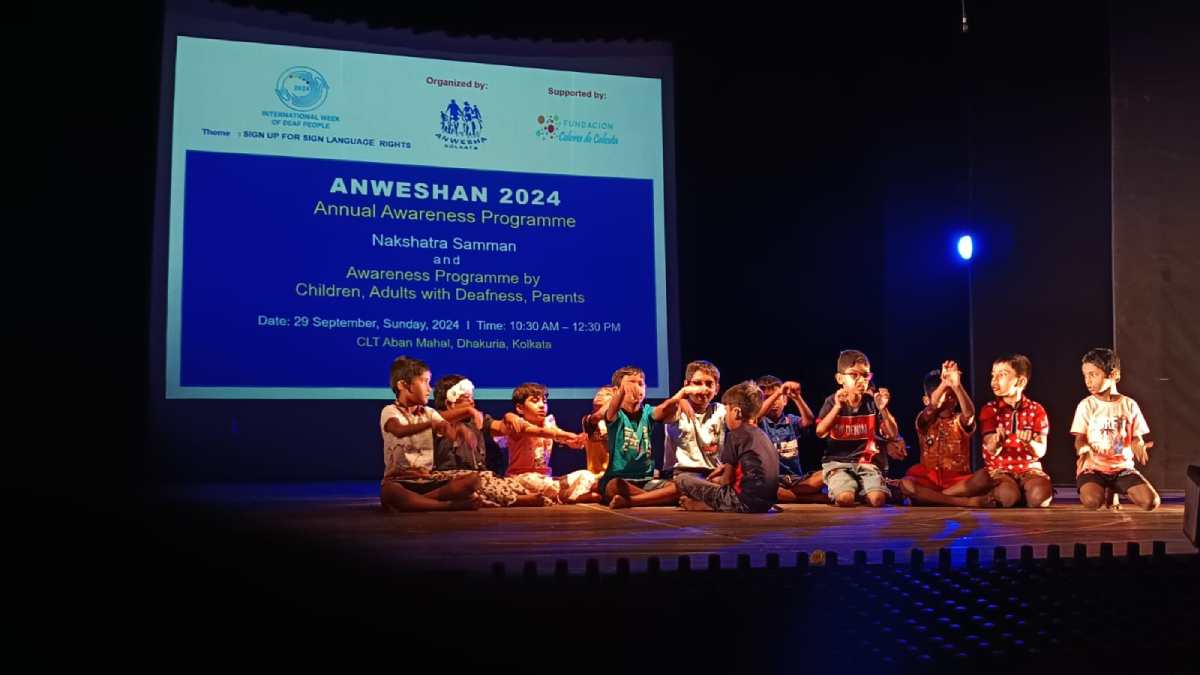
Anwesha Kolkata organises annual functions where children can express themselves freely and confidently. (Photo: Specially arranged)
While legal frameworks do exist, implementation remains weak. Sarkar highlights key policies like the Persons with Disabilities Act (1995), the United Nations Convention on the Rights of Persons with Disabilities (2006), and the Rights of Persons with Disabilities Act (2016). But, she adds: “Nine years have passed since the 2016 Act, and very little has been implemented. Some measures are in place, but they are grossly inadequate.”
How Anwesha Kolkata Is Creating Change
Anwesha Kolkata, a parent-led NGO founded in 2004, is tackling these challenges head-on. It provides early intervention, language development, counselling, and skill-building programs for deaf and hard-of-hearing children. What makes Anwesha stand out is its belief in total participation and empowerment.
“We organize annual programs where every child takes part. Be it Rabindra Jayanti, Holi celebrations, or our annual function—we create spaces where children can express themselves freely and confidently,” says Sarkar.
ALSO READ: Did you know it took a shipwreck and deaths of over 700 passengers to forge the Kolkata-Puri rail link?
The focus is on exploring diverse avenues—arts, technology, academics—and proving that deaf children are not limited by their condition, but by how the world treats them. Anwesha also trains parents, helping them understand how to support their children effectively, while advocating for better public awareness and inclusive policies.
“Our biggest challenge is mindset. Society looks at the disability first, not the person,” she says. “Change will only come when schools, teachers, the government, and communities start seeing deaf children as equals—not as exceptions.”