Written by Shruti Singh
In the bustling heart of Esplanade, amid the honks of buses and the footfall of shoppers, stands a wooden tram car frozen in time. But this isn’t just any tram—it’s Smaranika, a one-of-a-kind tram museum and café that rolls back Kolkata’s wheels of time.
Conceived in 2014 by Nilanjan Sandilya, then Managing Director of the Tram Company, the idea was simple yet visionary: preserve the fading legacy of trams in a city that once ran on them.
Nilanjan Sandilya was deeply aware that modern Kolkata was forgetting one of its oldest forms of public transport. “There is no dedicated museum or archive that preserves tram history,” he had said, convinced that the younger generation needed a living classroom on tracks.
Backed by the West Bengal Transport Department, his idea came to life inside a 1938 wooden tram car, originally brought from Bombay. It became Smaranika—a nostalgic space that now educates, entertains, and evokes pride.
Jalaluddin Shaikh, who has worked with the Smaranika Tram Museum since its inception, remembers the early days with a smile. “When it was launched in 2014, we had 200-plus visitors every single day,” he said during a brief interaction. The novelty of a tram-turned-museum drew crowds from across Kolkata and beyond. But time hasn’t been kind.
ALSO READ: Did you know it took a shipwreck and deaths of over 700 passengers to forge the Kolkata-Puri rail link?
“Today, we hardly get 50 to 80 visitors a day,” he added. “The idea was noble—especially for students and youngsters—but maintenance and public promotion have gone down.”
Inside Smaranika
Step into Smaranika, and you’re instantly transported into a different era. The tram is divided into two parts—the front half is a cozy café, while the rear half houses a museum that brims with memories. Among the prized exhibits are caps worn by drivers and conductors from 1902, batch insignias of traffic staff since 1905, and rare mechanical parts like spherical roller bearings, wheel bearings, and Steve-bearing type 2 used after 1917.
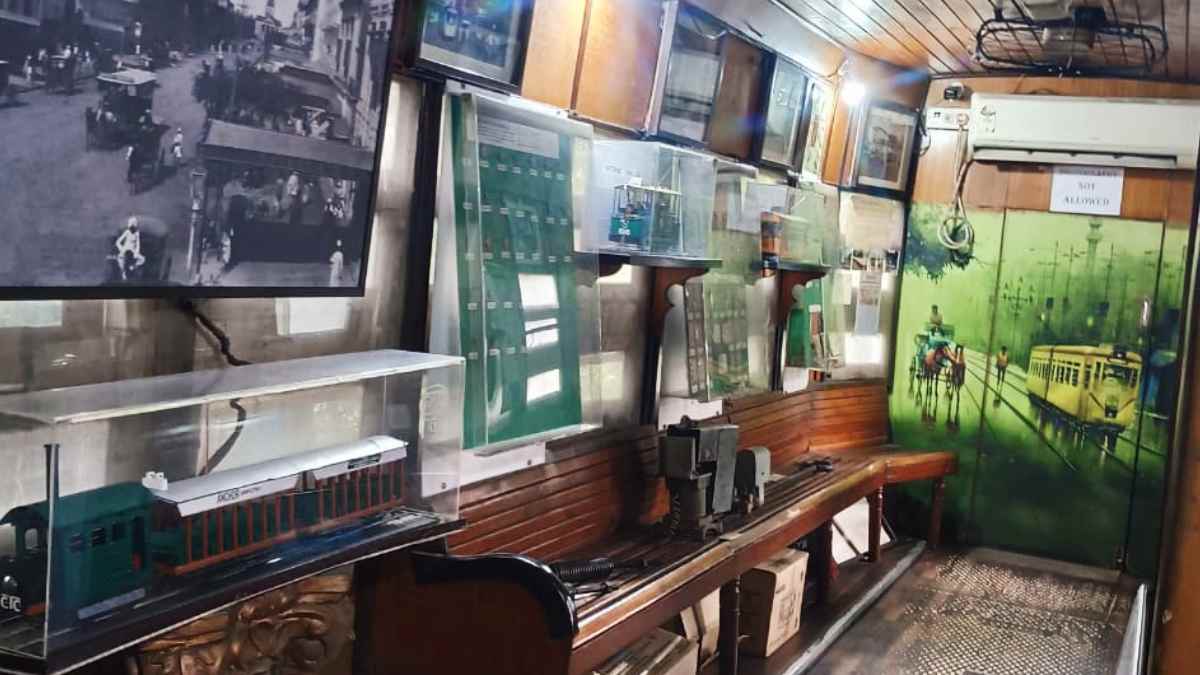
You’ll find miniature models of trams, including the Omnibus, the Armenian Ghat terminus, and the Bokala Tram Car inside the museum. (Photo by Shruti Singh)
You’ll find miniature models of trams, including the Omnibus, the Armenian Ghat terminus, and the Bokala Tram Car. A special model of the Byomkesh Bakshi Tram, made for a Bollywood shoot in 2013, also finds its place here. Artefacts such as old coins (annas, paise, kana), voltmeter, ammeter, and a unique Swiss security clock showcase the intricate functioning of the tram system. And then there are the black-and-white photographs—capturing the charm of British-era Calcutta and the city’s once-thriving tram culture.
ALSO READ: In a world of emails, this man still writes letters for others outside Kolkata GPO — Meet Shyam Narayan Shaw
If the museum is the brain, the café is its heart. The idea of sipping tea inside a vintage tram parked in central Kolkata is as charming as it sounds. Initially, the café offered a variety of snacks, but over the years, the menu has been trimmed down due to lack of funds and maintenance. Today, you can still enjoy tea, coffee, biscuits, and water under wooden fans and vintage lights, surrounded by wooden tables and green trees outside—a perfect setting for friends, family, or quiet reflection.
Shaikh, though concerned about the decline in visitors, remains hopeful. “The place still holds magic. People write beautiful messages on our comment board. Some come just to sit quietly inside the tram,” he said. He emphasized how more awareness, government support, and school visits could rejuvenate the space. “The purpose was never just nostalgia. It was about education—reminding the city of its journey, its innovation, and its cultural identity.”
Smaranika is more than a museum; it’s Kolkata’s attempt to hold on to its heritage in the face of rapid modernization. In a world rushing toward bullet trains and electric cabs, this old tram reminds us of a gentler time—when the journey mattered as much as the destination. For just Rs 20 and 45 minutes of your time, Smaranika offers not just a history lesson, but a soulful ride back to a forgotten Kolkata.
History of trams in Kolkata
The journey of Kolkata’s trams dates back to February 24, 1873, when the first horse-drawn tram ran. Discontinued the same year, trams made a comeback in 1880. By 1882, steam-driven trams were introduced, only to be replaced due to pollution concerns raised by locals. In 1902, electric trams became the city’s new lifeline, marking Kolkata as the first Indian city to adopt electric-powered trams.
ALSO READ: Kolkata’s Saturday coin market: Where history is sold by the Rupee
The timeline continues through the 20th and 21st century: steel-body trams in 1982, AC trams in 2013, and the Smaranika Museum in 2014—each phase a reflection of the city’s evolving transportation story. Recently, Kolkata’s tram system has been significantly scaled back.