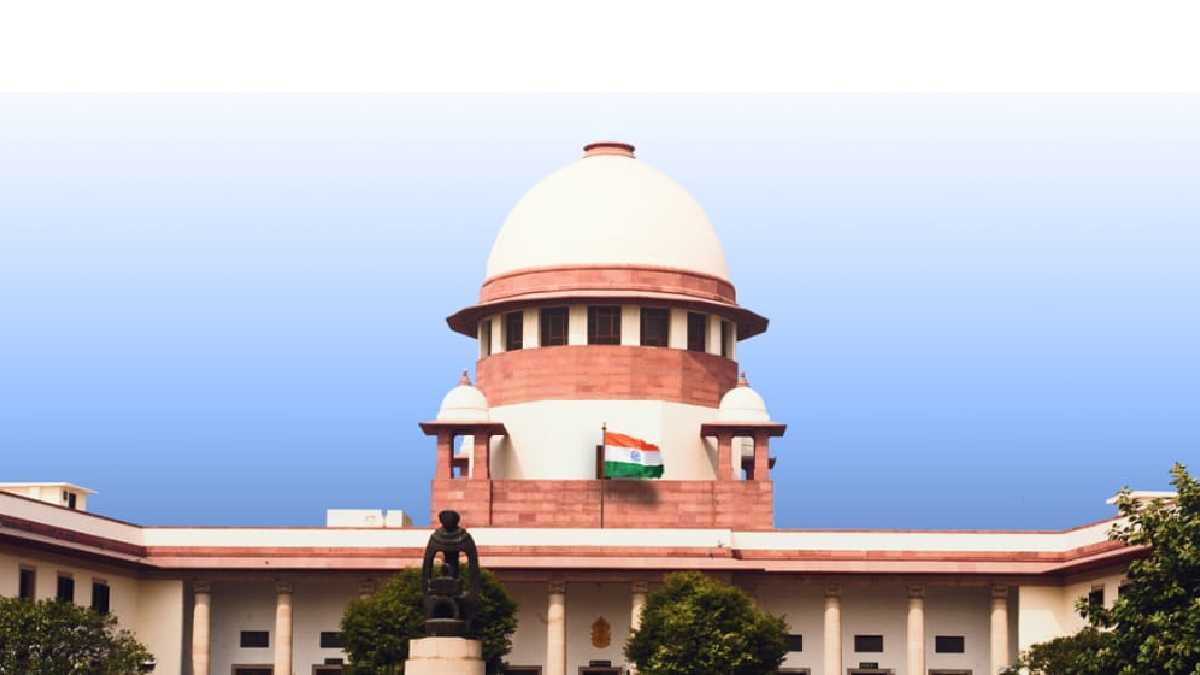
Supreme Court Ruling on Private Property: In a significant ruling, a nine-judge Constitution Bench of the Supreme Court, led by Chief Justice of India DY Chandrachud, held that only certain types of private property could potentially be considered community resources. The ruling was decided with an 8-1 majority, addressing the complex issue of how privately owned resources can be classified and controlled for the welfare of the community.
Key Points of the Judgment
The judgment centers on Article 31C of the Indian Constitution, which protects State laws enacted to fulfill directive principles of state policy. Among these directives is Article 39B, which directs the State to ensure that the community’s resources are distributed to serve the public good. The bench, with Chief Justice Chandrachud at the forefront, emphasized the need for clarity on what qualifies as “material resources” for the community.
ALSO READ: Ahead of Maharashtra polls, a Supreme Court setback for Sharad Pawar’s NCP — Clock to remain with Ajit Pawar
Chief Justice Chandrachud, in his opinion shared with six other judges, questioned the scope of Article 39B: “Does material resource of a community used in 39B include privately owned resources? Theoretically, the answer is yes… However, this court is unable to subscribe itself to the minority view of Justice Iyer in Ranganath Reddy. We hold that not every resource owned by an individual can be considered a material resource of a community.”
Individual Opinions and the Minority Dissent
Three separate judgments were presented. Chief Justice Chandrachud authored one judgment for himself and six other judges, Justice BV Nagarathna wrote a concurring opinion, while Justice Sudhanshu Dhulia offered a dissenting view. This nuanced approach highlights the complexity of balancing individual property rights against collective community welfare.
Justice Chandrachud elaborated on the factors required to determine whether a privately owned asset could qualify as a community resource under Article 39B. He specified that a case-by-case approach is necessary, with criteria such as the nature and characteristics of the resource, its scarcity, and its impact on public welfare.
A Case-Specific Approach to Community Resources
The Chief Justice’s judgment underscores that not all private assets are eligible to be treated as resources for public use. Each case must consider factors such as the resource’s scarcity, the implications of private ownership, and the overall community impact. He cited the “public trust doctrine,” which may guide the court in deciding which resources can genuinely serve the community as material assets.
“The enquiry about the resource in question falls under 39B must be contest-specific,” Justice Chandrachud stated. “It is subject to factors such as nature of the resource, characteristics, impact on community well-being, scarcity, and consequences of concentration in private hands.”
Implications of the Judgment
This ruling offers a framework that protects private property from indiscriminate classification as community resources, while also providing flexibility to identify truly essential assets for public welfare. By balancing individual ownership rights and public interest, the Supreme Court has set a precedent that could influence future cases involving the State’s right to acquire private property for the common good.