US President Donald Trump on Thursday unveiled his much-anticipated tariff plan as a part the “Liberation Day”. This newly revealed plan proposes to impose tariffs on nearly 60 nations that the Trump administration thinks have the most unfair trade restrictions on American goods. This list also includes India, which now has been slapped with 26% tariffs to every item it exports to the US.
This action has been taken as a part of Trump’s plan to balance trade with countries around the world and to boost manufacturing within America.
Thank you, Mr. President!
I am honored to serve the American people every single day here at the People’s Department — We will make eggs affordable again! pic.twitter.com/90WvWk4tdE
— Secretary Brooke Rollins (@SecRollins) April 3, 2025
In his speech at the Rose Garden of the White House, Trump said these new reciprocal tariff rates have been kept at half of what each of these countries levy on US-made goods. The tariffs also take account of the alleged currency manipulation and trade barriers mounted by the countries. Along with these reciprocal tariffs, Trump also announced a baseline tariff rate of 10% on all US imports.
How will the new tariffs on India be calculated?
According to Trump, these reciprocal tariffs on India have been set at half the rate it levies on US products, which according to the US President is at 52%. He added that while America charges a tariff of 2.4% on motorcycles, India charges 70%. He also asserted that in case of automobiles, India charges tariffs at 70%.
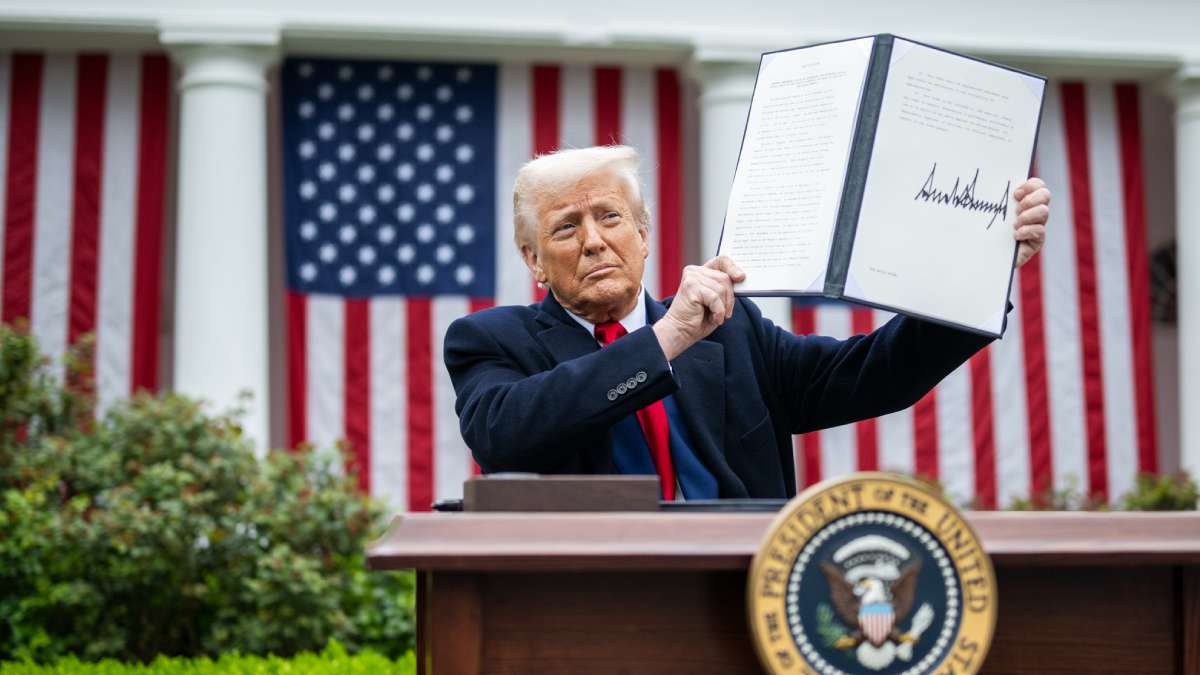
According to US trade representatives, the total bilateral trade between India and US in terms of goods was worth an estimated $129.2 billion in 2024. (Photo: The White House/X)
During his speech while announcing the tariffs, Trump said, “India – very, very tough. The prime minister just left and he’s a great friend of mine. But I said, ‘You’re a friend of mine but you’ve not been treating us right. They charge us 52%.”
How India reacted to Trump’s tariffs
While the Indian government is yet to react, experts familiar with this matter said in light of PM Modi’s upcoming visit to Thailand to attend a BIMSTEC Summit in Bangkok on April 4, any official response on this matter will come after he and his team reaches the Thai capital.
ALSO READ: US sends B-2 stealth bombers, other warplanes to Middle East amid rising tensions with Iran
During their last meeting in Washington in February, Modi and Trump had set a target of taking the Indo-US bilateral trade to $500 billion by 2030 and also agreed to negotiate the first tranche of a mutually beneficial, multi-sector bilateral trade agreement (BTA) by the end of 2025.
This deal is aimed at improving bilateral trade across goods and services, increasing market access, reducing tariff and non-tariff barriers, and deepening supply chain integration. US assistant trade representative Brendan Lynch had also visited India last month with his team for talks with the Indian officials aimed at setting the terms of reference of this proposed Bilateral Trade Agreement, where he also said that the two sides are ready to start negotiations on this matter.
How big is Indo-US trade?
According to US trade representatives, the total bilateral trade between India and US in terms of goods was worth an estimated $129.2 billion in 2024. US exports accounted for $41.8 billion, up 3.4% over the figure for 2023, while Indian exports amounted to $87.4 billion, up 4.5% over the figure for 2023.
According to Indian officials, the US was India’s largest trading partner during the fiscal year 2023-24, where India had gained a surplus of $35.31 billion. The US market is a major destination of Indian service exports which touched the figure of $337.5 billion in 2023.