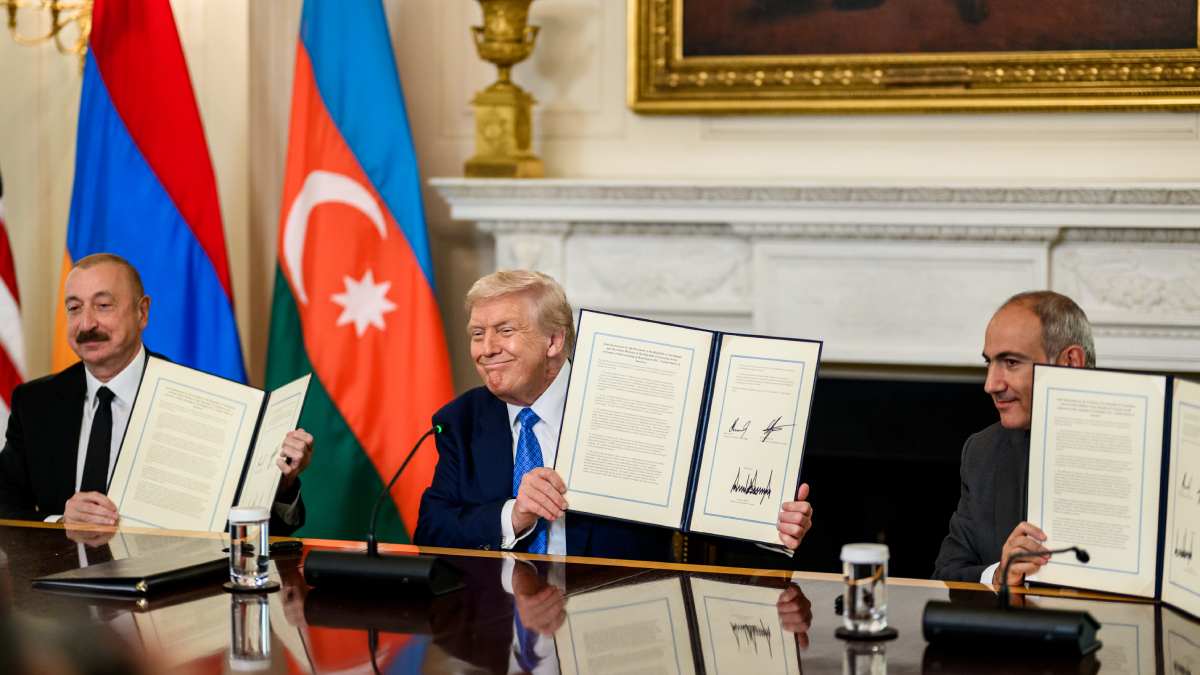
In a landmark move towards resolving decades of conflict, Azerbaijan and Armenia on Friday signed a US-brokered peace agreement during a trilateral meeting with US President Donald Trump at the White House. The accord aims to normalise relations between the two South Caucasus neighbours and expand bilateral economic cooperation.
Flanked by Azerbaijani President Ilham Aliyev and Armenian Prime Minister Nikol Pashinyan, President Trump hailed the development as a historic breakthrough. “It’s a long time – 35 years – they fought and now they’re friends, and they’re going to be friends for a long time,” he said during the signing ceremony.
The agreement commits both nations to cease hostilities, establish diplomatic relations, and respect each other’s territorial integrity. It also grants the United States exclusive development rights to a strategic transit corridor in the South Caucasus, intended to boost exports of energy and other resources.
“As President, my highest aspiration is to bring peace and stability to the world.” – President Donald J. Trump pic.twitter.com/mDSJ2GRsHl
— The White House (@WhiteHouse) August 9, 2025
Strategic Corridor and Expanded Cooperation
According to the White House, the deal includes separate bilateral agreements with each country to strengthen cooperation in energy, trade, and technology, including artificial intelligence. Restrictions on US defense cooperation with Azerbaijan have also been lifted.
ALSO READ: China welcomes Modi for SCO summit; meet between PM, Xi & Putin likely?
US officials said the so-called Trump Route for International Peace and Prosperity has already attracted interest from nine companies, including three American firms. Armenia plans to award exclusive development rights for the corridor to the United States for an extended period.
Regional Impact and Global Reactions
Experts say the agreement could reshape the South Caucasus, an energy-rich region bordering Russia, Europe, Turkey, and Iran. Brett Erickson, a sanctions adviser, said the deal could help the West address gaps in sanctions enforcement. “The Caucasus has been a blind spot in sanctions policy. A formal peace creates a platform for the West to engage Armenia and Azerbaijan… to shut down the evasion pipelines,” he noted.
Tina Dolbaia of the Center for Strategic and International Studies called the signing a symbolic milestone but cautioned that many details remain unresolved, including control of the transit corridor and the extent of each country’s involvement. Olesya Vartanyan, a regional expert, warned that without sustained US engagement, tensions could resurface.
Both Aliyev and Pashinyan praised Trump’s role in ending the conflict and said they would nominate him for the Nobel Peace Prize.