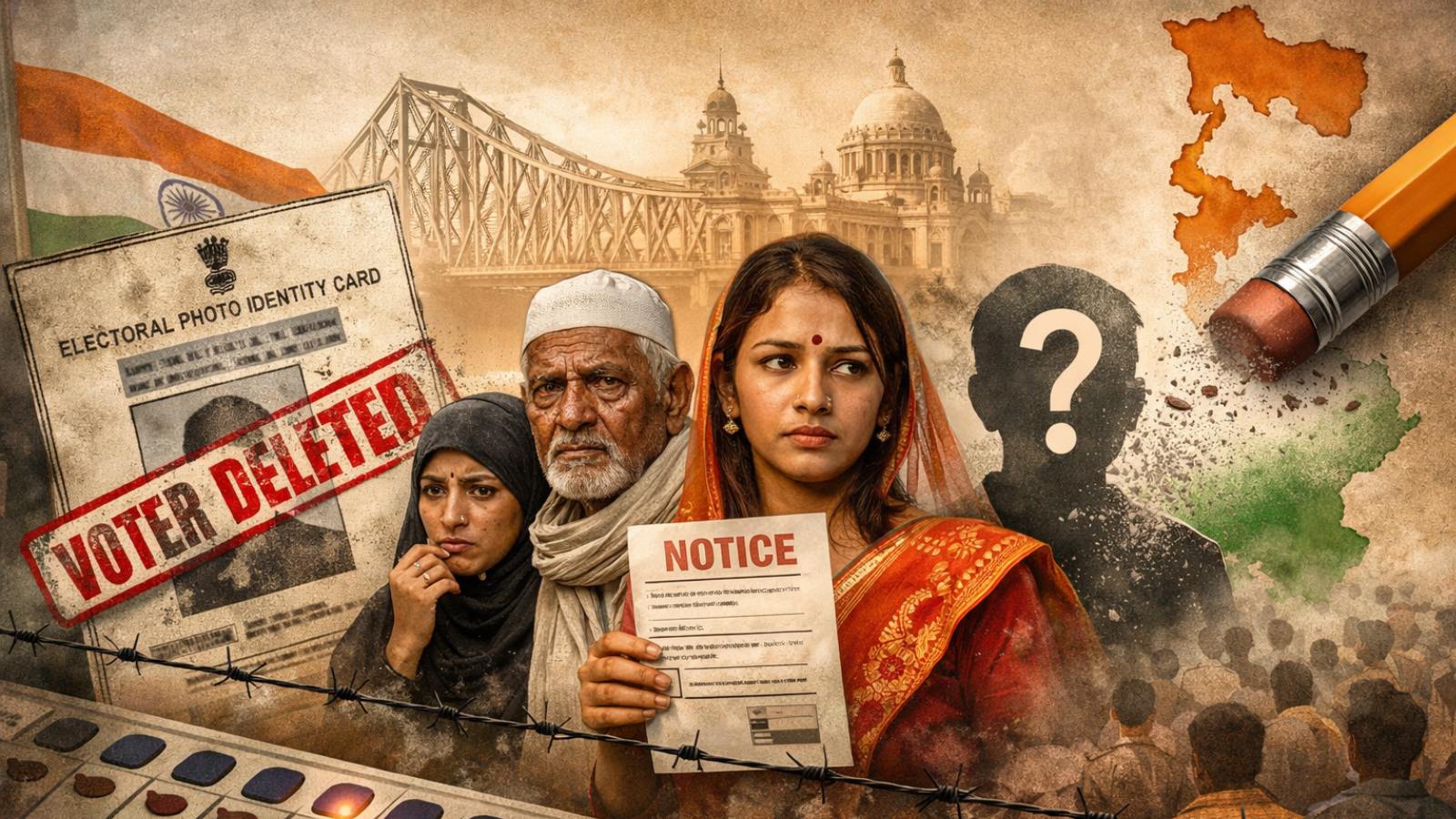
West Bengal SIR Voter Deletion: As announced by the Election Commission of India (ECI), the process of Special Intensive Revision (SIR) of electoral rolls began on November 4 last year across 17 states and Union Territories, including West Bengal. The process is now nearing completion. The Commission has already published final electoral rolls in several states, while in the case of West Bengal, the timeline for publication has been fixed by the Supreme Court of India.
`
However, the revision process in West Bengal has been marked by multiple controversies. The most serious allegation concerns the neutrality of the Commission. The Chief Minister of the state personally argued before the Supreme Court against the Commission’s actions. Opposition parties in West Bengal have repeatedly questioned the transparency of the voter list revision process. During the course of the exercise, at least ten Booth Level Officers (BLOs) reportedly died by suicide in the state — an unprecedented development.
The primary allegation against the Commission is that under the pretext of voter roll purification, a process of citizenship verification is being carried out. Critics argue that, in the name of intensive revision, the objective is to disenfranchise citizens belonging to religious minority communities in West Bengal. This raises a critical question: who will ultimately be excluded from the final electoral rolls of West Bengal?
Demographic Context
According to the 2011 Census, West Bengal is home to 2.46 crore Muslims, constituting 27.1% of the state’s total population. In several districts, the Muslim population is comparatively higher:
Murshidabad district – 66.3% Muslim population
Malda district – 51.3% Muslim population
Uttar Dinajpur district – 49.9% Muslim population
As per the 2025 electoral rolls, West Bengal has approximately 7.6 crore voters. It is evident that in districts such as Murshidabad, Malda, and Uttar Dinajpur, a large proportion of voters belong to the Muslim community.
MUST READ: Shaving kits, undergarments and more: Demands in BSNL director’s Prayagraj itinerary which drew show-cause notice
During the first phase of the SIR process, after enumeration forms were collected, it was observed that the percentage of voters with data discrepancies—termed “unmapped voters” by the Commission — was relatively low in these districts. For example, in Murshidabad, only 2% of voters were reported to have data discrepancies.
When the draft voter list was published, 58 lakh names were excluded across the state. Based on these figures, claims made by the Leader of the Opposition regarding massive irregularities appeared statistically unfounded. In Malda, Murshidabad, and Uttar Dinajpur, the number of deletions from the draft rolls was not mathematically abnormal.
Expansion of Notices
Following the publication of the draft list, the Commission stated that hearing notices would be issued only to those unable to establish linkage with the 2002 electoral rolls. However, in practice, this did not hold.
So far:
- 30 lakh voters received notices due to data discrepancies.
- 2 crore voters were summoned for hearings due to what the Commission termed “logical discrepancies.”
- In total, the voting rights of approximately 1.5 crore voters in West Bengal remain uncertain. Alongside this uncertainty looms the fear of potential loss of citizenship status.
Who are these 1.5 crore people?
Those receiving hearing notices for logical discrepancies reportedly include large numbers from Muslim communities, the Matua community, migrant workers, and married women.
In Murshidabad, where only 2% of voters initially had data discrepancies, nearly 66% of voters have now reportedly received hearing notices on grounds of logical discrepancies. In Malda, nearly 10 lakh voters have been called for hearings for similar reasons.
Findings from Independent Research
A study by the voluntary research organization SABAR Institute presents striking statistics. In the Metiabruz Assembly constituency of South Kolkata, 88% of voters have reportedly been summoned for hearings. Around 60% of voters in this constituency belong to the Muslim community.
In Bhawanipur, 52% of Muslim voters have reportedly received notices, while Muslims constitute about 22% of the electorate there. In Ballygunge and Kolkata Port constituencies, 77% and 81% of Muslim voters, respectively, have reportedly been called for hearings.
If such figures are accurate for central Kolkata constituencies, one can imagine the scenario in rural Bengal—especially considering that 82% of the Muslim population in West Bengal resides in rural areas.
Matua Community and Border Districts
In vast stretches of North 24 Parganas district, particularly near the Bangladesh border, members of the Matua community reside in significant numbers. Approximately 10–15 lakh Matua Hindus are spread across constituencies such as Gaighata, Bagda, Bongaon North and South, Ashoknagar, and Haroa.
ALSO READ: Moments after drawing SC ire, NCERT to remove portion on judicial corruption
Around 30% of the Matua community reportedly could not establish linkage with the 2002 voter rolls. In many Matua-dominated areas, nearly 40% of residents have received hearing notices. For a community that migrated from Bangladesh as religious refugees and settled as economically vulnerable groups, their voting rights now appear uncertain.
Migrant Workers and Absenteeism
Already, 58 lakh names were excluded from the draft list. During the hearing phase, approximately 5 lakh voters were reportedly absent.
In Nadia district, 12–18% of residents migrate to other states for work, many of them Hindu migrant workers. According to Commission data, nearly five lakh hearing notices were issued in Nadia alone, of which around one lakh recipients reportedly did not collect the notices.
Married Women and Naming Conventions
In Bengali Hindu society, women traditionally adopt their husband’s surname after marriage. Similar practices exist among non-Bengali Hindu communities. In contrast, many Muslim women use suffixes such as “Bibi” or “Khatun,” with limited use of surnames.
It is alleged that automated or AI-driven verification systems may not adequately interpret these cultural naming practices. As a result, a large number of Bengali Hindu and Muslim women now face uncertainty regarding their voting rights.
Assam, NRC, and Political Context
Meanwhile, the Chief Minister of Assam has publicly stated his intent to act against so-called “Miya Muslims.” Assam remains the only state where the National Register of Citizens (NRC) has been implemented under a “double-engine” government. Nearly 19 lakh people were excluded from the NRC list, including a majority of Bengali Hindus, while an estimated 8 lakh Muslims were also left out.
Political observers suggest that aggressive citizenship exercises have posed electoral challenges in Assam. Whether a similar rapid voter list revision ahead of the upcoming West Bengal Assembly elections could create difficulties for the state’s principal opposition party remains to be seen.
In this large-scale purification exercise, it is evident that economically vulnerable and marginalized communities—poor citizens, minorities, migrant workers, and women—have faced significant distress. Whether such distress will override religious polarization politics is a question only time can answer.
Questions on Institutional Neutrality
Concerns regarding the role and neutrality of the Election Commission in West Bengal’s SIR process arise from broader political contexts. Even the Supreme Court’s observations have indicated the sensitivity of the matter.
During the revision process, West Bengal Leader of the Opposition claimed that around 1.5 crore illegal Bangladeshi Muslim infiltrators, including Rohingya, were residing in the state. No verifiable evidence has yet substantiated this claim. Irresponsible political rhetoric before elections is not new to Indian politics. However, critics argue that such statements contribute to religious polarization, and some see reflections of this polarization in the functioning of a constitutional institution like the Election Commission.
As West Bengal approaches its 18th Assembly elections, critical questions remain: Is the principal opposition attempting to influence the Election Commission for political ends?
Is the Commission, by invoking administrative mechanisms, risking the disenfranchisement of women, migrant workers, and minority communities?
These questions will persist.