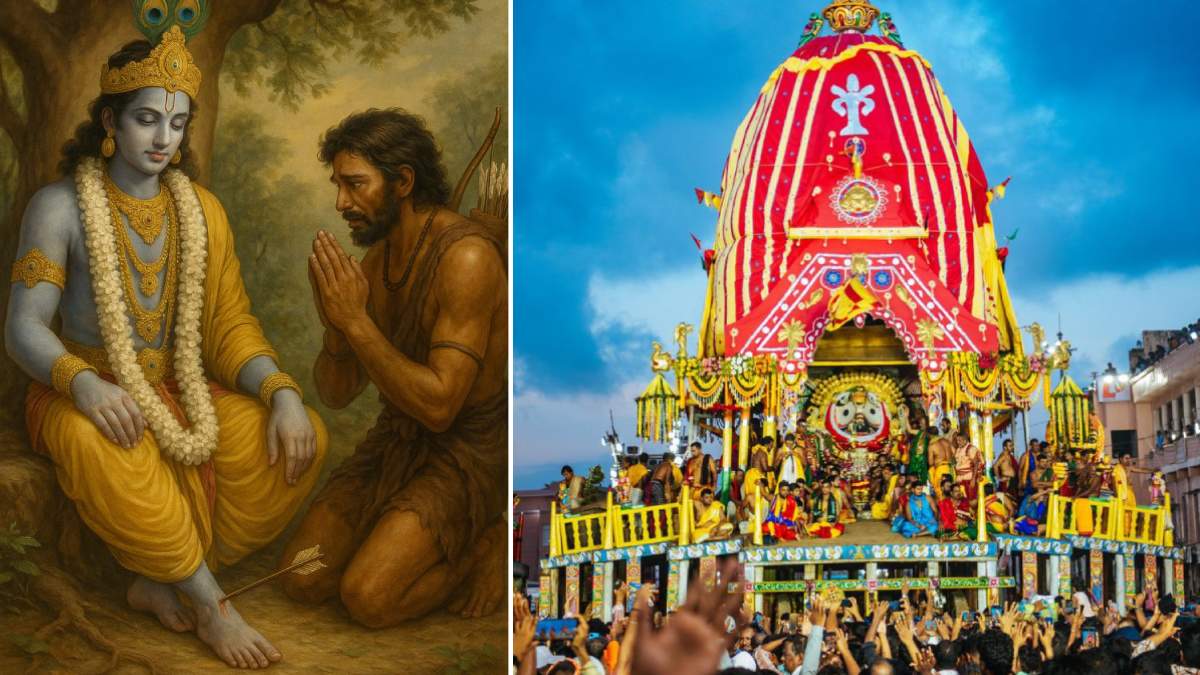
As the annual Jagannath Rath Yatra begins on June 27, lakhs of devotees from across the world prepare to witness Lord Vishnu’s grand procession in his form as Jagannath, the Darubrahma—the divine embodiment in sacred wood. But behind this vibrant chariot festival lies a lesser-known, soul-stirring tale of karma, redemption, and divine grace: the story of Jara, the tribal hunter who unknowingly became one of Krishna’s most blessed devotees.
Whenever we speak of the Mahabharata, the first image that comes to mind is that of Gandivdhari Arjuna—who, as a child in Guru Dronacharya’s ashram, aimed at a bird’s eye, later pierced the eye of a fish in Draupadi’s swayamvar, and finally struck down enemies on the battlefield of Kurukshetra.
But today, the focus shifts to another archer—one who achieved a feat no one else could. No, this is not Bhishma, Dronacharya, Karna, or even Eklavya. This is Jara, a humble tribal hunter who, mistaking Lord Krishna’s foot for a deer’s head, shot a poisoned arrow that pierced through the skin, ultimately bringing the mortal life of the Palanhaar (upholder of the universe) to an end.
However, this arrow was not the only cause of Krishna’s death.
A Curse Foretold: Gandhari’s Wrath and Krishna’s Acceptance
At the end of the Kurukshetra war, Queen Gandhari, unable to bear the grief of losing her hundred sons, cursed Krishna, saying: “O Devkinandan, just as my sons have perished, your Yadu clan too will be destroyed before your eyes. You will not be able to stop it, even if you wish to. You allowed this mass murder to happen. O Krishna, one day you too shall be killed.”
To this, Krishna, the Mayapati, simply replied: “So be it, O Mother.”
As foretold in the Mausala Parva of the Mahabharata, the Yadavas eventually turned against each other and perished in a bloody infighting. One day, Subhadra passed away grieving for her young son, Abhimanyu, who was brutally killed by seven armed warriors. Balarama, Krishna’s elder brother, then walked to the seashore, meditated deeply, and merged into the ocean, returning to his eternal form as Adi-Ananta-Shesh Naag.
ALSO READ: Rath Yatra: 15 fascinating facts about the grand chariot festival of Lord Jagannath in Puri
Watching these events unfold, a weary and heartbroken Krishna retreated to the forest and sat beneath a tree to rest. That is when Jara fired his arrow.
Karma and Redemption: Jara’s Eternal Boon
Realizing his grave mistake, Jara fell at Krishna’s feet, begging forgiveness. But Krishna, ever-compassionate, said: “O Jara, you have committed no sin. In truth, I was waiting here for your arrow. The work of this incarnation is complete. Everything that has happened is by my will.”
But Jara wept and pleaded to serve the Lord in some way. Krishna, moved by his humility, revealed a deeper cosmic truth: “In your past life, you were Bali, the monkey king, and I was Ram. Then, I wronged you by killing you from hiding. Today, karma is fulfilled, and I must honour the same law I set for the world. But I am pleased with your devotion.”
ALSO READ: An ignorant prince who became the emperor of hearts — How Siddhartha became Gautama Buddha
He continued: “In Kali Yuga, I shall appear in Utkala (modern-day Odisha) as Jagannath, and only your descendants shall have the sacred right to cook food offerings for me. I shall eternally accept service from your lineage. So be it!”
With these words, Krishna left his mortal form, and a divine radiance rose from his body, merging into the heavens.
The Divine Heart: From Dwarka to Puri
News of Krishna’s death reached Hastinapur, and Arjuna rushed to Dwarka. He performed the last rites for Krishna, Balarama, and Subhadra, placing their bodies on a neemwood pyre. Everything burned—except Krishna’s heart, which had turned into a hard, blue-glowing gemstone: the Neel Madhav.
Arjuna took the relic back to Hastinapur. Years later, King Indradyumna of Utkala, guided by divine dreams, constructed a temple on the shores of Puri. His court scholar Vidyapati retrieved the Neel Madhav gemstone from a tribal community in the forest and installed it inside the sacred idol of Jagannath.
How the heart of Krishna journeyed from Hastinapur to the forests of Odisha is shrouded in mystery. A tale for another time.
The Unfinished Idols and the Mystery of Ananta Maharana
It is believed that the temple idols were carved by none other than Vishwakarma, the divine architect, who came disguised as Ananta Maharana. He promised to complete the work in twenty days, with one condition: no one was to open the doors before the idols were finished.
The king agreed. For eighteen days, the sound of chiselling echoed through the temple. On the nineteenth day, there was silence. On the twentieth day, overwhelmed with curiosity, the king opened the doors. Ananta Maharana had vanished, leaving behind three incomplete idols—Jagannath, Balabhadra, and Subhadra—without arms and feet.
ALSO READ: Spiritual quotient is the new intelligence — Here’s why it matters more than ever
Since then, these incomplete idols remain enshrined in Puri, representing the Lord in his formless, universal aspect. In Kali Yuga, the Lord has no hands. I wonder though, if he did, would he have allowed such politics in his name?
During Mahabharata, there was a form of politics and now, in modern day Bharat, it is of a different form. He, however, simply watches and probably smiles but only He knows for what.
As chariots roll through the streets of Puri this Rath Yatra, remember that the hands that serve Lord Jagannath’s offerings come from a lineage that once held a bow in a forest—and were blessed forever by the Lord Himself.
Jai Jagannath!