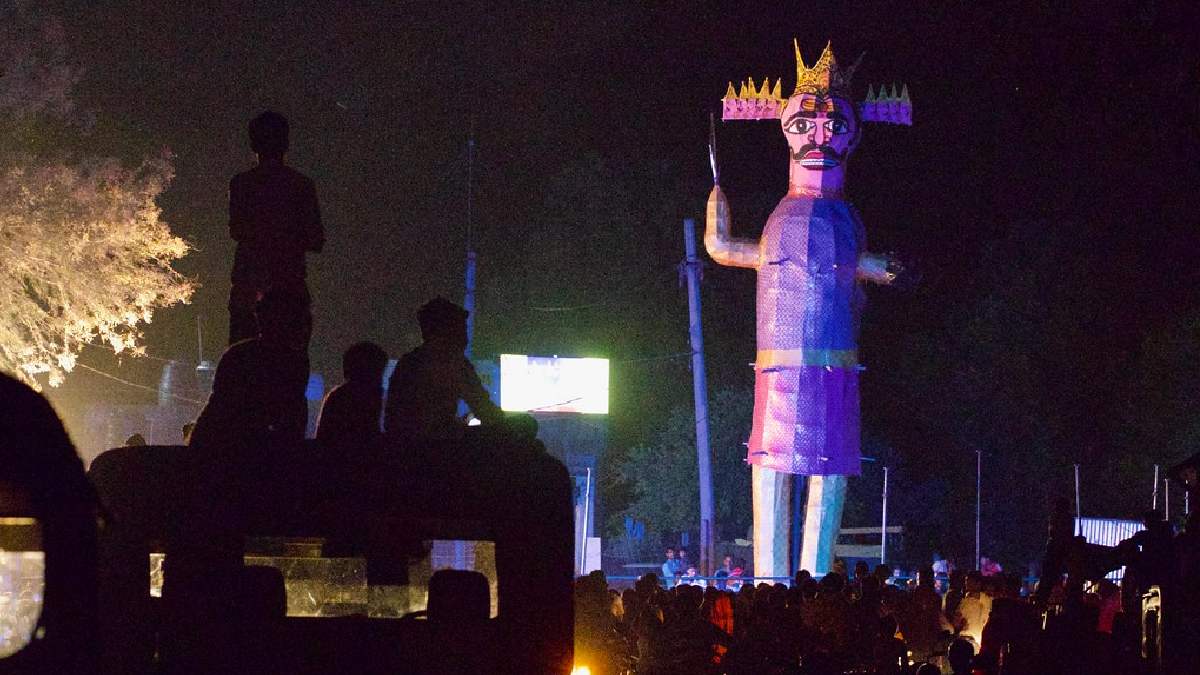
The festival of Dussehra, celebrated on the tenth day after the conclusion of Navaratri, is popularly understood as the commemoration of the triumph of absolute good over absolute evil. In almost every corner of India, especially in the north, the celebration climaxes with the burning of a towering effigy of Ravan, the ten-headed and twenty-armed demon-king of Lanka, at the hands of Shri Ram, revered as Maryada-Purushottam—the man who upholds morality above everything else. This ritual has become a cultural spectacle across the country, symbolizing the annihilation of evil forces.
But one must pause to ask: Is this simplified, pop-cultural interpretation the true essence of the Ramayana? Was it really the intention of Maharshi Valmiki, the original composer of the epic, to present Ravan as an unredeemable villain? Do the deeper philosophical traditions of Vedanta and the Puranas confine themselves to such stark binaries of good and evil? Or do they, instead, reflect upon the shades of grey that define human existence—the play of virtues and vices, the conflicts of dharma and adharma, and the fragile relationship between man and nature?
Let us step beyond the surface narrative and explore these questions in greater depth.
The Shaping of Ram’s Image
The title Maryada-Purushottam is often assumed to be an intrinsic part of Ram’s identity. However, Valmiki, in his original Ramayana, did not bestow this title upon Ram. It was popularized much later by Goswami Tulsidas in his Ramcharitmanas, composed in the 16th century. Unlike Valmiki’s classical Sanskrit text, Tulsidas’s version was written in Awadhi, the language of the people in North India, making it accessible to the masses. Its clear moral binaries—Ram as the embodiment of good and Ravan as the epitome of evil—resonated with ordinary folk and became the dominant lens through which much of northern India interprets the epic.
Yet, the Ramayana is not a single story but a living tradition with more than a hundred versions across Asia. From Valmiki’s Sanskrit narrative to Kamban’s Tamil Ramavataram, from the Thai Ramakien to the Indonesian Kakawin Ramayana, and even the retelling in the Mahabharata’s Vanaparva, each version presents Ram in a different light. In some he is tender and compassionate, in others stern and uncompromising. Sometimes he appears misogynistic and harsh—such as in the episode of Sita’s banishment—and at other times he embodies balance and magnanimity.
ALSO READ: Spinning facts, dissembling truth: Cinema as soft power
This diversity suggests that Ram is not a one-dimensional icon but a complex human being navigating the difficult terrain of dharma.
Ravan: The Demon-King or Misunderstood Hero?
The character of Ravan is equally multifaceted. Popular narratives portray him as the archetypal villain—lustful, arrogant, and tyrannical. Yet, for the people of his kingdom, Lanka, Ravan was a revered ruler who brought prosperity and cultural glory. He was no ordinary demon but the son of Rishi Vishrava and the grandson of Pulastya, one of the Prajapatis. As such, he was deeply learned in the Vedas and a Brahmin by lineage.
Ravan’s reign transformed Lanka into a golden kingdom. He overthrew the control of the devas and expanded his empire, securing wealth and resources for his people. Unlike his elder brother Kubera, the original ruler of Lanka, Ravan proved to be a formidable administrator. He reformed agricultural policies, promoted trade, and patronized learning and the arts.
Moreover, Ravan was an ardent devotee of Lord Shiva. The famous Shiva Tandava Stotram, chanted even today with reverence, was composed by him in ecstasy while attempting to lift Mount Kailash. His musical mastery of the Rudra Veena is also celebrated in tradition.
Thus, Ravan cannot be dismissed as a mere demon; he was also a scholar, a musician, a devotee, and a capable ruler.
The Fatal Flaw
Despite his many virtues, Ravan’s life was undone by one grave mistake: the abduction of Sita. Yet even here, his conduct is far from that of a depraved villain. The abduction was driven less by lust and more by the duty he felt to avenge the humiliation of his sister Shurpanakha, who was insulted by Lakshman. Importantly, during Sita’s captivity in Lanka, Ravan never violated her dignity. He neither coerced her physically nor touched her without consent, despite being consumed by desire.
This restraint, paradoxical though it may seem, highlights the complexity of Ravan’s character. He was not without flaws, but neither was he bereft of principles.
Ravan’s Last Teachings
The Ramayana contains a poignant episode at the end of the war. As Ravan lay dying on the battlefield, Ram instructed his younger brother Lakshman to seek wisdom from the fallen king. At first, Lakshman approached him arrogantly, and Ravan remained silent. Ram then reminded Lakshman of the proper way to seek knowledge: one must approach even an enemy with humility if the enemy possesses wisdom.
When Lakshman returned with folded hands, Ravan imparted profound lessons on governance and life. Among them were three particularly striking points-
ALSO READ: How Mahavatar Narsimha revives Vedantic philosophy on the big screen
Number one: always complete what you begin. Ravan admitted that he once started building a staircase to heaven but left it unfinished due to his obsession with war. This became a symbol of wasted potential.
Number two: never reveal your vulnerabilities. He warned that sharing one’s weaknesses, even with close kin, can lead to downfall. His own death was made possible only because his wife Mandodari and his brother Vibhishan revealed his secret to the enemy.
And, number three: never let women become pawns in politics and war. He confessed that the tragedies of his life revolved around women—Shurpanakha’s insult and Sita’s abduction. In letting these events dictate his actions, he lost all that he had built.
Ravan’s final words reflect not the ravings of a villain but the wisdom of a seasoned ruler who had reflected on his errors.
The Political Use of Myth
Fast forward to our present age, the narrative has shifted. Ram has become a political icon, the personification of righteous rule and the model of Ram Rajya. Ravan, on the other hand, is cast as the embodiment of all that is evil. The burning of his effigy each year has become a public performance of this binary.
But this raises a crucial question: Is the ideal of Ram Rajya truly the legacy of Ram alone, or does it also carry echoes of Ravan’s dying counsel? The principles of governance, statecraft, and ethical caution that Ravan articulated at the moment of his death resonate with modern ideas of political responsibility as much as Ram’s example of justice and duty.
The Spectrum of Dharma
Hindu philosophy rarely confines itself to rigid categories of good and evil. The Upanishads, the Puranas, and the epics all emphasize the spectrum of dharma—fluid, contextual, and often paradoxical. Both Ram and Ravan are part of this spectrum. Ram embodies restraint, sacrifice, and adherence to societal order. Ravan represents ambition, knowledge, and defiance, but also the dangers of unchecked pride. Together, they form a dialectic of human experience.
To reduce this complexity into a simple moral binary is to diminish the richness of the tradition.
Dussehra is undoubtedly a celebration of victory, but perhaps not merely of good over evil. It is also a reminder of the fragility of human virtues, the danger of pride, and the importance of wisdom even in defeat. Ram’s victory is not only about the destruction of a demon but also about learning from that demon’s fall.
In today’s climate, where myths are often politicized and weaponized, it is worth revisiting the deeper lessons of the Ramayana. Ravan was no absolute villain, and Ram was no flawless god. Both were human in their struggles, their strengths, and their limitations. Their story continues to endure because it reflects the spectrum of human nature—our light and our shadows, our virtues and our vices.
So when the effigies of Ravan burn this Dussehra, perhaps we should not only see the destruction of evil but also hear the echo of his final wisdom—reminders of ambition, caution, and humility that remain relevant even today.
Happy Dussehra!