Chhattisgarh Naxal-hit Areas Get PMAY Houses | The Chhattisgarh government is taking firm steps to integrate every family in the Maoist-affected remote forest regions into the mainstream of development. Under a special project for the rehabilitation of families affected by Naxal violence and surrendered Maoists, nearly 3,000 houses are currently being constructed in the state.
Following a special request by the state, the central government approved 15,000 houses under this project for those families who do not meet the eligibility criteria of the Pradhan Mantri Awas Yojana (PMAY).
Out of approximately 5,000 eligible families identified so far, housing has been sanctioned for 3,000, with the first installment disbursed to 2,111 families and the second installment to 128 families.
Construction is progressing rapidly, even in the most remote forest areas. Despite difficult terrain, homes for affected individuals like Sodi Hungi from Sukma and Dashari Bai from Kanker have been completed in just three months. Both homes were approved in March 2025 and construction began in May.
The special project has brought hope and happiness back to the lives of families of surrendered Maoists and Naxal violence victims in Bastar.
Permanent houses approved under the scheme are quickly taking shape, proving that even in tough geographical locations, development is possible with resilience and government support. The initiative marks not just a concrete step but a milestone in the rehabilitation efforts for Naxal-affected families in Chhattisgarh.
Dashari Bai’s New Home in Remote Koylibeda, Kanker
Dashari Bai Nureti, whose husband Doge Nureti was killed by Maoists during the Assembly elections, lives in Uliya Gram Panchayat in Koylibeda block, about 200 km from Kanker district HQ.
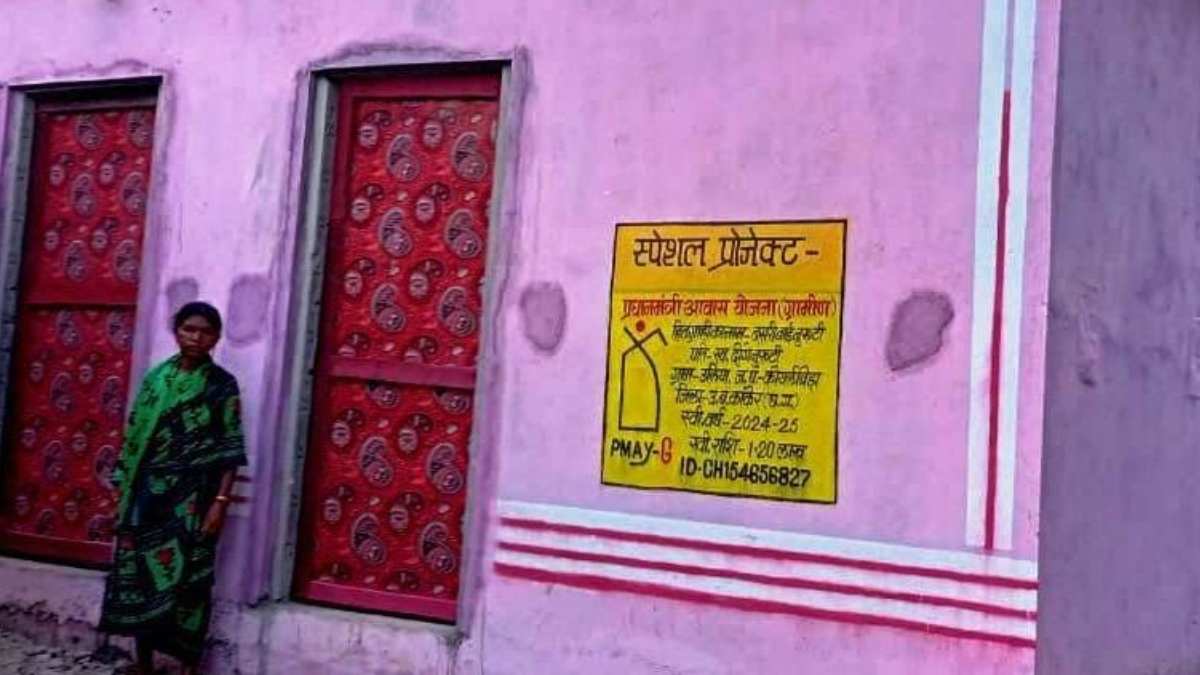
The completion of homes within just three months in adverse conditions shows what government and citizens can achieve together. (Theorist photo)
Her house was approved in March under the special project and construction began in May. Despite the absence of roads for four-wheelers, erratic access for two-wheelers during the monsoon, and high transport costs for construction materials, her home was completed within just three months.
Maoist with ₹24 lakh bounty on head, 8 others give up arms in Chhattisgarh
She credits the support of the Kanker district administration, Gram Panchayat, and PMAY officials for fast-tracking construction. The local housing team helped manage the transportation of materials and labor. She praised the government’s sensitive and effective rehabilitation policy, which helped her transition from a dilapidated hut to a permanent home.
Sodi Hungi’s Journey from Leaking Roof to Permanent Shelter
Sodi Hungi from Oiras village, under Gadiras Gram Panchayat in Sukma, also completed her home in three months. Her husband, Masa Sodi, was killed in 2005 by Maoists on suspicion of being an informant.
ALSO READ: Maoist with ₹24 lakh bounty on head, 8 others give up arms in Chhattisgarh
After years of living in a mud house with a leaking roof and threats from venomous insects, her home was sanctioned under PMAY’s special project. She received a total of ₹1.35 lakh in three phases, and her house was completed in July 2025 with technical support and regular monitoring by the Gram Panchayat.
District-Wise Breakdown of Approved Houses
Out of the nearly 3,000 approved homes for surrendered Naxalites and Naxal-affected families under the special project:
Sukma tops the list with 984 families
Bijapur – 761 families
Narayanpur – 376 families
Dantewada – 251 families
Bastar – 214 families
Kondagaon – 166 families
Kanker – 146 families
Gariaband – 27 families
Balrampur-Ramanujganj – 25 families
Manpur-Mohla-Ambagarh Chowki – 23 families
Chief Minister Vishnu Deo Sai affirmed that the state is working with a strategy of trust, development, and rehabilitation in Naxal-hit regions. He said the special project approved by the Centre for 15,000 houses is not merely about bricks and cement, but lays the foundation for trust, security, and stability.
The completion of homes within just three months in adverse conditions shows what government and citizens can achieve together. The state is committed to ensuring every eligible family gets a permanent home.
Deputy Chief Minister and Home Minister Vijay Sharma stated that the government is implementing a policy of rehabilitation, security, and dignity to ensure sustainable peace and inclusive development in affected areas.
He described the housing initiative under PMAY as a historic step toward social justice and human dignity. He highlighted the examples of Sodi Hungi and Dashari Bai as proof that development can reach even the most remote forests if the government is sensitive and the administration proactive. The mission is to provide both shelter and dignity to every affected family, and it is progressing with full commitment.