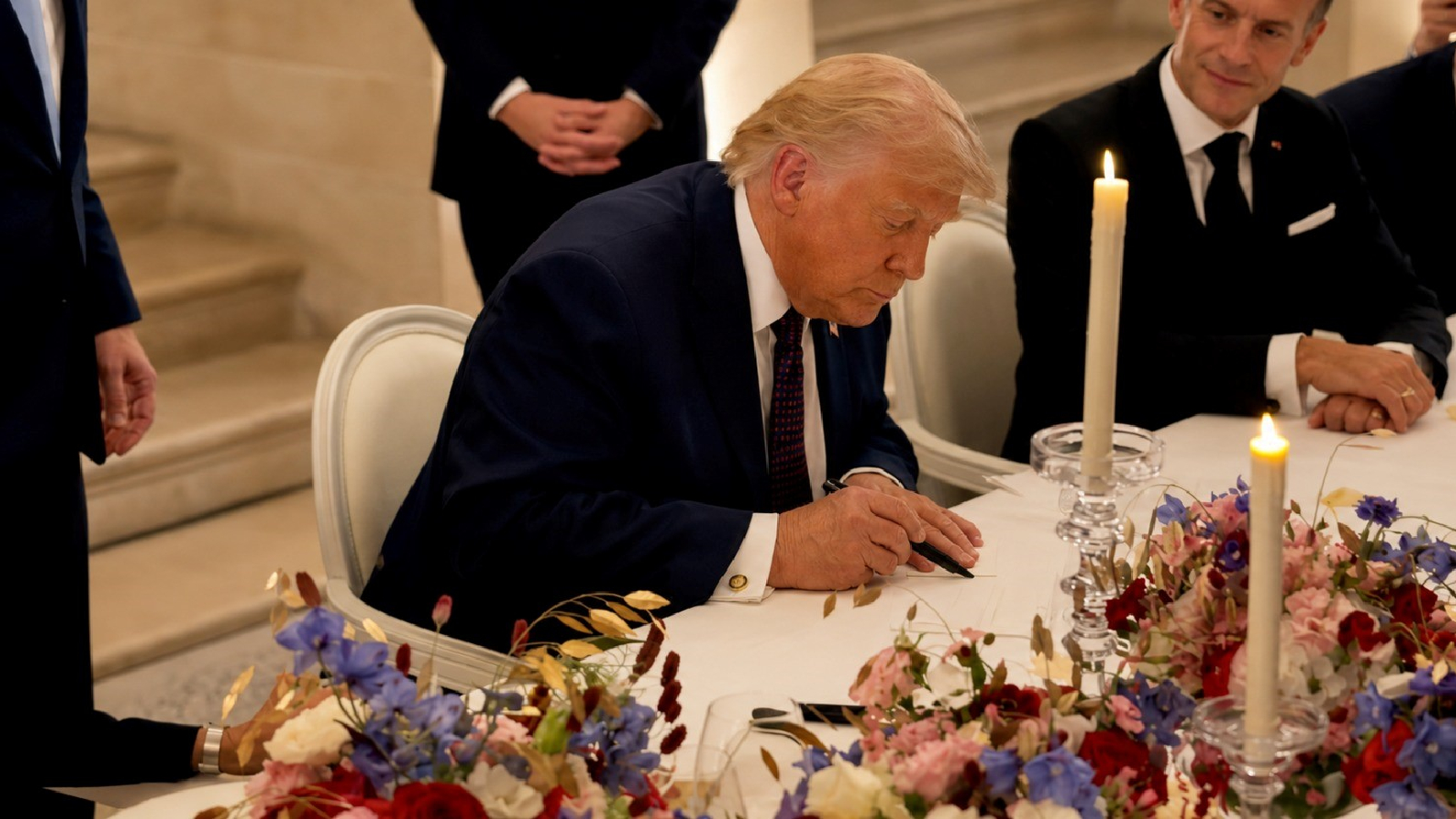
US President Donald Trump has signed a landmark agreement with Iran aimed at ending the prolonged Middle East conflict, with the deal paving the way for a ceasefire, reopening of the Strait of Hormuz and negotiations on a broader long-term settlement.
The agreement was signed during a dinner with French President Emmanuel Macron at the Palace of Versailles after the G7 summit in France. Macron confirmed the development in a post on X, describing the agreement as a major step towards lasting peace and saying it could help ease global energy prices.
Le Président Trump a signé ce soir à Versailles l’accord entre l’Iran et les États-Unis.
Cet accord ouvre la voie à une paix durable et permet la réouverture du détroit d’Ormuz.
C’est un pas important dans la bonne direction pour nos compatriotes… pic.twitter.com/b1XgZrBv0m
— Emmanuel Macron (@EmmanuelMacron) June 18, 2026
The deal, formally titled the “Islamabad Memorandum of Understanding between the United States of America and the Islamic Republic of Iran”, was also signed by Iranian President Masoud Pezeshkian, according to Tehran.
US-Iran agreement signed, but final deal still 60 days away
While the signing marks a major diplomatic breakthrough, the agreement is only an initial framework. The United States and Iran now have 60 days to negotiate the terms of a final agreement, with the possibility of extending discussions.
Iranian Foreign Ministry spokesman Esmaeil Baqaei confirmed the signing, saying the text had been finalised and that the next stage would be testing whether both sides follow through on their commitments, according to Iranian state news agency IRNA.
The formal signing was originally expected to take place in Switzerland, but the agreement was completed in France instead.
Strait of Hormuz set to reopen after conflict disrupted global energy supply
One of the biggest consequences of the agreement is the planned reopening of the Strait of Hormuz, a critical global shipping route through which around one-fifth of the world’s oil and liquefied natural gas supplies normally pass.
The conflict had triggered fears of a global energy crisis after Iran effectively restricted movement through the waterway, causing concerns over rising fuel prices and inflation.
Under the agreement, the United States has committed to lifting its naval blockade of Iran within 30 days. Commercial vessel movement is expected to gradually return to pre-war levels.
The memorandum also states that Iran will make efforts to ensure safe passage for commercial ships without charges for 60 days.
However, Iranian parliamentary speaker and key negotiator Mohammad Bagher Ghalibaf suggested that the Strait of Hormuz may not completely return to its previous status after the 60-day period, indicating future transit fees could be considered.
MUST READ: The 14 Points of the US-Iran Agreement Explained
$300 billion Iran reconstruction plan included in framework
The agreement includes a proposed $300 billion reconstruction framework for Iran, though US officials clarified that Washington would not directly provide money to Tehran.
During a media briefing, US officials said the fund could involve foreign investment projects, such as infrastructure development, with one example being Gulf nations building facilities in Iran with US approval if Tehran complies with the agreement.
The deal also includes provisions requiring the United States to withdraw forces from Iran’s vicinity within 30 days after a final agreement is reached.
Nuclear issue remains unresolved as talks continue
Despite the breakthrough, one of the most sensitive issues — Iran’s nuclear programme — remains unresolved.
The United States had previously cited concerns over Iran’s nuclear capabilities as a key reason behind its military campaign. The agreement does not settle the nuclear dispute immediately, leaving it for negotiations during the upcoming 60-day period.
Trump said the agreement would prevent a wider economic crisis, arguing that prolonged conflict could have pushed the global economy towards a downturn.
He also warned that if negotiations fail, Washington could take further military action against Iran.
War began after US-Israel strikes on Iran
The agreement comes after nearly 110 days of conflict that began when the United States and Israel launched strikes on Iran on February 28.
The initial attacks reportedly targeted senior Iranian leadership and military figures, escalating tensions across the region.
The conflict quickly expanded, affecting energy markets and increasing concerns about wider regional instability.
Israel-Hamas-related tensions threaten to complicate deal
Although the agreement calls for an immediate and permanent halt to military operations “on all fronts, including in Lebanon”, questions remain over whether all regional actors will comply.
Israel has indicated it does not plan to withdraw troops from Lebanon and launched attacks against Hezbollah even as the agreement was announced.
Trump has reportedly expressed concerns that Israeli military actions against Hezbollah could undermine the broader Iran deal. During the G7 summit, he urged Israeli Prime Minister Benjamin Netanyahu to adopt a more restrained approach.
US lawmakers raise questions over Iran agreement
The agreement has also faced criticism inside the United States, including from some members of Trump’s own Republican Party.
Senator Bill Cassidy criticised the deal as a major foreign policy mistake, while Senator Ted Cruz questioned the reconstruction plan and expressed concerns about providing economic benefits to Iran.
Despite criticism, the Trump administration has defended the agreement as necessary to avoid a wider international crisis.
The coming 60 days of negotiations are expected to determine whether the framework becomes a lasting peace agreement or another temporary diplomatic pause in the long-running US-Iran confrontation.