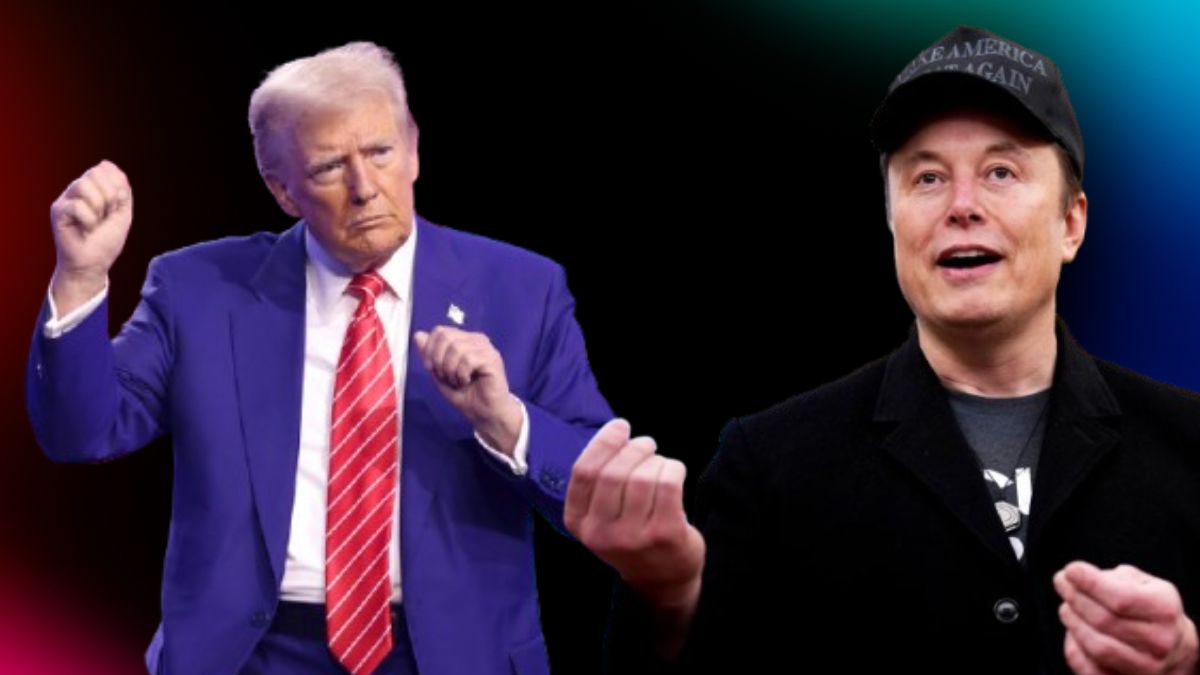
Donald Trump vs Elon Musk | In a rare and escalating public feud between two of the world’s most influential figures, US President Donald Trump and billionaire entrepreneur Elon Musk have turned their once cordial relationship into a bitter political and ideological standoff.
The controversy erupted on Thursday after Trump accused Musk of suffering from “Trump Derangement Syndrome” — a term often used by Trump allies to describe what they see as irrational opposition to the former and current President.
“Very Disappointed in Elon”: Trump’s Blunt Rebuke
Speaking from the Oval Office, President Trump did not hold back.
“He (Elon Musk) hasn’t said bad things about me personally, but I’m sure that will be next,” Trump said. “We had a great relationship. I helped him a lot. I don’t know if that will happen anymore.”
Trump added that he was “very disappointed in Elon” following Musk’s sharp criticism of the administration’s flagship tax and spending legislation—nicknamed the “Big Beautiful Bill.”
Musk had earlier called the bill a “disgusting abomination” and warned that it would further increase the federal deficit. He also suggested that President Trump should be impeached, marking a dramatic rupture between the two high-profile figures.
Musk’s Exit from Trump’s Government Efficiency Panel
Until May 31, Elon Musk led the Department of Government Efficiency (DOGE), a cost-cutting initiative created under the Trump administration. He stepped down citing the need to refocus on his growing business commitments, including space, energy, and AI ventures.
ALSO READ: Elon Musk appears with black eye, here’s what happened
While Musk’s role was mostly advisory, his exit and subsequent criticism of Trump’s fiscal strategy have prompted a fierce backlash from the President and his allies.
“I Didn’t Need His Money”: Trump Dismisses Musk’s Support
Musk was among the influential donors who financially backed Trump’s 2024 presidential campaign, which saw a narrow but crucial win in key battleground states. However, Trump claimed that he could have won Pennsylvania even without Musk’s support.
“I didn’t need his money. I would’ve taken Pennsylvania anyway,” Trump said.
The statement underscores a growing rift that has turned from subtle disagreements into full-scale political sniping.
What Is Trump Derangement Syndrome?
The term Trump Derangement Syndrome (TDS) first gained popularity in political discourse during Trump’s first term. According to Urban Dictionary, it refers to a “mental condition in which a person’s hatred for Donald Trump drives them to abandon logic and reason.”
The phrase traces its intellectual lineage to the concept of “Bush Derangement Syndrome,” coined by conservative columnist Charles Krauthammer in 2003, describing an irrational reaction to former President George W. Bush.
A 2018 CNN report noted that TDS became a catch-all phrase used by Trump defenders to dismiss criticism as emotionally charged and lacking in substance.
TDS As a ‘Mental Illness’? A Controversial Minnesota Bill
Adding fuel to the fire, earlier this year, Republican lawmakers in Minnesota introduced a bill to classify Trump Derangement Syndrome as a mental illness. According to the draft, it is defined as:
“The acute onset of paranoia in otherwise normal persons that is in reaction to the policies and presidencies of President Donald J. Trump.”
The legislation also cites symptoms such as “Trump-induced general hysteria” and an inability to distinguish between policy differences and “psychic pathology.”
Though largely symbolic and unlikely to pass into law, the bill reflects how polarizing Trump’s presidency remains—even into his second term.