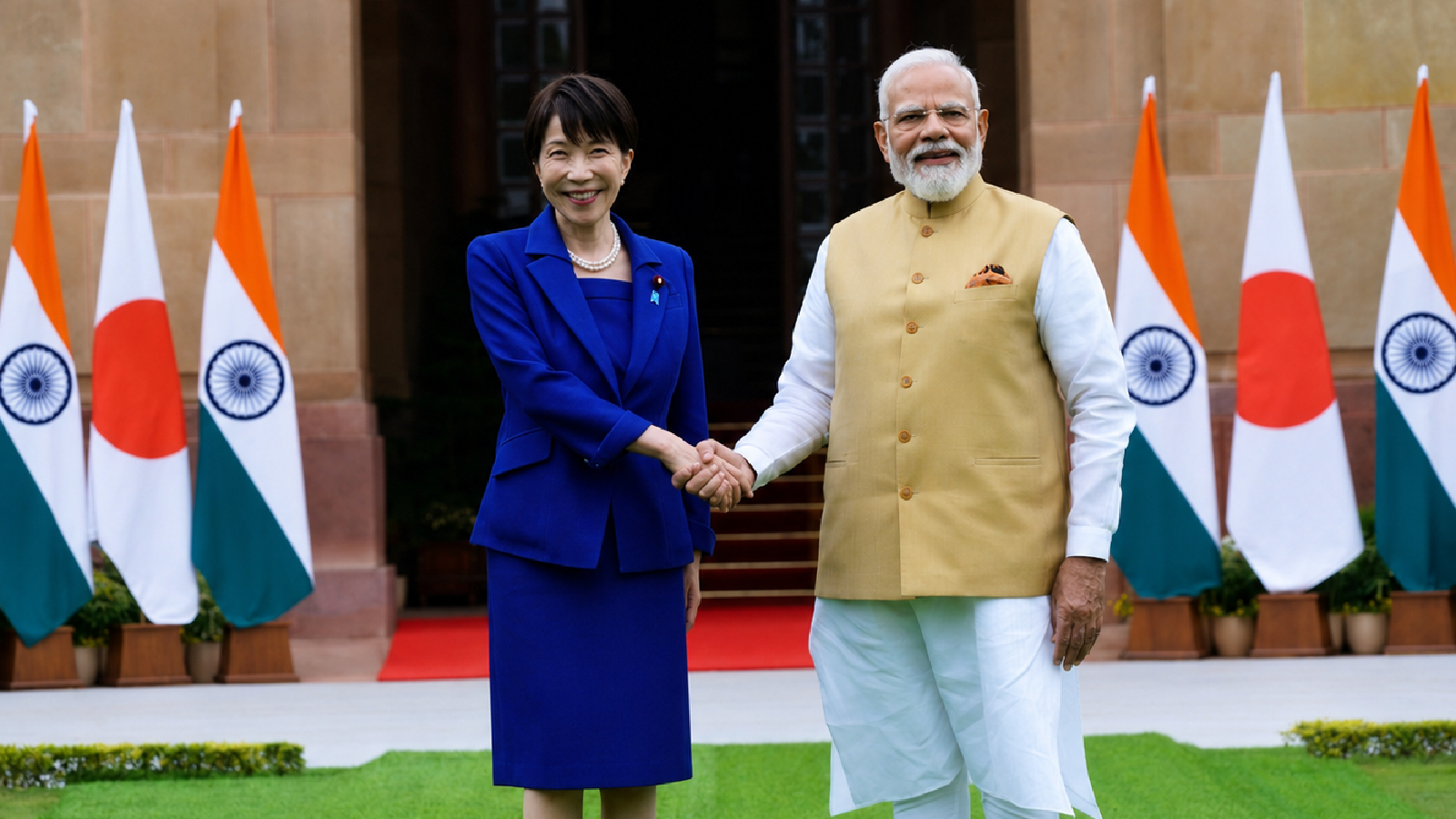
Japanese Prime Minister Sanae Takaichi arrived in New Delhi on Wednesday evening for a three-day official visit to India, where she is scheduled to hold wide-ranging discussions with Prime Minister Narendra Modi on bilateral and regional issues.
The visit marks the 20th annual summit between India and Japan since the two countries institutionalised regular meetings at the highest political level. The talks are expected to chart the direction of the India-Japan partnership over the next decade, particularly amid evolving geopolitical developments and ongoing conflict in West Asia.
Assam not on itinerary despite strategic significance
Although Takaichi’s itinerary does not include a visit to Assam, officials said the decision was made due to time constraints. A stop in Guwahati would have underscored the increasing importance of Northeast India in the bilateral relationship and highlighted the Centre’s Act East Policy alongside Japan’s engagement with the region.
Despite Assam’s absence from the official schedule, the Northeast continues to occupy a central place in Tokyo’s vision for cooperation with India. Northeast India has emerged as one of the key pillars of the India-Japan strategic partnership, aligning closely with Japan’s vision of a “Free and Open Indo-Pacific.”
MUST READ: India sends gasoline to Russia amid fuel shortage triggered by Ukrainian airstrikes: Report
Speaking at the Kizuna India-Japan Intellectual Conclave in Shillong earlier this year, Japanese State Minister for Foreign Affairs Iwao Horii said Northeast India represents the convergence of India’s Act East Policy and Japan’s Indo-Pacific vision in practical terms.
Siliguri Corridor drives strategic calculations
The region is connected to mainland India through the 20-22 kilometre-wide Siliguri Corridor, commonly known as the “Chicken’s Neck,” located between Nepal, Bhutan, Bangladesh and China’s Chumbi Valley.
ALSO READ: Commercial LPG, jet fuel prices cut as US-Iran talks ease oil market
The corridor serves as the primary land connection for more than 40 million people. Since the 2017 Doklam standoff with China, India has regarded the narrow passage as one of its most critical strategic vulnerabilities. Infrastructure projects that provide alternative connectivity to the Northeast are therefore viewed as strengthening national security and reducing dependence on the corridor.
For Japan, improved connectivity in eastern India also supports broader objectives of securing stable supply chains and reducing vulnerabilities arising from regional geopolitical tensions.
Japan expands development partnership in Northeast
Japan has significantly expanded its development cooperation in Northeast India through infrastructure and connectivity projects. During the Advantage Assam 2.0 summit held in Guwahati in February 2025, Japan’s Ambassador to India, Ono Keiichi, said Tokyo had provided more than ₹22,000 crore for projects covering roads, water supply, electricity, healthcare and biodiversity conservation.
Act East Forum strengthens bilateral cooperation
A key mechanism driving this collaboration is the India-Japan Act East Forum, established during the September 2017 visit of former Japanese Prime Minister Shinzo Abe. The forum integrates India’s Act East Policy with Japan’s Free and Open Indo-Pacific vision, facilitating coordinated development initiatives in the Northeast.
External Affairs Minister S. Jaishankar has previously said the forum has helped secure priority status for Northeast infrastructure and development projects within Japan’s assistance framework.