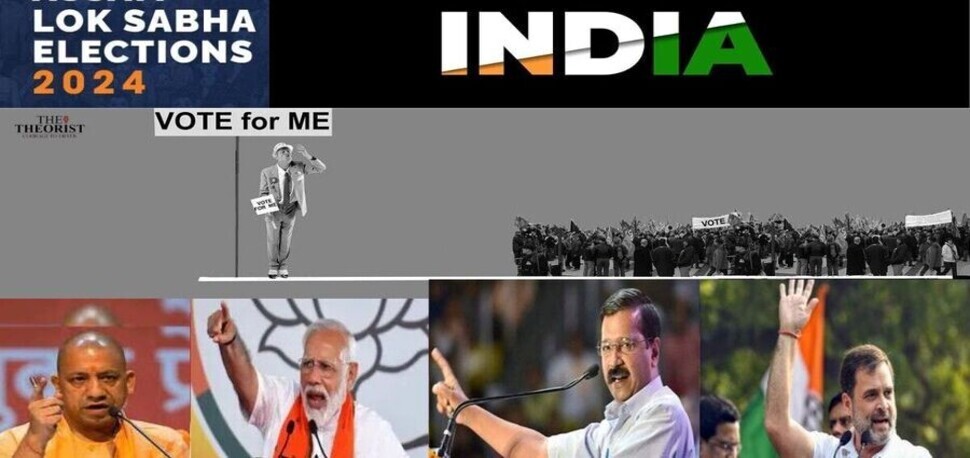
The Election Commission announced the schedule for the 2024 Lok Sabha election, with Prime Minister Narendra Modi, eyeing a third term, asserting that the National Democratic Alliance (NDA) under his leadership is fully prepared for the electoral contest. Modi framed the upcoming polls as a battle between the NDA, which he credited with bringing about “a glorious turnaround,” and an opposition that he characterized as “rudderless and issueless.”
India, the world’s largest democracy, is gearing up for elections as Prime Minister Modi seeks a third consecutive five-year term. While opposition to PM Modi and his Bharatiya Janata Party (BJP) is gradually emerging, and pockets of resistance exist across the country, many analysts believe that the Prime Minister, renowned as one of the globe’s most popular elected leaders, holds strong prospects for victory.
India’s status as the fastest-growing major economy and its increasing influence on the global stage contribute to Modi’s appeal. Additionally, his emphasis on Hindu nationalism resonates with a significant portion of the electorate, evidenced by the BJP’s recent triumph in state-level elections.
Election Schedule Announced
The Election Commission’s announcement of the 2024 Lok Sabha election schedule sets the stage for a pivotal political event. Prime Minister Modi, leading the National Democratic Alliance (NDA), is poised to contest against a fragmented opposition. The election, scheduled to unfold over seven phases from April 19 to June 1, will culminate in the counting of votes on June 4, ultimately determining the composition of India’s lower house of Parliament.
Importance of the Election
As the world’s largest democracy, India’s multi-phase elections carry significant implications for the nation’s political trajectory over the next five years. The electoral process, spanning nearly two months, presents formidable logistical challenges in accommodating the diverse electorate and ensuring a free and fair democratic exercise.
India’s Electoral Process
India’s parliamentary system empowers the party securing a majority in the 543-seat Lok Sabha to form the government and appoint the prime minister. The phased polling, spanning different regions and demographics, reflects India’s geographical and cultural diversity. This staggered approach aims to facilitate a smooth electoral process while accommodating various logistical considerations.
BJP’s Dominance in 2019 Elections
In the 2019 Lok Sabha elections, the Bharatiya Janata Party (BJP) made history by securing a remarkable 37.36 percent of the total votes, marking the highest vote share for any political party in India since the 1989 election. The BJP’s stellar performance translated into individual victory in 303 seats, contributing significantly to the National Democratic Alliance’s (NDA) overall tally of 353 seats. Conversely, the Indian National Congress, led by Rahul Gandhi, managed to secure only 52 seats, with the United Progressive Alliance (UPA) clinching a total of 98 seats.
Did you know The Theorist also has a WhatsApp channel? Click here to follow us on WhatsApp
Election Timeline and BJP’s Ambitions
The 2019 Lok Sabha elections unfolded across seven phases, spanning from April 11 to May 19, with results declared on May 23. As the nation gears up for the upcoming polls, the BJP has commenced its campaigning efforts, aiming to secure a commanding majority of over 400 seats out of the total 543 in the Lok Sabha.
Anticipated Outcome of 2024 Elections
According to a recent various Opinion Polls, the BJP-led National Democratic Alliance (NDA) is poised to reclaim power with a significant majority in the upcoming 2024 Lok Sabha elections. The survey predicts that the BJP-led NDA could secure a staggering over 400 Lok Sabha seats, surpassing Prime Minister Narendra Modi’s ambitious target of “Abki baar 400 paar.” The last instance of a party securing over 400 seats dates back to 1984 when the Congress Party clinched 411 seats out of 542. The projected NDA vote share is expected to reach 48% in the upcoming General Elections.
Projections for Opposition and Alliance
In contrast, the Congress-led I.N.D.I.A. alliance is projected to secure 105 seats, signaling an improvement from the 91 seats garnered by the United Progressive Alliance (UPA) in 2019. Smaller parties are also expected to secure 27 seats, as indicated by the findings of the opinion poll.
Electoral Preparedness and Voter Turnout
The Election Commission has revealed that approximately 97 crore Indians will be eligible to cast their votes in this year’s Lok Sabha elections, reflecting a 6 percent increase in registered voters since 2019. The electoral rolls underwent nationwide publication following an intensive Special Summary Revision 2024 process in early February.
Potential for Simultaneous Elections
Efforts are underway to explore the feasibility of conducting simultaneous elections across India. Several states, including Andhra Pradesh, Odisha, Sikkim, and Arunachal Pradesh, are gearing up to conduct concurrent Lok Sabha and assembly polls. The terms of the Andhra Pradesh, Arunachal Pradesh, Odisha, and Sikkim Assemblies are set to expire on June 11, June 2, June 24, and June 2 respectively.
Read all the World News, Business News, Sports News, Entertainment News, Business News and Opinion here. Follow us on Facebook, Twitter and Instagram