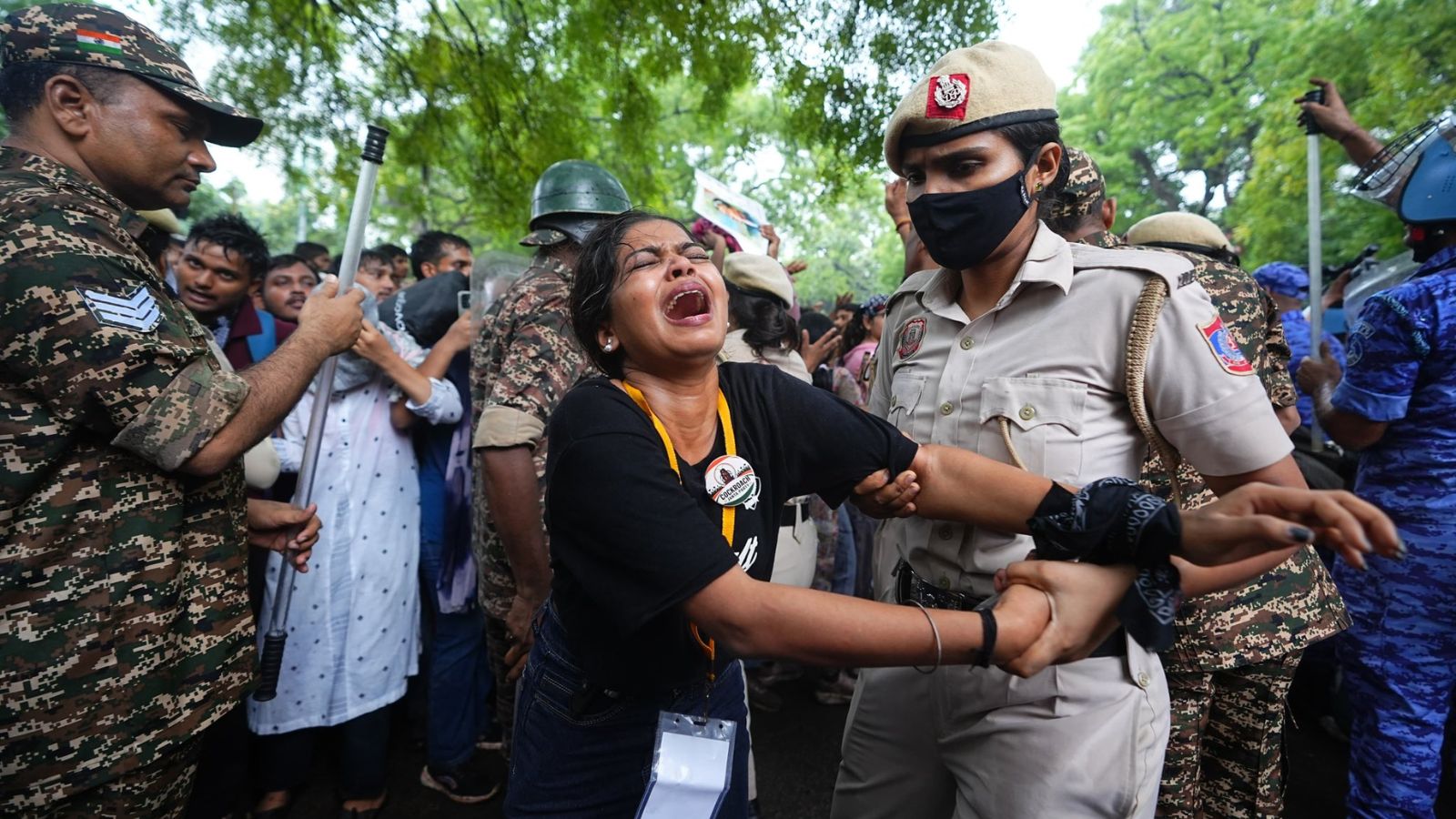
The Delhi High Court on Wednesday directed authorities to preserve CCTV footage, videography and other records related to the alleged use of excessive force by police during the Cockroach Janata Party (CJP)’s march towards Parliament in the national capital.
A division bench comprising Chief Justice D.K. Upadhyaya and Justice Tejas Karia also issued notices to the Centre and the Delhi Police, seeking their responses to petitions demanding an independent investigation into the incident.
The matter has been listed for further hearing on September 11.
High Court orders preservation of evidence
In its interim order, the court directed that all material connected to the incident—including CCTV recordings and any available video footage—be preserved in accordance with the Standard Operating Procedure (SOP) issued by the Delhi Police or the Union government.
The bench observed that maintaining the records would be necessary while the petitions are under consideration.
The pleas before the court seek the constitution of a Special Investigation Team (SIT) to probe the alleged police action, registration of FIRs against officials involved, disclosure of deployment and operational records, and disciplinary proceedings against those found responsible.
Petitioners allege excessive force
Appearing for the petitioners, Senior Advocate N. Hariharan argued that the protest began peacefully at Jantar Mantar before police allegedly used disproportionate force against demonstrators.
He submitted that no prior warning was issued before action was taken and alleged that protesters, including women, were assaulted. According to the submissions, more than 90 people sustained injuries during the incident.
Hariharan urged the court to direct registration of criminal cases against police personnel identified in videos and to order a comprehensive inquiry into the alleged use of force.
Lawyers question police action
Senior Advocate Vikas Singh, appearing for another set of petitioners, argued that although the crowd had grown in size during the July 20 demonstration, it remained peaceful and that authorities themselves had not alleged that the assembly had turned violent before police intervened.
He claimed that police personnel, along with individuals in civilian clothes, attacked demonstrators without provocation.
Meanwhile, Senior Advocate Gopal Sankaranarayanan alleged that several people participating in the police action were not in uniform. Referring to video clips of the incident, he claimed they showed indiscriminate use of tear gas, lathi-charge and physical assault, including against women and family members present at the protest.
He also alleged that Additional Deputy Commissioner of Police Sandeep Lamba assaulted a woman standing on the sidelines and urged the court to hold the officer accountable. Sankaranarayanan told the bench that he had examined more than 100 videos documenting the incident and argued that judicial intervention was necessary.
Delhi Police rejects allegations
Opposing the petitions, the Delhi Police denied allegations of police brutality and maintained that the protest did not remain peaceful.
Representing the Centre, Solicitor General Tushar Mehta, along with Additional Solicitor General Chetan Sharma, appeared before the court, while Senior Advocate S.V. Raju represented the Delhi Police.
Raju argued that protesters had turned violent, allegedly pelting stones and injuring police personnel. He contended that individuals claiming to be victims of cognisable offences had legal remedies available before a magistrate under Section 156(3) and need not invoke the High Court’s writ jurisdiction.
He also submitted that the petitions relied selectively on videos circulating on social media while ignoring other material relating to the incident. Describing the pleas as “publicity-seeking,” Raju argued that those allegedly injured had not themselves approached the court.
Court says issue goes beyond an individual grievance
While hearing the matter, the bench observed that the case could not be viewed as an isolated incident.
The judges remarked that if the allegations related to a single individual, the argument that the affected persons should pursue remedies before a magistrate might have been appropriate. However, the court indicated that the petitions raised broader issues requiring judicial consideration.
With notices now issued and evidence ordered to be preserved, the High Court will examine the rival claims when the matter is taken up on September 11.