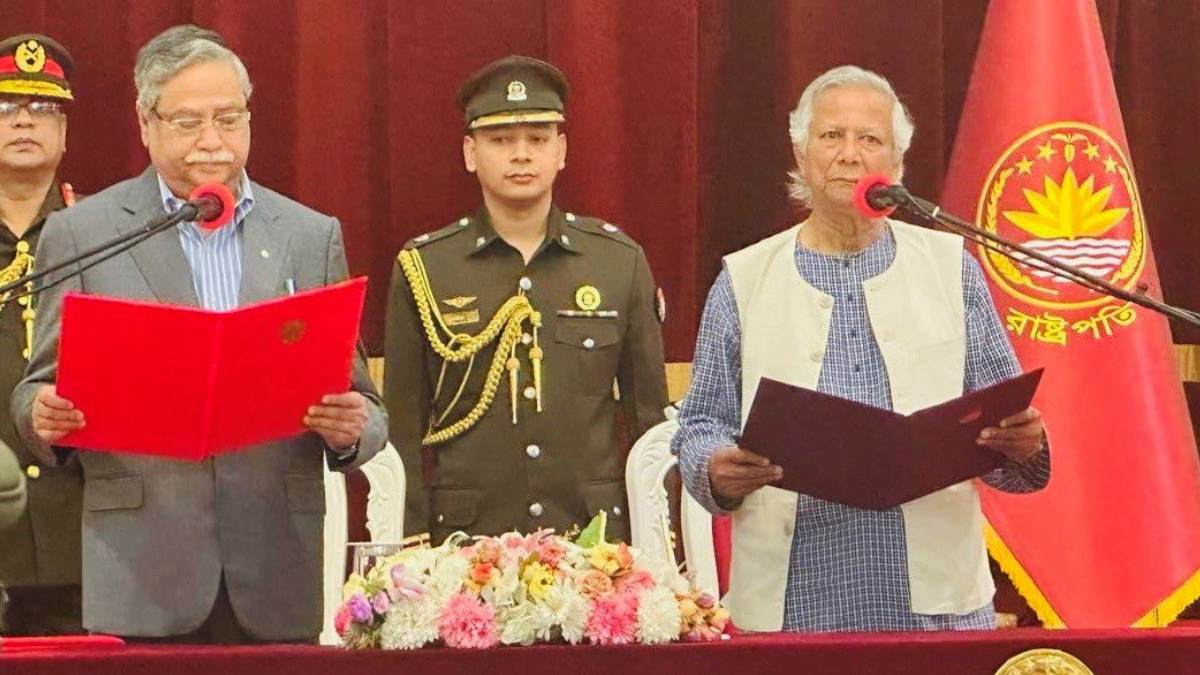
Nobel laureate Muhammad Yunus has been sworn in as the Chief Adviser to Bangladesh’s interim government, a move that comes amid significant political turmoil following the resignation of Prime Minister Sheikh Hasina. The swearing-in ceremony took place at Bangabhaban, the presidential palace, where President Mohammad Shahabuddin administered the oath to Yunus.
Alongside Yunus, 16 additional advisers were also sworn in to join the interim government, all taking their oaths under the supervision of the president. This development follows the dramatic exit of Prime Minister Sheikh Hasina, who fled the country after widespread protests demanding her removal.
The protests, primarily led by student groups, were sparked by a violent government crackdown on demonstrations advocating for reforms in the public service quota system. The violence resulted in over 400 deaths in recent weeks, further escalating the political crisis.
The announcement of the appointment of Muhammad Yunus appointment was made during a critical meeting at Bangabhaban, which was attended by President Mohammed Shahabuddin, military leaders, and student representatives.
ALSO READ: As Sheikh Hasina continues to live in India, Jaishankar speaks to UK over Bangladesh crisis, MEA confirms
In the meeting, the president underscored the necessity of establishing an interim government to steer the country through the current crisis. He also suggested that the composition of the Advisory Council be finalized in consultation with various political parties to ensure broad-based support.
Muhammad Yunus, 84, is globally recognized for his pioneering work in microfinance through the Grameen Bank, an effort that earned him the Nobel Peace Prize in 2006.
ALSO READ: Bangladesh actor Shanto Khan, his father lynched amid violence; Kolkata film industry express shock
His appointment as Chief Adviser is being hailed as a potential turning point for Bangladesh, offering hope for the restoration of democratic governance after years of authoritarian rule under Hasina. Student leaders who advocated for Yunus’s candidacy believe his vision for a society free from poverty and unemployment resonates with the aspirations of the Bangladeshi people.
As Chief Adviser, Yunus now faces the formidable challenge of stabilizing a nation in crisis. His leadership will be pivotal in addressing demands for human rights and democratic reforms, and guiding the interim government through a delicate transitional period as the country seeks to recover from recent violence and political unrest.